 Sara Danial
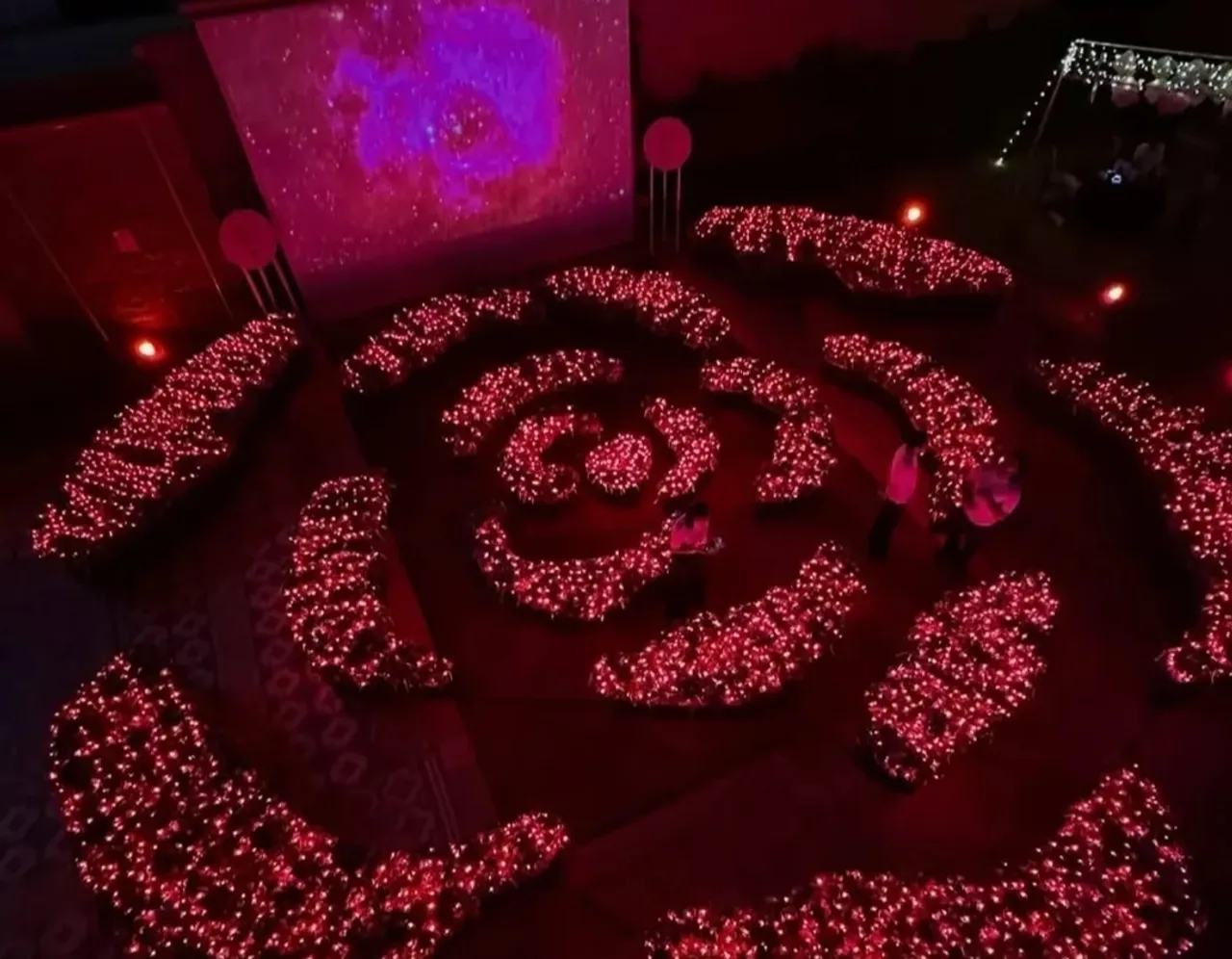
Inside a dimly lit garden in Pakistan’s city Karachi, thousands of red roses glow under a soft crimson light.
Each flower is hand-stitched from discarded fabric and bears the handwritten name of a child killed in Gaza.
Visitors walk slowly through the installation. Some stand in silence while others wipe away tears. In a world saturated with images of war and destruction, Roses of Humanity seeks to slow grief long enough for people to confront it personally.
The immersive art installation, recently displayed at Beaumont House in Karachi after its initial showing in Lahore, was created in response to the ongoing war in Gaza, where the humanitarian toll has continued to deepen since the conflict escalated on October 7, 2023.
According to Gaza health authorities, more than 72,500 Palestinians have been killed since the war began, while United Nations agencies estimate that around 1.9 million people have been displaced, many of them multiple times.
UN Women reported in April that more than 38,000 women and girls had been killed during the conflict, while humanitarian agencies continue to warn of widespread destruction of homes, schools, and hospitals across Gaza.
Against this backdrop, the installation’s visual language feels both simple and devastating.
Thousands of fabric roses rise from the ground like a memorial garden. Names and ages of toddlers and infants killed hang from the stems like tags in a nursery, transforming what might otherwise be statistics into something painfully personal and intimate.
The project was created by Labour & Love, a Lahore-based social enterprise founded in 2008 to train and employ women artisans using recycled and sustainable materials.
Over time, the organisation’s work has expanded beyond handicrafts to projects focused on dignity, memory and social healing.
“That philosophy lies at the heart of the installation,” Nuria Rafique Iqbal, curator of Roses of Humanity and founder of Labour & Love, tells TRT World.
“While the installation began with 15,000 roses, representing the number of children reported killed in Gaza as of June 2024, this number is not static. Thousands more roses have been added and will continue to be added, up to 20,000, as we bear witness.
Each rose reborn in beauty
Inside the Karachi exhibition space, no two roses are alike.
Some are made from velvet, others from cotton. Some are faded, rough-edged and worn, while others appear vibrant and soft.
Nuria Rafique Iqbal says the choice of recycled fabric was deliberate.“Each rose is crafted from discarded fabric, once cast aside and now reborn in beauty, symbolising the forgotten lives of Gaza’s children,” she says.
“The varied colours and textures reflect the diversity of creation and the strength of unity amidst difference.”
The symbolism of the rose also carries deep spiritual meaning within Islamic and South Asian traditions. Roses are often associated with beauty, mercy and remembrance in Sufi poetry and devotional culture.
Within the installation, that symbolism merges with imagery of mourning. At first glance, the sea of red fabric evokes blood and violence. But when viewed from afar, the different textures and shades gradually blur into a single collective bloom.
The creators say the installation drew inspiration from the Rosette Nebula, a vast red cosmic formation photographed by NASA and often likened to a rose suspended in space.
The experience is designed to be immersive. Fragrance lingers throughout the room as ambient soundscapes quietly move through the exhibition space.
Visitors do not simply observe the installation from a distance; they move through it, becoming part of the experience itself.
That sense of participation extends beyond viewing. Community members wrote names and ages by hand on tags before the roses were collectively planted in the exhibition.


“To write the name of a dead child by hand is to refuse emotional distance,” one volunteer involved in the project said during the exhibition.
“Communal grief calls for communal healing, which can only occur when we are able to express that grief openly,” Amira Haroon, curatorial consultant, tells TRT World.
“Roses of Humanity, as a project, has given everyone involved the chance to create, make, display, write, photograph, and record — a shared, beautiful act of communal healing. It is an invitation to mend that small fracture in the heart that opens each time we see another image, another headline, another innocent life plucked from a lifetime of possibility,” she says.
The women artisans behind the installation describe the project as personally transformative. One of the artisans, Salma, says the work changed her life both emotionally and financially.
“Nuria entrusted me with this work, and I feel fortunate that we were given this opportunity. Through this work, many women like me were able to support our homes and improve our circumstances. We felt proud because the work created by our hands gave us dignity and confidence,” Salma tells TRT World.
“These flowers did not come into my life just to be woven — they came to transform my life. Whenever I look at these roses now, I see not just flowers, but also Nuria Bibi behind them. She is an example of a woman who changes the lives of other women.”
For many involved in the project, the slow, deliberate process of stitching the flowers became central to its meaning. Every rose was made by hand, and each fold and stitch became an act of remembrance.
That sense of slowness stands in sharp contrast to the speed at which images of destruction circulate online.
Beyond symbolism
Since the beginning of the war, humanitarian agencies have repeatedly warned of worsening conditions inside Gaza, where overcrowded displacement camps, damaged sanitation systems, and shortages of medical supplies continue to affect civilians.
Aid organisations have also reported growing public health risks, including contaminated water, disease outbreaks, and deteriorating shelter conditions.
For visitors at the Karachi exhibition, however, those realities are encountered through names and symbols rather than headlines. Children are not represented as anonymous casualties, but as individuals whose lives were interrupted.
The exhibition avoids overt political messaging. There are no speeches, slogans, or campaign banners inside the space. Instead, the installation centres grief itself.
That approach appears to resonate strongly with visitors who are constantly exposed to images of conflict online.
As wars increasingly unfold through social media feeds and breaking-news alerts, many people describe feeling emotionally exhausted or desensitised. Roses of Humanity attempts to counter that numbness through physical presence and ritual.
The project also includes a fundraising component, in collaboration with Bioniks Welfare Foundation, to support the Palestine Children’s Relief Fund’s Child Amputee Rehabilitation Program (PCRF), which provides prosthetic limbs for child amputees in Gaza.
The organisers say the initiative was designed to move beyond symbolism and direct public engagement towards practical support for affected children.
Still, the installation’s strongest impact is emotional.
Visitors emerge quietly from the exhibition space into Karachi’s busy streets carrying the weight of what they have just witnessed.
The garden remains unfinished, mirroring the grief left by the war itself.
“Though rooted in Gaza, this work speaks to a wider human reality, of lives lost, voices unheard, and the urgent need for compassion across all issues we face today,” Nuria Rafique Iqbal, the curator of Roses of Humanity, tells TRT World.
“Together, these roses form a living tribute to humanity, reminding us that dignity flourishes when we are seen, heard, and held in compassion."