 Zeki Tarik Sarioglu
Kusadasi is a town known for its beaches, tourism and ancient history. But beyond its busy streets and coastline, the Aegean town is also home to traditions that have endured for generations.
One of them is the craft of making accordion-style boots, once worn by wealthy landowners and the legendary Efe fighters of western Türkiye. Today, however, that tradition is slowly disappearing.
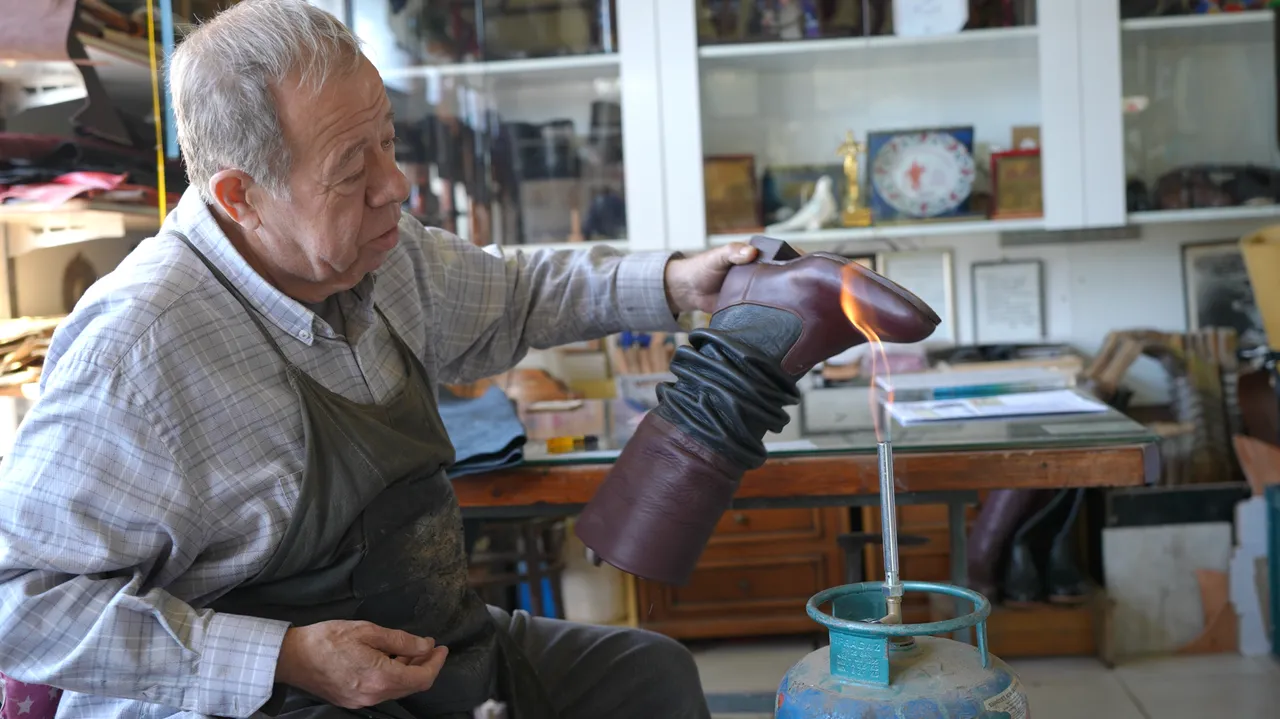
Mustafa Karpuzcu is the last master of accordion-style boots in the town of Kusadasi. Having learned the craft from his father at age 6, he has spent decades making distinctive handmade leather boots in a small workshop, using techniques passed down through generations.
“There used to be many craftsmen and masters besides me,” Karpuzcu tells TRT World.
“But now, I am the only one left.”
As older masters pass away and fewer young people choose to learn the trade, Karpuzcu sees it as his responsibility to keep a piece of Aegean cultural heritage alive.
The heritage runs deep in Kusadasi.
Over thousands of years, the town has been shaped by civilisations ranging from the Ionians and Lydians to the Persians, Romans and Byzantines, while landmarks such as Guvercinada Castle and the historic caravanserai reflect its importance during the Ottoman era.
Yet traces of the region's past survive not only in its architecture but also in traditions such as accordion-style bootmaking.
The handmade leather boots are closely associated with the Efe, the legendary fighters of western Türkiye known for their bravery, honour and strong sense of justice.
During the Turkish War of Independence, the Efe became powerful symbols of the region, and their distinctive accordion-style boots became one of the most recognisable elements of their identity.
The boots were famous for their creaking sound, which once announced the arrival of wealthy landowners and prominent local figures before they even appeared around the corner.
"Accordion-style boots were worn by landowners, noblemen and the wealthy. On Fridays, which were considered the day of rest in Kusadasi, the landowners would wear their boots and go to the traditional coffeehouse or visit a friend,” Karpuzcu tells TRT World.
“We would make the boots 'gıcırdaklı' [creaky] according to their preferences. When the landowner walked, the boots would make a creaking sound. We made such beautiful boots, and kind-hearted people wore them," Karpuzcu says.
People believed the boots conferred confidence, strength and prestige on the wearer, according to Karpuzcu.
Even the creaking of the boots carried meaning, reflecting the wearer's status and presence.
Every pair of accordion-style boots was made entirely by hand from natural materials and using techniques passed down through generations.
The outer layer was crafted from durable cowhide leather, while the interior was lined with soft sheepskin for comfort. Each pair was made to measure, with the leather cut, stitched and moulded according to the customer's foot and leg dimensions.







The boots' distinctive folded, accordion-like sections served a practical purpose as well as a symbolic one. They helped air circulate inside the boots, making horse riding more comfortable.
The boots also became known as "creaking boots" because of the sound they made while walking. Master craftsmen intentionally left tiny gaps between layers of leather to create the characteristic squeak.
Training with passion
Growing up in the family workshop surrounded by leather, wooden tools and handmade shoes, Karpuzcu began learning bootmaking from his father at the age of six.
Later, he trained under master bootmaker Sukru Bicakci.
“I can never speak anywhere without mentioning him. These are my masters. They are the people who shaped me in every way — in this craft, in life, and in how I began my journey," Karpuzcu says.
"I could never be ungrateful to any of them. That would never be right. All the tools you see here were passed down from my father. I never stopped using any of these tools. Many new ones are being made now, but I do not use them. I still use my father's tools," he adds.
He says the trade cannot be learned from instruction alone. Instead, it requires years of observation, patience and practice. Karpuzcu recalls spending his life working with leather, a passion that continues to shape his daily routine.
Even today, he says, he sometimes dreams of new boot designs at night.
His dedication to preserving the craft earned national recognition in 2025, when he was included in the “Living Human Treasures Türkiye” inventory and received an award from President Recep Tayyip Erdogan.
Yet Karpuzcu says his greatest achievement would not be an award, but seeing younger generations continue the tradition after him.
The disappearing tradition
Today, the centuries-old tradition is slowly fading. Many of the old masters have passed away, while fewer young people are willing to devote the time and patience required to learn the craft.
In Kusadasi, Karpuzcu now works largely alone, determined to keep the tradition alive.
"Right now, I feel alone here. I want more craftsmen, journeymen and apprentices to be trained. I don't want this craft to disappear,” Karpuzcu tells TRT World.
“Young people should study, get their education and do whatever they want in life. But they should also have a craft or skill like this at hand. A craft is something valuable you carry for life.”