 Zeynep Conkar
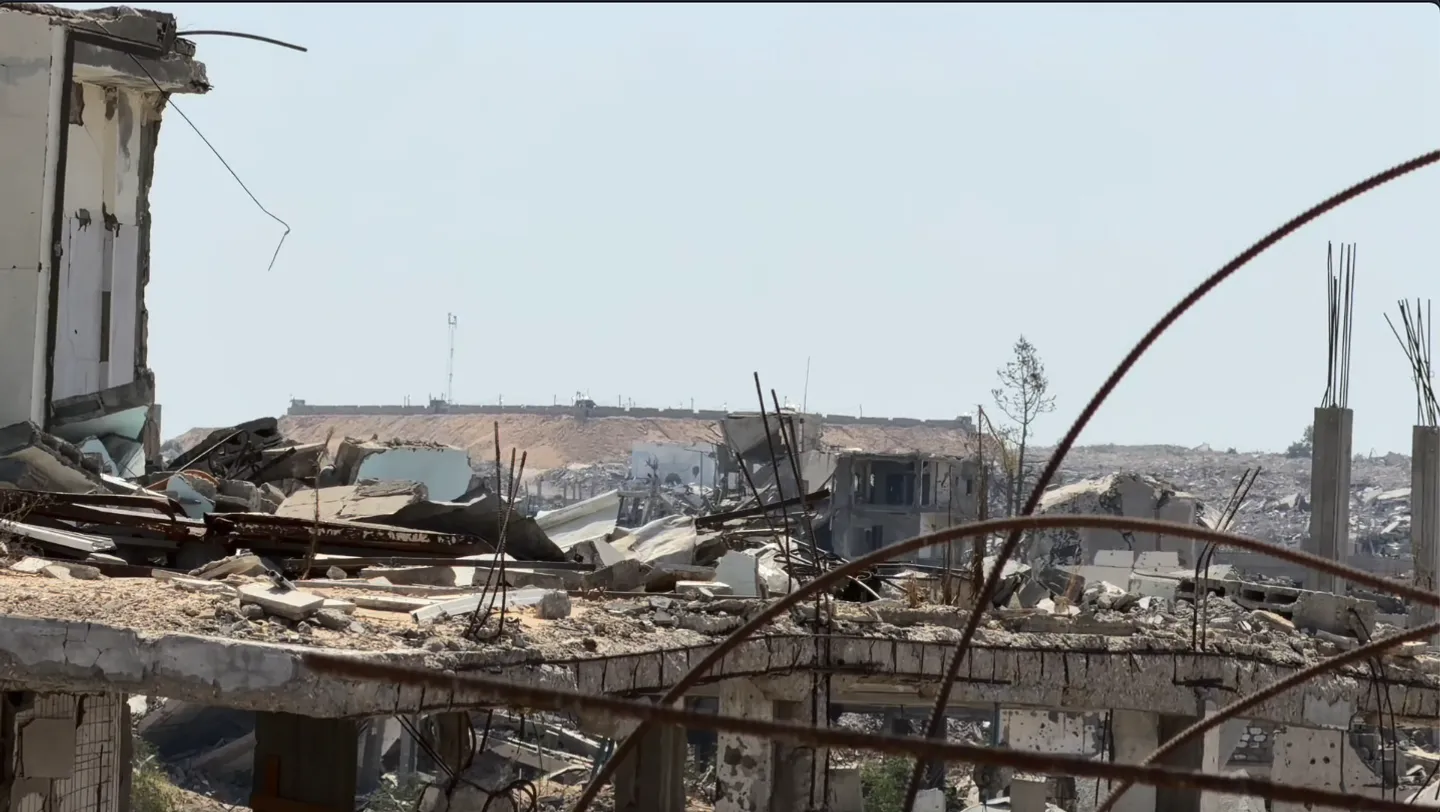
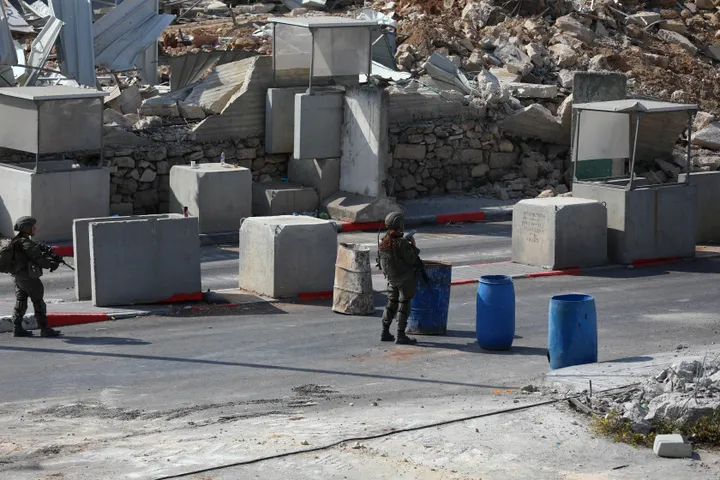
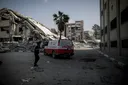
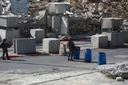
Amid the grey wasteland that Gaza has become, the only splash of colour is an out-of-place yellow concrete block. It marks what the Israeli military calls the ‘Yellow Line’, one of dozens placed across Gaza to signal where Palestinians must stop or risk being shot.
Except the line never stays where it is, and Israelis shoot Palestinians on either side of it. As Israeli forces keep expanding their occupation, the markers advance further into the enclave. With every shift, Gaza becomes smaller.
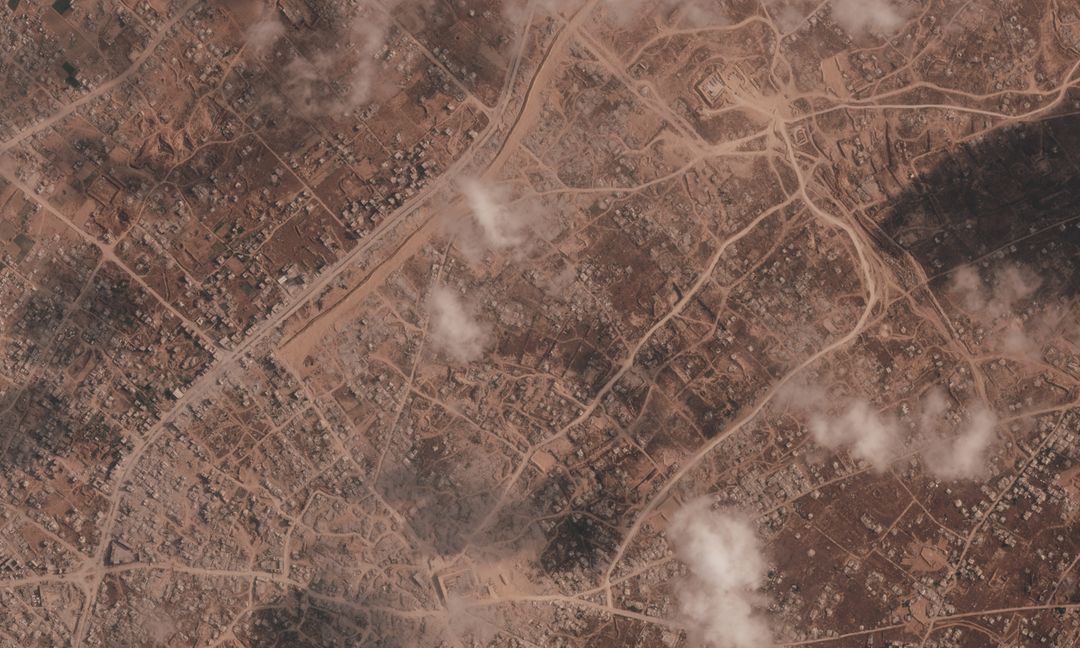
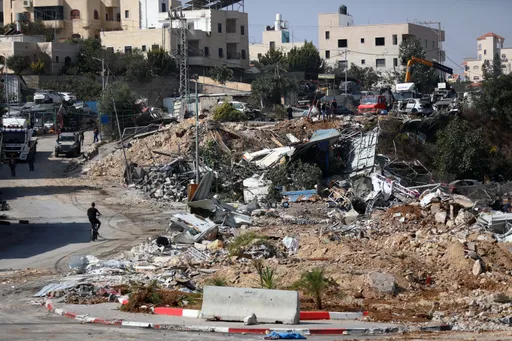
Behind the yellow block, past the collapsed concrete and twisted rebar of what used to be homes, a long earthen ridge now cuts across the horizon, freshly built and rising higher than anything else left standing for kilometres.
It wasn't there a year ago. Bulldozed dirt and sand, piled metres high, now marks where the so-called “buffer zone” ends and where, in theory, Palestinian-controlled Gaza begins.
Beyond the mound, families are still trying to survive. Among them is 60-year-old Khader al-Ashqar, who shares a tent with his wife and five daughters near the Yellow Line in Khan Younis, close to Salah al-Din Street, where the line has advanced farther than anywhere else.
“Before the war, the Israelis were on the barbed wire to the east, three kilometres away from us… little by little, with the war and the bombing, everything was destroyed bit by bit, they got closer and closer until they reached Salah al-Din,” Khader tells TRT World.
“Day by day the Israelis advance the Yellow Line. Of course they've reached, roughly, al-Salam Mosque, meaning they're now only about 700 metres away. There, the area is lit up with terrifying floodlights.”
“There are four military positions: position 86, east of Khan Younis; one at al-Qarara, to the northeast; one at al-Zana; and one at Bani Suheila. At evening time, you'd see how the sky lights up on us, with random gunfire and shelling,” Khader adds.
About a month ago, al-Ashqar’s only son, Salim, was shot dead by Israeli soldiers positioned on the earthen berms while he was on his way to buy cooking gas for his family.
Salim, a newlywed, lived in a tent beside his parents' and played football for Khadamat Khan Younis club. His wife was six months pregnant at the time.
“Things turned upside down; I mean, I should have been the one to go, and Salim would remain,” Khader says.
“But I will bear a great deal, and may Allah keep his wife safe, and may our granddaughter be well, and we'll raise her,” he adds.
It gets worse every day
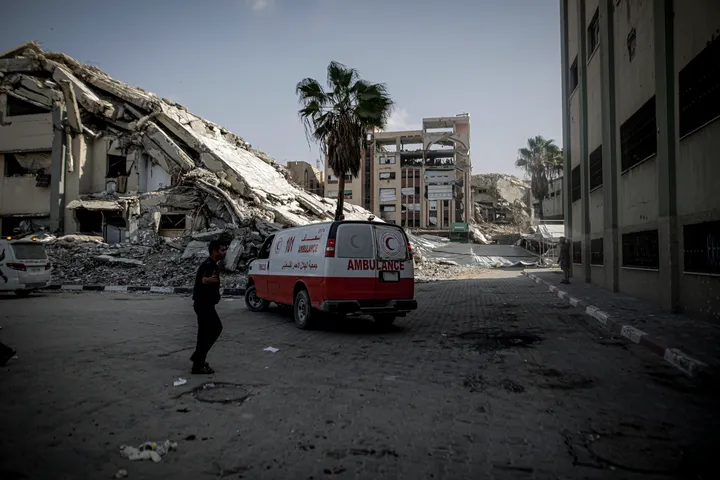
On the western side of the earthen wall now cutting through Gaza, more than two million people are packed into tent camps, cut off from land many of them lived on before the war.
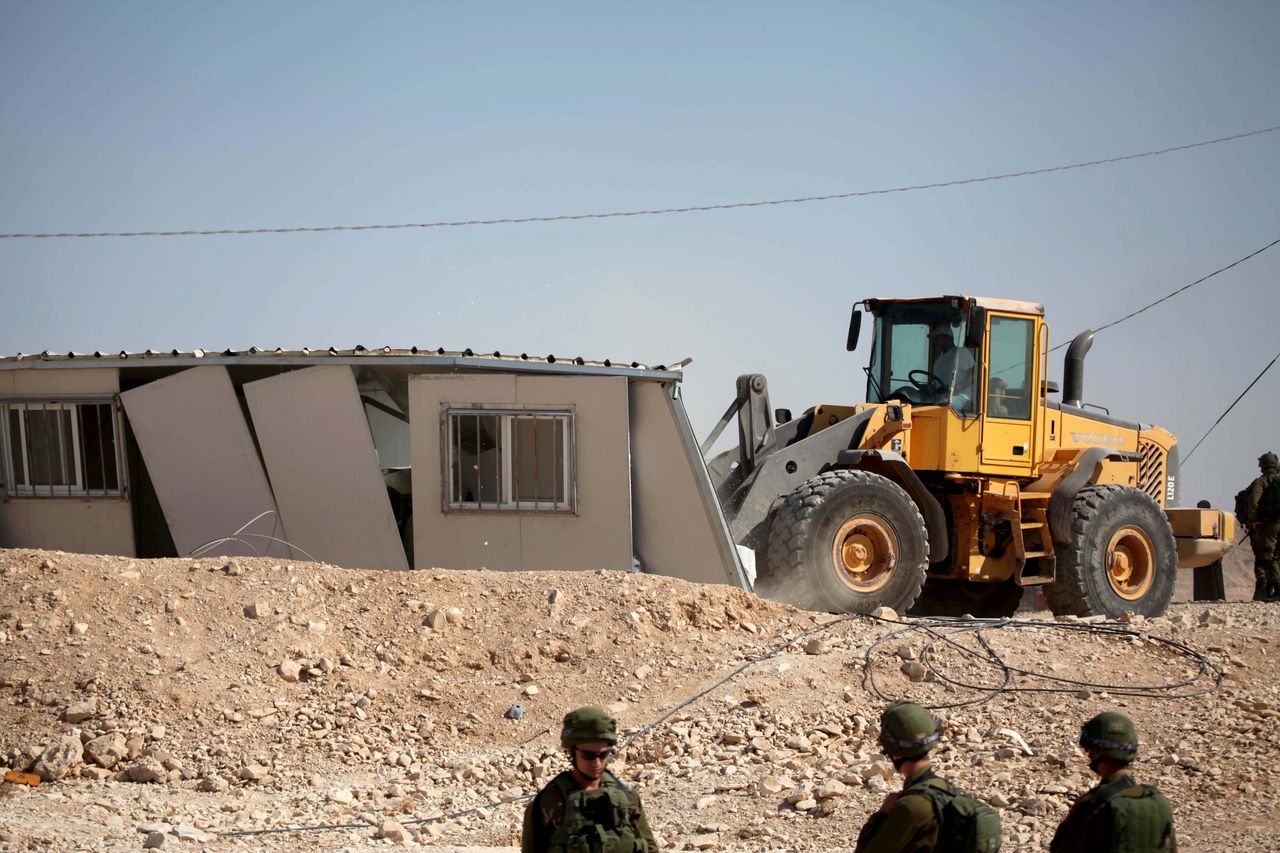
On the eastern side, there are bulldozed streets, flattened neighbourhoods, and Israeli military bases built directly on the ruins of towns like Bani Suheila and Rafah, along with new road networks carved through what used to be agricultural land.
“No tent protects us from the bullets, no house, nothing protects us,” Umm Salim Al-Ashqar, mother of Salim, tells TRT World.
“The gunfire comes at us from the wall every day. We sleep in terror every day. I take my daughters and we sit in the eastern room so that we could be away from the line.”
“The Israelis fire at us…at the tents, at the house. We're expecting the gunfire to reach us any time. Bullets reached the house a while before Salim was martyred, reached the walls,” Umm adds.
Since October, the so-called Yellow Line has expanded from covering roughly half of Gaza to nearly 65 percent of the territory by June, according to the UN's humanitarian coordination office, and more than 23 kilometres of berms have gone up alongside it.
In one stretch near Rafah, a barrier grew from 500 metres to 2.4 kilometres in two weeks. Roughly a third of the more than 1,160 Palestinians killed since “the ceasefire” took hold have died near this advancing line.
Every day the situation gets worse in the areas adjacent to the Yellow Line and the earthen barrier, according to Ali Abduldaim Ashour, who currently lives there.
“Previously, the Yellow Line was about a kilometre and a half away. Now it is only 400 to 500 meters from us,” Ali tells TRT World.
“We don't know what to do, as you can see the whole area is destroyed. We try to remain here, but we suffer from many things: drones, buzzing quadcopters, gunfire, and injuries.”
“Honestly, we don't know what it means to live a life of safety and security; there's no such life, it's all fear. Even at night, one is afraid,” Ali adds.



Not the first time
Gaza is not the first place Israel has drawn a line and called it temporary.
In 2002, it began building a separation barrier through the occupied West Bank, describing it as a security measure against attacks. Two decades later, the barrier still stands, and in long stretches it never followed the internationally recognised Green Line at all.
It curves deep into Palestinian territory, placing an estimated tenth of the occupied West Bank, including illegal settlements and farmland, on the Israeli side, while cutting Palestinian towns off from their own land and from each other.
The 700-km-long barrier has hindered social life, economic activities, and access to services as thousands of Palestinians live in communities that remained between the Barrier and the internationally recognised 1949 Armistice Line (Green Line).
The International Court of Justice ruled in 2004 that the barrier's route violated international law, a ruling that changed nothing on the ground.
What was framed as an emergency measure became, over years of construction and expansion, a fixture of the landscape.
The berms rising in Gaza follow the same pattern as they were built quickly, justified as security infrastructure, and, once poured into the ground, extremely difficult to walk back.
Along newly built earth barriers, Israeli forces have positioned snipers who, according to families living nearby, open fire directly towards tents and homes. Overhead, quadcopter drones circle almost constantly.
“Our children now wake up at night not understanding what's happening, with the sounds they hear, the gunfire and artillery,” Ali says.
“We're truly suffering a great deal. Even now, if you go out, as far as the eye can see you'll see these earthen barriers, which keep getting higher, and they extend along the eastern line,” he adds.
Unlawful occupation
Military occupation, under international humanitarian law, is meant to be a temporary state of affairs, an administration of territory pending its return.
The International Court of Justice's July 2024 advisory opinion went further than any prior ruling, finding Israel's occupation of the Palestinian territory unlawful in itself, and calling on states to avoid rendering aid or assistance that helps maintain it.
A barrier built to outlast a ceasefire, stretching across more than half of Gaza and cutting off two million Palestinians from land Israel still occupies, is a step towards illegal annexation.
Under longstanding rules on state responsibility, states that continue supplying weapons or diplomatic cover to Israel while that barrier is built are not bystanders to the process.
They are implicated in maintaining it, under the same principle that has long held states responsible for aiding another state's internationally wrongful acts.
“The Israelis took everything, they destroyed the trees, the stones, the people, nothing was left,” Khader says.
“The world thinks the war has stopped, and there's a truce, but unfortunately there is none.”
“They're (Israelis) giving the impression to people abroad..that we're living a life of prosperity, but unfortunately the war continues, and the bombing and killing happen every day,” Khader adds.
Israel's military says the barrier and the surrounding "security zone" exist to stop infiltration and protect its troops.
It has declined to say how far construction will extend. But a line meant to mark where a ceasefire holds is beginning to look like a border nobody agreed to, built while the world watches the satellite images and, for now, does little else.
“We call on the international community, the world, to find us a solution; we want to live like everyone else lives, safely and securely. We came down here and but this isn't life; life doesn't exist here,” Ali says.
“Every single day, the Israeli occupation moves further into Gaza.”
“There's no hope that the Israelis will pull back or leave these areas; they keep advancing, encroaching. And all this land they're taking, I don't think they'll ever leave it again,” he adds.