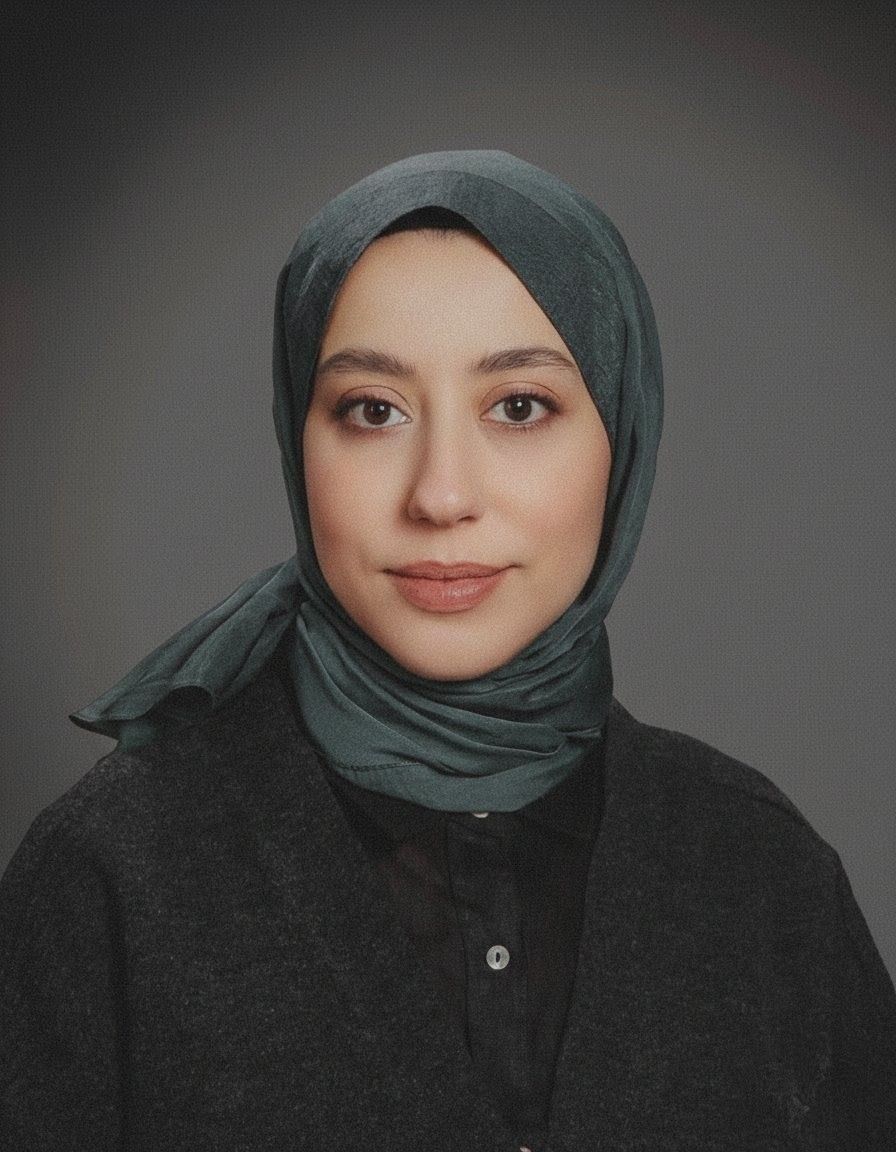
 Esra YAGMUR
The first days of Ramadan in 2025 marked my first journey to perform Umrah.
Before dawn dimmed the stars, the cool Istanbul night seemed to bid us farewell as we began our journey to the sacred lands.
The feeling surrounding this journey was unlike anything I had ever experienced.
Alongside the familiar anxiety of forgetting something important, there was a quiet excitement—the kind that arises from knowing you're about to experience something you've awaited for a long time.
Our small group of six friends boarded a plane filled with travellers from various countries, all bound for Medina al-Munawwara in Saudi Arabia.
As the aircraft gradually descended towards the airport, the landscapes of Arabia stretched out beneath us.
Faded pastures, dusty plains, and sand dunes dotted with thorny shrubs formed the very image of the desert many of us had only imagined before.
When we arrived in Medina, the warm air that greeted us felt strikingly different from the climate we were used to.
After leaving our luggage at the hotel, we began walking toward the Prophet’s Mosque with the guide who would accompany us throughout our journey.
Soon, the green dome of Masjid al-Nabawi stood before us, as if quietly greeting its visitors.
It is one of the three mosques regarded as the most sacred in Islam. As mentioned in the Quran, it is a mosque “founded upon piety,” honoured by the presence of the Prophet Muhammad and by the countless memories associated with him. Standing there, it felt like a jewel among the lands he once walked.
The Prophet’s refuge: al Balad al Tayyiba
In his renowned account of pilgrimage journeys, the Ottoman traveller Evliya Çelebi describes the gruelling caravan routes that once stretched across deserts for weeks at a time.
Yet what impressed him most was not the hardship of the journey, but the moment when travellers finally glimpsed the dome of the Prophet’s Mosque.
“When the dome of the Prophet’s Mosque becomes visible, the believers in the caravan begin to weep. The camels, exhausted from the journey, suddenly revive and rumble like thunder; horses neigh, and mules and donkeys cry out as if in the musical mode of Segâh,” he said.
Segâh, in Turkish classical music, is a mode associated with deep spiritual contemplation, carrying a sense of noble detachment from the world. It was with a feeling like this that we approached al-Madinah al-Munawwarah.
The streets of the city were filled with people from every corner of the world, dressed in a remarkable variety of colours and garments.
Yet, the atmosphere felt far from chaotic. On the contrary, there appeared to be an unspoken understanding that everyone was gathered under the same spiritual invitation, moving within the protective presence of the Prophet Muhammad.
The diversity visible everywhere did not seem divisive; it merely became apparent to the eye that attempted to analyse it.
We stayed in Medina for three nights. On our first evening, we joined the long line of visitors waiting to enter the sacred chamber where the Prophet Muhammad is buried.
In the faces of those standing in line, one could read the anticipation of an encounter with one of the most meaningful moments of their lives.
It is difficult to describe such a moment in words. The crowd moved slowly toward the resting place of the Prophet.
While waiting for our turn, we prayed in the mosque.
The Prophet is reported to have said that a prayer performed in Masjid al-Nabawi is worth a thousand prayers elsewhere, except those performed in Masjid al-Haram in Mecca. Knowing this made the moment feel even more extraordinary.
Finally, we entered.
Before us lay Rawdah al-Mutahhara, the “Garden of Paradise.” The fourteenth-century traveller Ibn Battuta once wrote that this place “has been perfumed for centuries, so that its fragrance seems to rise constantly into the air”.
Despite the crowd around us, one could not help but feel that every worldly intermediary between oneself and the Divine had vanished. In that moment, it felt as if each person stood alone before God.
Life in Medina moved slowly and quietly, yet with its own gentle rhythm. We spent most of our days in the mosque, often sleeping very little. This was not merely a place where rituals were performed; it was also a living reflection of the Quranic verse: “For every nation there is a direction to which they turn” (Surah Al-Baqarah, 2:148).
People from every culture prayed according to the traditions and spiritual habits they had inherited. Some remained in long prostrations. Others recited passages from the Quran in soft murmurs. Some simply sat in contemplation facing the resting place of the Prophet. Others lay quietly on the green carpets, resting their bodies as they breathed in the mosque's calm atmosphere.
Here, whatever one did seemed to become a form of worship.
On our final evening in Medina, my heart was divided. On the one hand, I carried the excitement of soon encountering the Kaaba, the ultimate destination of our journey. On the other I felt a quiet sadness at the thought of leaving this city behind.
Visiting Medina is not a formal requirement of Umrah. However, once you are there, you come to appreciate the virtue of visiting the city that welcomed the Prophet when he was forced to leave Mecca, offering him refuge and protection.
After the migration, the Prophet himself gave the city the name “Taybah”, literally meaning “the good and pure city”.
For more than fourteen centuries, Muslims have journeyed to this place, once a collection of scattered villages called Yathrib, which the light of revelation transformed into Madinat al-Nabi, the City of the Prophet.
Standing there, I was astonished to realise I was part of this long human procession.
It felt as if the Prophet himself had walked through every corner just yesterday; his presence and grace were tangible here. Our tour guide’s words still resonate in my mind:
"We see the effects of the Prophet’s blessing prayer for this place. The finest fruits and vegetables from around the world are still brought here."
This remarkable, blessed city, where colours and sounds from all corners of the globe converge in harmony, has carried the same joy in each person’s heart for centuries, each in their own way.
The words of Austrian thinker Muhammad Asad, who later embraced Islam and adopted this name, seem to be proof that the Prophet left a piece of his spirit on these lands.
"In Medina, time advances not on the winged horses of haste, but on the bare feet of desert tranquility."






The centre of our changing self: the Holy Kaaba
Soon, it was time to leave Medina. We set off from our hotel for the five-hour journey to Mecca.
The landscapes along the way inspired awe: vast green valleys, herds of grazing camels, and the changing climate and atmosphere reflected the spirit of the land.
Our first stop was Dhul-Hulayfah, the miqat mosque, one of the designated points where pilgrims enter the sacred state of ihram, once visited by the Prophet and his companions for the same purpose. Surrounded by lush date palms, this mosque of stone and mud brick serves as both a resting place for pilgrims and a station for entering ihram and preparing for worship.
Ihram, the special garments worn to enter the act of worship, symbolise both humility and equality, a spiritual process where worldly status dissolves. Men wear plain white unstitched sheets, women modest attire, and all stand equal before the Creator.
Entering this state invites the pilgrim to turn entirely toward God.
At this moment, we verbalised our intention. Islam teaches that acts of worship gain meaning only when combined with sincere intention:
"Labbayk, Allahumma labbayk! Labbayk, la shareeka laka, labbayk! Innal-hamda, wan-n’imata, laka wal-mulk. La shareeka lak."
These words echo the prayers of Prophet Ibrahim as he first shaped the holy structure, looking to the sky while carving the stones: “Here I am, my Lord. Truly, You have no partner. Here I am. No doubt, all praise and blessings are Yours, and the dominion belongs to You alone. You truly have no partner.”
Repeating the talbiyah, we approached Mecca, each repetition reinforcing our devotion and surrender. Together, we felt powerfully that all blessings and praise belong to Him. Our bodies, wealth, and souls were entirely His, a sensation of deep gratitude and humility that was impossible to resist.
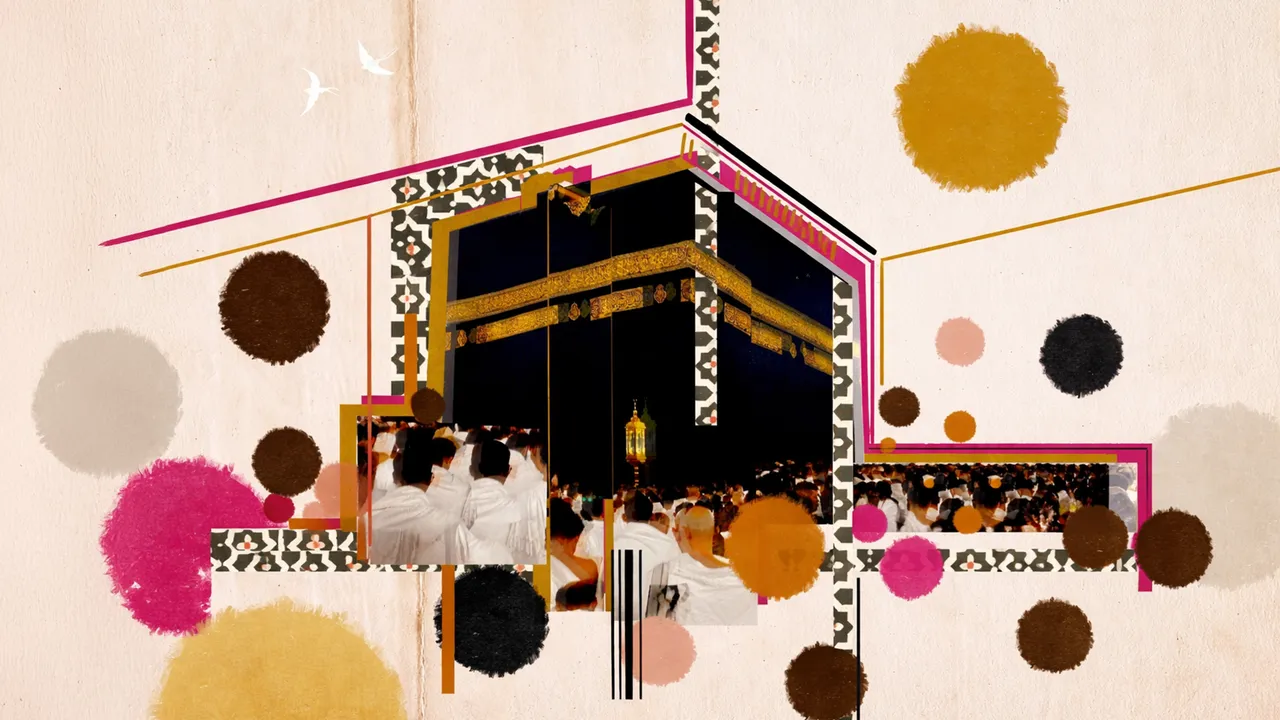
Then, finally, the Kaaba.
At first, it revealed itself only partially, glimpsed between the columns beneath the King Fahd Gate.
The emotion I felt was unlike anything I had anticipated. With its form half hidden and half revealed, the first impression it left on my mind was that of a dark pearl emerging from its shell.
It is said that the first prayer one offers upon seeing the Kaaba will be accepted.
Yet, when that moment arrived, I found it impossible to focus on anything other than the structure before me.
As I examined its simple geometry and tranquil presence, I thought my eyes had perhaps waited too long to witness this sight. With a mixture of awe and humility, I repeated silently within myself: Lebbeyk, here I am.
To perform the tawaf, we walked around the Kaaba seven times, keeping it on our left side, close to our hearts.
This ritual, conducted through tangible objects, holds deep meanings that guide the soul on its journey of spiritual growth.
Perhaps, I thought, our ability to understand the infinite layers of existence is limited, and each created being stands uniquely before God. It is through these symbols and practices, speaking directly to our senses, that God chooses to communicate with us.
The Kaaba stands as a fixed point amid our ever-changing identities. Each encounter reveals new perspectives.
In the footsteps of Hajar
After completing our final circumambulation, we moved to the second essential ritual of Umrah, the sa’y, which literally means “striving” or “hastening”, between the hills of Safa and Marwa.
Trusting in God’s promise, Prophet Ibrahim had left his wife and son, Ishmael, in a barren valley, one that would later become the site where he and his son would lay the foundations of the Kaaba.
Hajar, hoping to quench her son’s thirst and carrying the worries every mother bears, ran seven times between the two arid hills of Safa and Marwah, refusing to surrender to despair.
Eventually, water miraculously sprang forth beneath the feet of the infant Ishmael, the well of Zamzam.
For centuries, Muslims have reenacted this moment, retracing the steps of a mother’s search for water.
This stage was not merely physical; it was profoundly spiritual for me. I reflected on the purpose behind God’s design: why did we traverse these hills? How should a mother’s relentless efforts for her child resonate within me?
Hajar did not undertake this effort as an act of worship. At that time, these lands were not yet regarded as sacred. She simply acted out of trust and perseverance, pressing on through a barren desert where, to an outside observer, the effort might have seemed futile.
Her steadfastness was so profound that, through her effort alone, the valley became sanctified. For centuries, millions of Muslims have retraced their steps, completing this ritual, a deep journey of faith, effort, and surrender.
Umrah, in this way, is both a deeply personal act of worship and a reminder of the diversity of paths that unite millions of Muslims worldwide and guide them toward God.
Few experiences can unite people from so many nations, colours, and corners of the world in such harmony.
Watching people of all ages circumambulating the Kaaba, I saw Asian women in groups reciting the Quran with meticulous precision, elderly men praying alone with their hands lifted to the heavens, and others standing quietly in contemplation.
Rich and poor alike, I was reminded that our value before God does not depend on worldly labels.
When Ibrahim built the Kaaba, he prayed that believers would come here to worship. Perhaps the greatest honour for any human being is simply to be counted among God’s servants.
In this sacred space, worldly ambitions, ego, and measures of wealth lose their significance.
Yet it becomes clear that every person who has made sacrifices and endured hardships to reach these lands holds profound value, regardless of appearance, and stands as a living testament to Prophet Ibrahim’s prayer.