 Murat Sofuoglu
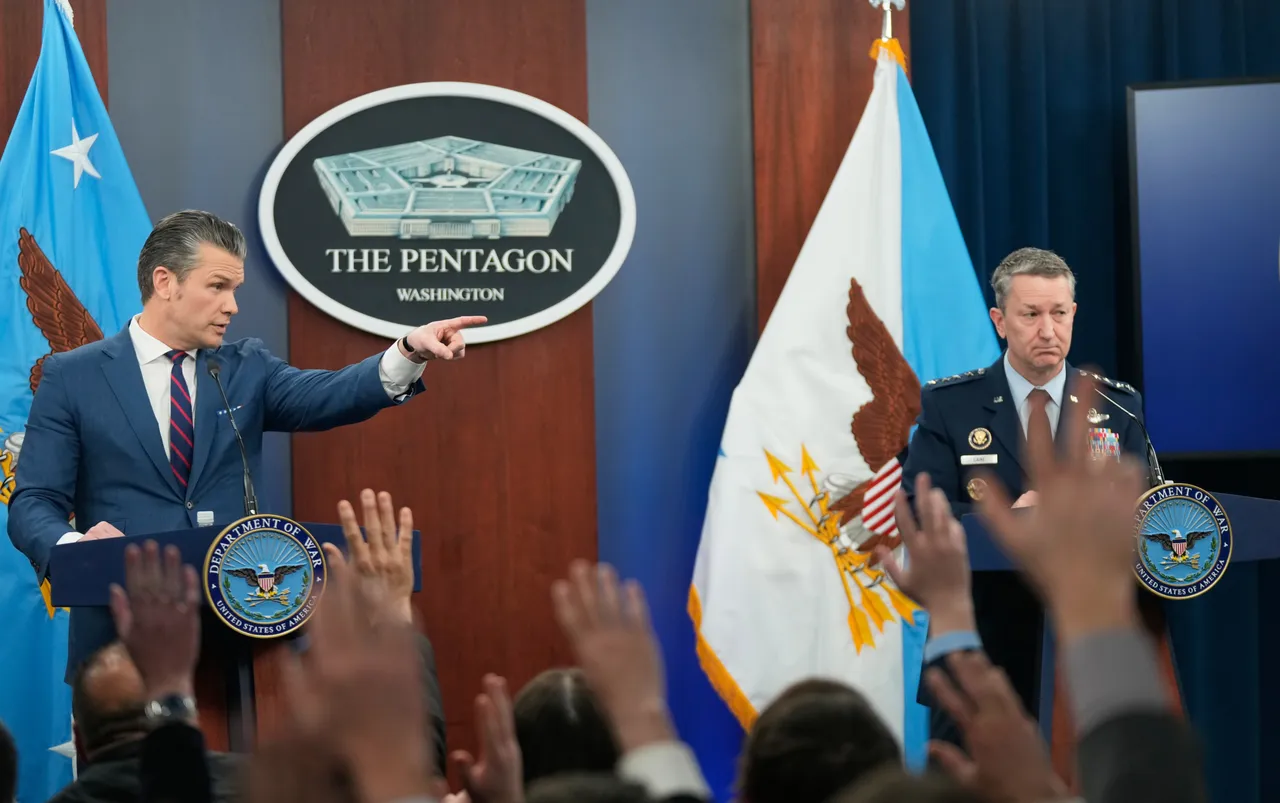
Defense Secretary Pete Hegseth’s press conference alongside joint chief’s chairman Dan Caine bore little resemblance to Secretary of Defence Donald Rumsfeld’s briefing at the outset of the 2003 Iraq war, when US forces rapidly spread across the country.
This time, the two top defence officials confronted a far more formidable adversary - one that launched hundreds of missile salvos at American forces in the region, Israeli cities as well as US bases in Kuwait to Bahrain, Qatar, Saudi Arabia, UAE, Jordan and Iraq.
Caine acknowledged that additional troops and weapons would be deployed to the region to confront Iran, suggesting current force levels may not be sufficient.
“This is not Iraq. This is not endless,” Hegseth said at the news conference.
“We set the terms of this war from start to finish. Our ambitions are not utopian. They are realistic, scoped to our interests and the defense of our people and our allies,” he added.
Earlier on Monday, ahead of the Pentagon briefing, reports emerged that three US warplanes had gone down in Kuwait, incidents the Pentagon attributed to friendly fire.
While the circumstances remain unclear, the episode underscored the risks of a rapidly intensifying confrontation.
President Donald Trump, who campaigned on ending “forever wars,” acknowledged American fatalities and warned that further casualties were possible as the conflict unfolded.
For some analysts, however, the central question is not battlefield capability but endurance.
“The key point is that Washington can sustain the war in three different senses, and the ceiling is political and economic long before it is purely military,” Andreas Krieg, associate professor at King’s College London and director of MENA Analytica, tells TRT World.
In military terms, the United States retains the capacity to keep forces in the region for months and to conduct a lower-tempo air and maritime campaign if it chooses.
The greater vulnerability, Krieg argues, lies in political tolerance at home and mounting anxiety among Gulf partners as Iranian attacks raise the risk of prolonged disruption to shipping lanes and airspace.
Off-ramp or long war
That political and economic ceiling becomes even more visible in the Gulf.
Shortly after hostilities began, Iran warned that any vessel entering the Strait of Hormuz would be targeted, effectively threatening to close the narrow waterway through which roughly 20 percent of global oil supplies transit.
Even without a full blockade, prolonged disruption would rattle energy markets, raise prices and quickly translate into domestic political pressure in the United States and beyond.



“In practice, the current tempo is most sustainable for something like one to two weeks before Washington faces a choice: either reduce the intensity and pivot to a political off-ramp, or accept rising risks and costs as air defence stockpiles are stressed, civil aviation and trade remain disrupted, and the probability of a mass-casualty incident climbs,” Krieg tells TRT World.
The choice between a political off-ramp and a prolonged, painful war has framed the conflict from the outset.
President Donald Trump’s own rhetoric has oscillated between those two poles - at times hinting at regime change, at others suggesting the objective is limited to degrading Iran’s missile capabilities.
The shifting language has fueled uncertainty about Washington’s true endgame.
"I can go long and take over the whole thing, or end it in two or three days and tell the Iranians: 'See you again in a few years if you start rebuilding [your nuclear and missile programs]," he said on Saturday after he launched attacks on Iran.
But most recently, the US president said that his military confrontation with Iran might last four or five weeks and possibly “far beyond”, signalling his inclination towards a harsh war rather than a peace settlement. He has threatened that Iran will face an overwhelming attack in the coming days.
Trump’s Secretary of Defence Hegseth even suggested that a ground operation is possible, raising eyebrows across MAGA base, which has long opposed US foreign interventions abroad.
Some important voices in the MAGA base clearly expressed their displeasure with Trump’s war on Iran. Among others, Tucker Carlson, a leading American political commentator, who visited the White House prior to the war, described Trump’s decision as “disgusting and evil”.
Democrats, meanwhile, see a political opportunity. With polls showing limited public support for the war and a clear majority expressing opposition, a protracted conflict could carry electoral consequences ahead of the November midterms.
Recent polls suggest that only 27 percent of Americans support the ongoing war with Iran. A CNN poll showed that nearly 60 percent oppose the war.
“The most likely US approach is a time-boxed burst designed to claim visible degradation of Iran’s missile capability and residual nuclear infrastructure, followed by 'mission accomplished' messaging and a push for a mediated pause,” says Krieg.
‘A long campaign’
The phrase “Mission accomplished” evokes former US President George W Bush’s speech aboard the USS Abraham Lincoln on May 1, 2003, delivered just weeks after the invasion of Iraq, at a moment when swift military success masked the protracted conflict that followed.
“A longer campaign is possible, but it becomes progressively harder to sustain as Hormuz disruption, insurance and oil prices, and partner pressure in the Gulf begin to bite,” Krieg adds.
Yet not all analysts believe domestic constraints will quickly force Washington’s hand. Some argue that the United States has historically demonstrated a high tolerance for extended military engagements, even when public opinion is divided.
“The United States has an enormous capacity to sustain long wars politically (even unpopular wars) for a prolonged period,” Edward Erickson, a former American army officer and a leading military analyst, tells TRT World.
“Americans prefer short wars, of course, but Vietnam, Iraq, and Afghanistan prove they will support a long war as well. If we don't lose a lot of Americans, the United States can keep this up for a long time.”