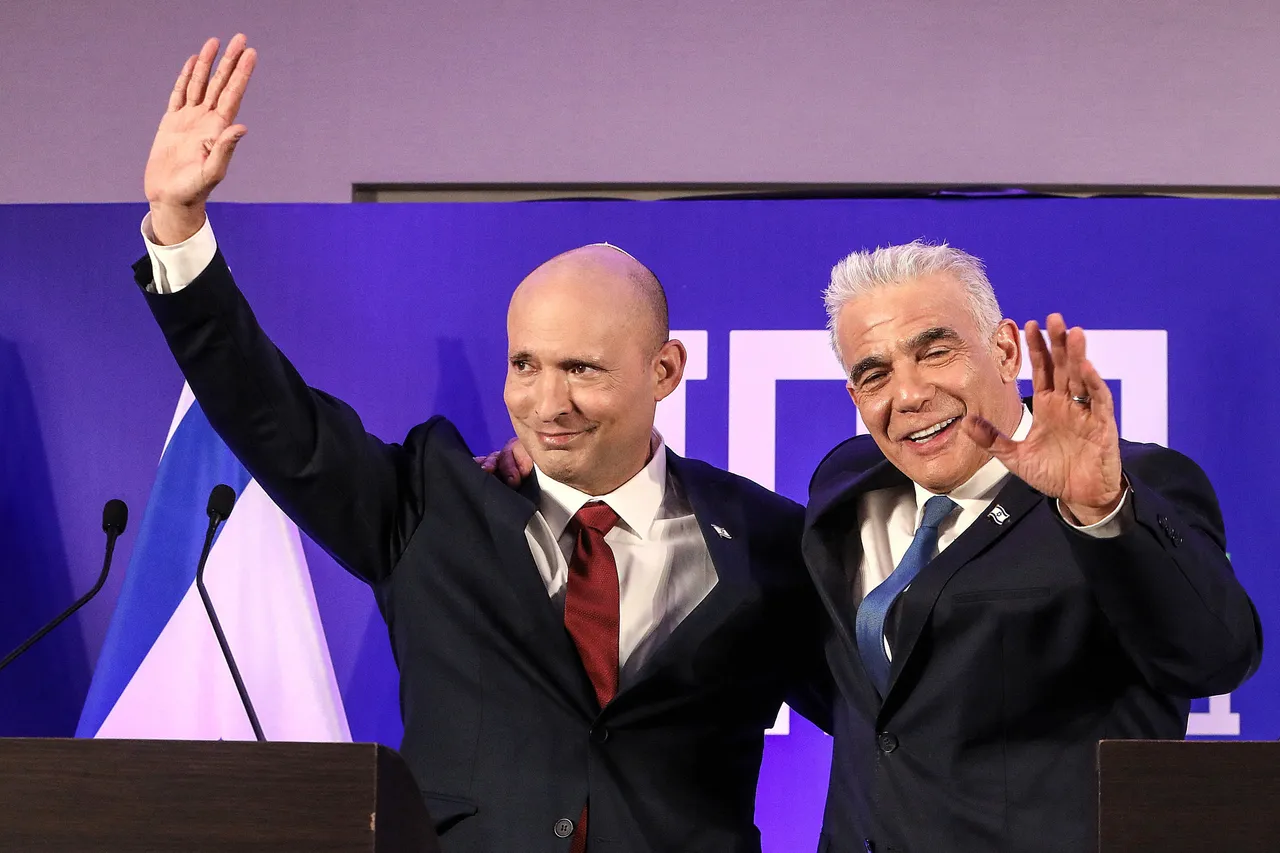
Naftali Bennett and Yair Lapid, two former Israeli prime ministers who once toppled Benjamin Netanyahu’s government in 2021, announced on April 26 the formation of a new party called ‘Together – Led by Bennett’.
The merger of Bennett’s nascent ‘Bennett 2026’ party and Lapid’s Yesh Atid party aims to capitalise on the Israeli public’s weariness after non-stop wars in Gaza, Iran and Lebanon for two and a half years.
Led by Prime Minister Benjamin Netanyahu, the Likud party was in power from 2009 to 2021. Then Bennett became prime minister in 2021 and was succeeded by Lapid in July 2022.
Netanyahu regained the premiership in December 2022 and has led the country since then as Israel’s longest-serving prime minister.
Bennett declared the creation of the new party as “the most Zionist and patriotic act we have ever done”, while promising to end the era of division.
But experts say there is little evidence that a possible Bennett-Lapid victory in the election, scheduled for October this year, will change Israel’s approach to the Palestinians.
The new alliance offers fresh packaging for the same Zionist security doctrine – continued occupation of Palestinian lands, illegal settlement expansion and high-intensity military assaults to maintain regional hegemony, they say.
Ozgur Dikmen, a PhD candidate studying Jewish politics of communal reform at Stanford University, tells TRT World that a potential victory for the newly formed alliance will represent a “significant transition in leadership style and internal governance”.
“(But) it would be a mistake to interpret this as a foundational departure from Israel’s long-standing approach to the occupation,” says Dikmen, an expert on Israeli politics.
The underlying Zionist security doctrine is expected to remain the “operational baseline” even in the event of a Bennett-Lapid victory.
“The packaging may shift towards more professionalised military management, but the commitment to the settlement growth is likely to persist,” he says.
Referring to new political realities post-October 7, 2023, he says Israeli society has become “significantly more hawkish across the political spectrum”.
As a result, domestic approval for military assaults against Palestinians remains high, as these are now framed as an “existential necessity” rather than mere policy.
Israel’s war against Iran, currently paused under a shaky ceasefire, has only reinforced this consensus. The Jewish-Israeli approval of the war effort reportedly exceeds 90 percent, Dikmen says.
“Any incoming leader, Bennett included, would find it politically undesirable to adopt a restrained posture without risking immediate domestic delegitimisation,” he says.

Mehmet Rakipoglu, an associate professor at Mardin Artuklu University in Ankara, tells TRT World that Bennett was all for expanding occupation during his short stint as premier in 2021-22 – a fact that may foretell his policy towards Palestinians if he wins back the top office.
“I do not foresee any real departure (under a possible Bennett-Lapid setup) from the current government’s approach to occupation or settlement policies,” he says.
Bennett’s government approved tenders and planning for thousands of illegal settlement units, continuing a pattern documented by monitoring groups.
For Rakipoglu, the continuity in Israeli virulence towards Palestinians runs deeper than personalities.
“Whether it is Netanyahu or Bennett, when it comes to Zionism, all of them are the same,” he says.
Will Arab parties join in?
Experts highlight how the alliance’s populist rhetoric reinforces its strictly pro-Zionist identity.
After all, Bennett has already vowed to form a ‘Zionist government’.
Arik Rudnitzky of the Moshe Dayan Centre at Tel Aviv University tells TRT World that it is “too early to say” whether Arab citizens will accept the new Bennett-Lapid party.
Bennett made it clear that he would not rely on Arab parties because they are not Zionists, he says. This is despite the fact that the 2021 Bennett-Lapid government did secure support from Mansour Abbas’s United Arab party.
Rudnitzky says that the vast majority of Palestinian Israelis are expected to vote for Arab parties, while expecting that their representatives will make every effort to maximise political influence in exchange for budgets to beat crime and overcome economic neglect in Palestinian-Israeli communities.
“Arab voters expect Arab members of the Knesset to negotiate cooperation with the future government in exchange for actual achievements,” he says.
Polling data cited by the experts underscores the numbers game.






Dikmen says the Together alliance is polling between 26 and 27 seats. Even with Gadi Eisenkot’s potential addition, the broader anti-Netanyahu bloc can fetch around 59-60 seats – a number still short of the 61-seat majority in the 120-member Knesset.
“The Arab parties, holding a projected 10 to 11 seats, are the natural mathematical counterbalance,” Dikmen says.
He describes an “Abbas paradox”: the alliance needs Palestinian Israeli votes to govern, but risks alienating the hawkish Jewish voters by embracing the former openly.
Behind-the-scenes talks with Abbas are likely, Dikmen says.
“Pragmatism often overrides ideological purity when the alternative is political deadlock,” Dikmen says.
Tugce Ersoy Ceylan, associate professor at Izmir Katip Celebi University, views the alliance’s broader electoral prospects more optimistically.
“I believe this alliance has electoral potential,” she tells TRT World.
“(But) I do not think this alliance will be able to form a government on its own,” she adds.
She says that the merger of the two parties can prove more consequential than the 2021 arrangement because multiple wars for over two years have fostered immense weariness, exhaustion and anger towards Netanyahu within Israeli society.
The rhetoric of “reconstruction and rebuilding” and an “island of stability” may resonate with the Israeli public going forward, she notes.
Yet Ceylan cautions against over-reading any centrist shift in the Israeli political ecosystem.
“Bringing the opposition together under a single umbrella to prevent Bibi from gaining 61 seats is a tactical necessity,” she says.
On the Palestinian issue, she expresses doubt about a genuine return to mainstream negotiation.
“If we interpret ‘mainstreaming’ as the resolution of the Palestinian issue through the initiation of a negotiation process with the Palestinians, I do not believe such a trend will be possible in Israeli politics for some time to come,” she says.
Bennett casts himself as a symbol of the liberal-Zionist right, which means he’s attempting to fill the gap between the far right and the centre, she says.
“In other words, the centre could be redefined by positioning itself further to the right.”
Acceptable internationally?
International pressure on Israel is unlikely to force meaningful political change from Netanyahu’s government either, analysts say.
Dikmen predicts that a Bennett-Lapid government may initially receive a “mild applause” from the international community simply by lacking the current coalition’s most inflammatory figures.
The centrist image of the new alliance can serve as a diplomatic buffer, allowing the new government to buy time.
But he warns that the new leaders may adopt an even more rigid public discourse on security matters to reassure their base. Such a strategy will ensure that any tactical flexibility is protected by a shield of nationalistic rhetoric.
This will also ensure that the core objectives of the Israeli hardliners, such as preventing Palestinian statehood and maintaining control over occupied lands, remain undisturbed.
Rakipoglu views the entire exercise as a tactical deflection.
“There have been many attempts by both Israel and other pro-Israeli states to just blame Netanyahu for what Israel has committed in Palestine and also in Iran,” he says.
While a new government may appear to ‘soften’ its policies towards Palestinians, the record of Bennett as premier suggests otherwise: “They expfanded settlements and punished Palestinians,” he says.
Rakipoglu says that an overwhelming majority in Israeli society remains “in favour of genocide,” underscoring the domestic constraints over a major policy shift that any new Israeli leader is bound to face.
“All parties and ideologies are serving the Zionist project… It’s going to be the same Zionist doctrine,” he says.