 Zulal Sema
Medina, 27 January 632 CE: As daylight begins to fade, Prophet Muhammad rises to perform Salat al-Kusuf, the special prayers offered during a solar eclipse.
His infant son Ibrahim died that day, prompting some to whisper that the Sun darkened because of his loss.
But the Prophet (PBUH) rejects the superstition: the Sun and Moon do not eclipse for the birth or death of anyone, he teaches, urging people to pray and invoke Allah until the light returns.
The moment, as mentioned in the Hadith, remains one of the clearest early examples of how Islam directs believers to respond to celestial phenomena—with awe and humility, but without superstition. Nearly fourteen centuries later, the sky is preparing to darken once more.
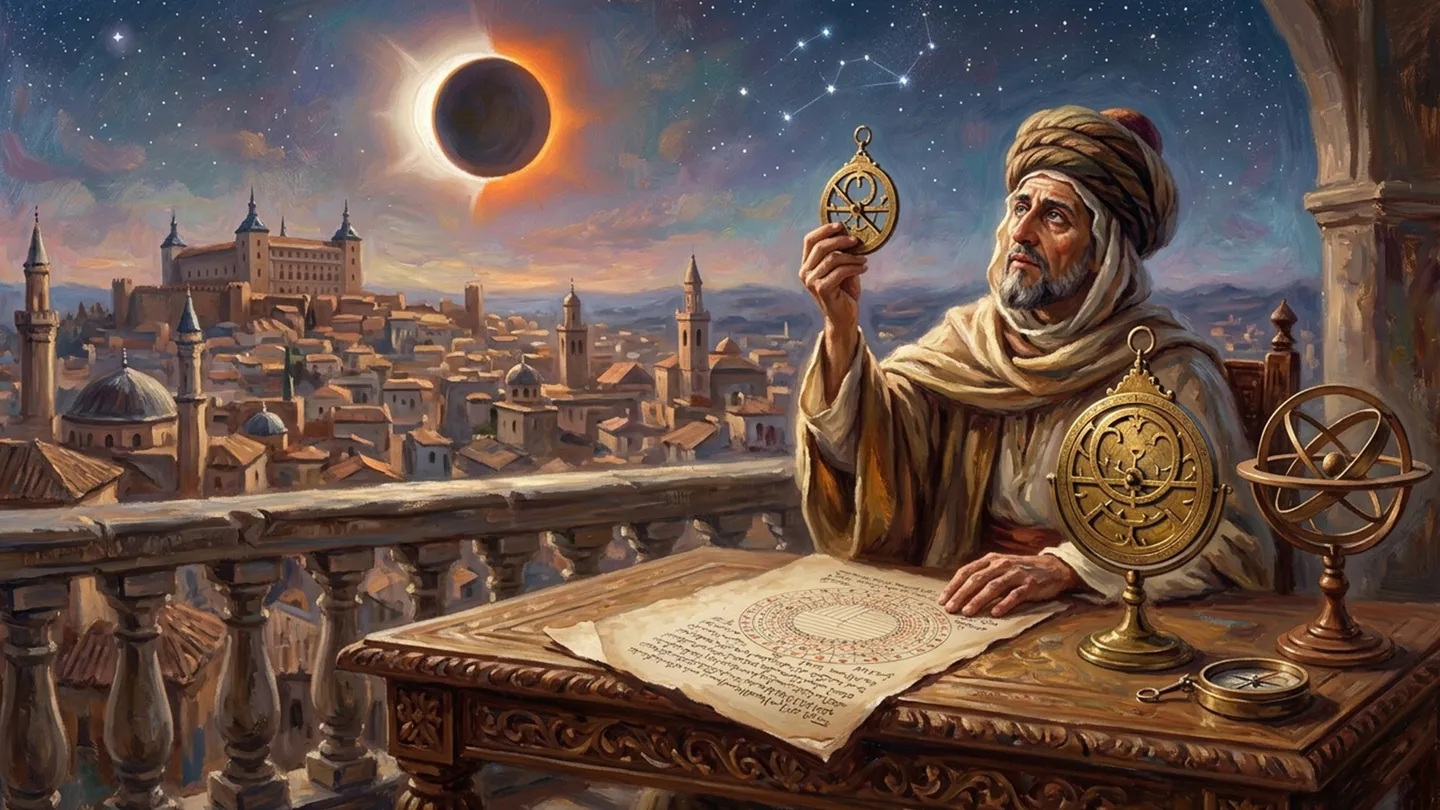
On August 12, as the first total solar eclipse visible from the Iberian Peninsula in more than a century sweeps across Spain, the spectacle puts the spotlight back on another age—to the 11th-century Andalusian astronomer Al-Zarqali, who studied the movements of the Sun and planets from the city of Toledo.
Toledo lies just beyond the path of totality, yet the Moon will conceal about 99.3 percent of the Sun, leaving only a razor-thin crescent of fire above the ancient city.
In the 11th century, Toledo was part of a Muslim emirate, formed after the disintegration of the mighty Andalusian state.
Al-Zarqali’s observations helped shape the Toledan Tables, astronomical charts used to predict the movement of the planets.
His astronomical works travelled across linguistic and religious frontiers through Latin translation. Centuries later, 16th-century astronomer Copernicus cited him by his Latinised name, Arzachel, in De revolutionibus orbium coelestium.
The Toledo circle
The Romans had called the city Toletum; in Arabic it became Tulaytula, an adaptation of the older name, before the Spanish form Toledo prevailed.
Built on a steep granite hill and enfolded on three sides by the river Tagus, the city was the centre of an independent Muslim-ruled taifa in Al-Zarqali's lifetime.
Emilia Calvo Labarta, a scholar of medieval Arabic astronomy at the University of Barcelona, says that “the Toledo group carried out observations over a long period”.
“It was not only Al-Zarqali, but several astronomers working together…We have the treatises and astronomical handbooks they wrote, as well as information preserved by later authors, but we do not know exactly how they performed their observations,” she tells TRT World.
Al-Zarqali appears in scientific literature of the period as an exceptionally skilled maker of instruments. Largely self-taught in astronomy, he worked with Said al-Andalusi, a judge and historian in Toledo.
Al-Zarqali’s ability to turn metalwork, geometry and celestial measurement into one practice eventually made him the group’s leading figure.
“His achievements rested on long-term observation: the sources attribute to him 25 years of observations of the Sun and 37 years of the Moon,” Mustafa Kacar, head of the History of Science Department at Fatih Sultan Mehmet Vakif University, tells TRT World.
“This continuity enabled him to calculate solar and lunar parameters and to question values inherited from Ptolemy. The observations made in Toledo became part of the foundation on which astronomy later developed in Europe.”
A portable sky
Al-Zarqali did not merely record the sky; he redesigned the tools through which it could be calculated. A conventional astrolabe required different plates for different latitudes.
His universal plate, the al-safiha al-zarqaliyya—known in medieval Europe as the saphaea or azafea—used a new projection so that one instrument could solve problems across many latitudes.
“He found a mathematical solution for representing this on a single plate,” Kacar says. “In practical terms, it was an instrument that could be used at almost any inhabited latitude.”
The first version was so dense with intersecting grids that Al-Zarqali wrote a 100-chapter guide to its use; he later designed a simpler version, the shakkaziyya, accompanied by a 60-chapter treatise.

He also devised an equatorium that converted planetary models into a working instrument. “Calculating a planet's position from tables was a long and cumbersome process,” Calvo says.




“With the equatorium, many of those calculations could be avoided.” His design placed the deferents and other circles of the planets on plates that could be manipulated instead of recomputed line by line.
Al-Zarqali brought the same precision to his theories of the Sun and planets. Drawing on decades of observation, he argued that the solar apogee slowly shifted against the fixed stars and developed a model that influenced astronomers through the age of Copernicus.

Across languages
The writings of Al-Zarqali reached Europe through the translations of Gerard of Cremona, an Italian who was proficient in Arabic and lived in Toledo during that period.
Later translated into Castilian, Latin and Hebrew, Al-Zarqali’s works influenced generations of European astronomers.
“We find Latin treatises from later periods following the innovations in his solar model,” Calvo says.
Copernicus did not inherit a heliocentric universe ready-made from Toledo. What he inherited were observations, parameters and mathematical devices that could be rearranged inside a radically different cosmology.
In the 1543 first edition of De revolutionibus, the name “Arzachel Hispanus” appears alongside other authorities whose measurements he examined. Al-Zarqali's solar model, transformed into a Sun-centred system, became one component in Copernicus's groundbreaking reconstruction of the heavens.
Yet translation also changed how Muslim names changed across time and languages – Al-Zarqali became Azarquiel in Spanish and Arzachel in Latin.
These forms made Arabic names pronounceable to Latin readers, but over time they could also obscure the Islamic intellectual world from which the works had emerged. Europe often retained the calculation even when the person behind it became difficult to recognise.

Recovering Arzachel
“The trail did not disappear altogether. Arabic manuscript copies of Al-Zarqali’s treatises on the universal plate survive in Istanbul, including in the Ayasofya collection at the Suleymaniye Library and the Nuruosmaniye collection,” Kacar says.
Castilian, Latin and Hebrew witnesses are dispersed across other collections, while a 12th-century safiha zarqaliyya survives in Barcelona.
Together, they show that transmission was not a single handover, but a centuries-long process of copying, translation, repair and reuse.
A replica is displayed at the Istanbul Museum of the History of Science and Technology in Islam. Prepared by historian of science Fuat Sezgin and opened in 2008, the museum turns descriptions recovered from manuscripts into a collection of copies, models and instruments.

Al-Zarqali’s design is therefore not only preserved on the page; in Istanbul, it can be seen again in three dimensions.
Kacar says Latin translators were selective, concentrating on mathematics, astronomy, medicine, chemistry and philosophy.
He identifies a second layer of erasure in modern historiography. “As a result of the Orientalism that began in the 19th century, we forgot these works while learning to remember and accept figures such as Leonardo da Vinci,” Kacar says.
He draws on a wider thesis associated with Fuat Sezgin: European science did not emerge in isolation, but was shaped by accumulated knowledge from Islamic civilisation.
In Al-Zarqali’s case, the chain is unusually concrete—observations made in Toledo, tables copied across Europe, instruments rendered in Castilian, Latin and Hebrew, and parameters still examined by Copernicus centuries later.
Calvo points to ninth-century experiments involving Baghdad and Mecca, as well as similar work by Al-Biruni in the 11th century.
“Astronomers had known since antiquity how to forecast eclipses,” Calvo says. “By registering them in different places, they could use the difference in local time to calculate longitude.”
As Toledo falls into near darkness on this August afternoon, the sliver of sunlight will be a fitting image for a body of knowledge that survived conquest, migration and the loss of its original language without ever disappearing entirely.