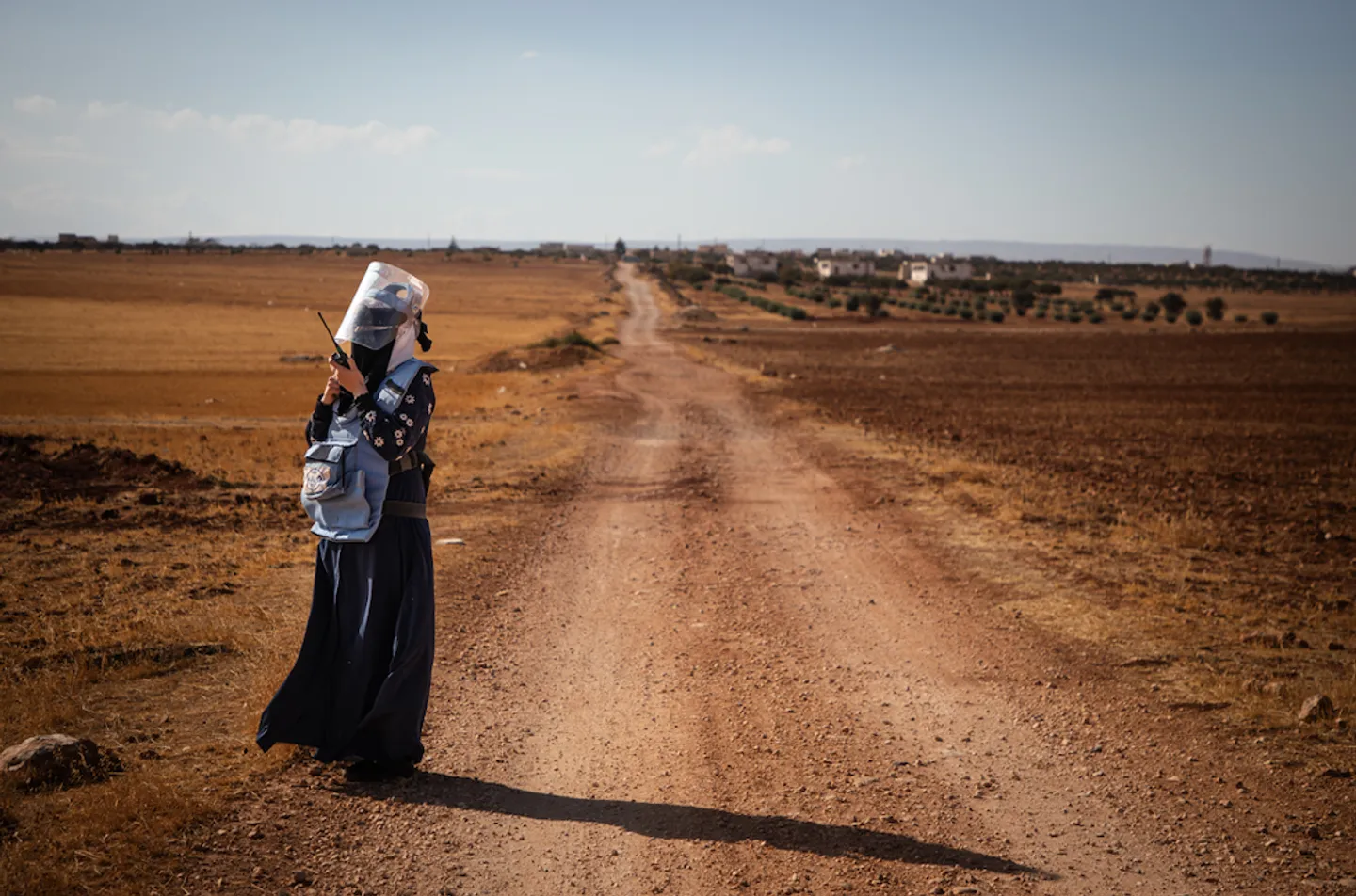
In a dry field in Syria’s Idlib countryside, Lama Haj Kaddour holds a detonator, steady and practised.
She and her all-female team have spent hours locating and safely approaching a buried landmine. A short distance away, the rest of the team waits, still and silent.
When the blast goes off, a column of smoke rises from where the mine had been.
Kaddour wears a protective vest over her clothes. Like her colleagues, she dresses fully in black with only her eyes visible, in line with social norms in Idlib.
Fourteen years of civil war have left Syria littered with landmines and explosive remnants of war (ERW). The threat has followed families back to the villages they fled, even after the end of a conflict that killed hundreds of thousands, displaced millions and devastated the economy.
Kaddour is one of 31 women now working in operational roles in Idlib’s demining effort, according to The HALO Trust, an international NGO involved in Syria’s demining work.
They clear landmines, survey contaminated ground and teach communities how to recognise the dangers left behind by the civil war.
Kaddour, a 33-year-old mother of three, left the Hama countryside for Idlib in 2019. She first worked with relief organisations before joining The HALO Trust.
In a conservative region like Idlib, being a woman can carry a particular advantage in demining work.
“A woman working in this field can enter local households and speak directly with women and children in ways her male colleagues often cannot, giving her direct access to a part of the community that is otherwise hard to reach in a conservative context,” Emma Pomfret, Global Media Manager for The HALO Trust, tells TRT World.
Women remain a minority in demining worldwide.
A 2019 survey of a dozen mine action operators published by the Journal of Conventional Weapons Destruction found that women made up only around 20 percent of mine action staff globally, with clearance roles particularly male-dominated.
According to Pomfret, however, more women are entering the field in Syria.
The fall of the Assad regime in late 2024 removed severe operational restrictions that had constrained HALO’s work, she says, allowing the organisation to expand training and clearance into areas including Daraa and the northwest and recruit from a much larger pool of people.
“When the Assad regime fell in December 2024, HALO opened recruitment and training to women, as we do on all of our programmes globally,” she says.
Supporting landmine survivors
In training hubs such as Daraa, women now make up about 20 percent of new demining trainees — eight out of a recent class of 40, according to Pomfret. As HALO expands beyond 250 staff nationwide, women are increasingly working as manual deminers, team supervisors, paramedics and community educators.
The shift is not only about new opportunities. Some of the women joining HALO were widowed during the war and are now the main breadwinners for their families, Pomfret says.
Kaddour's own path into demining began earlier. She started by supporting landmine survivors before training for fieldwork in 2022 and taking on the work of clearing unexploded ordnance herself.
“I could never live with the idea that a single wrong step by my children could set off a landmine that ends their lives, or takes one of their limbs,” Kaddour tells TRT World.
More than three million displaced people have returned to areas badly damaged by the conflict. Many find their homes still standing, but the roads leading to them contaminated.
Raed al-Hassoun, director of clearance operations at Syria’s National Mine Action Centre, tells TRT World that 49 landmine incidents were recorded across the country between the start of 2026 and the end of August, killing 24 people and injuring 61.
On August 31, an unexploded object detonated in the village of Faydat Ibn Muwaina in the Deir Ezzor countryside as children were handling it. Four children were killed and one was injured, according to SANA.
The Syrian Network for Human Rights (SNHR) says at least 3,799 civilians — including 1,000 children and 377 women — have been killed by landmines and cluster munition remnants across Syria since March 2011, with 329 of those deaths recorded since December 2024.
The highest tolls were recorded in Aleppo, with 814 deaths, followed by Raqqa with 676 and Deir Ezzor with 645. Hama, Daraa and Idlib were also among the worst affected.
According to SNHR, the Assad regime, Russian forces and terror groups have planted landmines across Syrian territory since 2011, often without marking or recording their locations.
Siba Abdul Karim, a 36-year-old mother of two who heads the non-technical survey department at The HALO Trust, says floods and heavy rains can expose or move buried mines and other war remnants.
“The danger isn’t necessarily fixed where the war left it,” she tells TRT World
“Floodwater, like what we saw in late August, can reshape the land and carry buried explosive objects with it, rendering old maps insufficient. Ground that seemed safe yesterday can become a fresh hazard after a flood or landslide.”
Abdul Karim and her colleagues have chosen to confront that danger directly.
The women say years of war have made them less afraid of the risks involved in their work.
“Every morning, I say goodbye to my children before leaving for the field. Every evening, when I walk back through the door, I give thanks that I made it home unharmed,” Abdul Karim tells TRT World.
She recalls once calming a child who had found an explosive device, reassuring him before explaining the danger of what he had found.
Also working in the field is Mariam al Asaad, 26, who is married and has an eight-year-old daughter.
For nearly four years, al Asaad has volunteered with the Syrian Civil Defence, also known as the White Helmets, conducting non-technical surveys and risk education and helping map contaminated areas. In 2022, she received specialised training in survey and munitions classification, becoming one of the first women to join Syria’s ERW teams.
Every morning, al Asaad kisses her daughter goodbye before leaving for the field. When she returns home, she faces the challenge of balancing a dangerous job with motherhood.
“I worry all the time about the balance between my daughter and this job,” she tells TRT World.
For al Asaad, the work is also personal. Her father owned land east of Idlib that was contaminated with landmines the family did not know were there.



In 2017, as fighting around Idlib eased, he returned to tend to the family’s olive grove, taking al Asaad’s younger brother, then nine years old, with him.
“A landmine exploded when my brother threw a stone at the ground. It tore into his left foot,” she says.
With no way of knowing how many more mines lay buried there, the family abandoned the land.
“My father spent his final years watching the trees go wild, and the little fruit that still fell just rotted on the ground,” she says. “We ended up buying olive oil every season, even though we had a grove that used to give us our own.”
Al Asaad believes the grief of losing access to the land took a heavy toll on her father’s health.
Waiting for the land back
In the village of Dadikh in the Idlib countryside, Abu Mohammad al Ali, 62, owns land that was once his family’s sole source of livelihood. The war has turned it into a place he can no longer enter.
He grew olive and fruit trees there, relying on the harvest to support his family, before mines and other war remnants contaminated the land.
“We used to come here at first light, plough, plant, and tend to the trees,” al Ali tells TRT World.
“Today I’m afraid to take a single step onto my own land. The trees we worked so hard to grow have died because we can no longer reach them to water them and care for them.”
According to al Ali, his land was the scene of clashes and aerial bombardment during the war.
Assad regime forces, backed by Russian air support, attempted to advance towards the edges of the village but were unable to take the area from local forces.
His land lay along the front line.
Months of fighting left the land heavily contaminated with mines and other remnants of war, making it inaccessible even after the fighting stopped.
“Fear is part of daily life for my family and everyone in the village,” he says.
He recalls an incident in 2025 when a mine exploded on his land while a child was nearby.
Since then, he has struggled with the thought that land that once fed his family could instead kill a child.
“Farmers in Dadikh live between leaving their land and losing their livelihood, or returning to it with the possibility that the next step could be their last,” he says.
“The hardest part is that when I look at my land, I still see it as it used to be. I see the trees, and I remember the seasons we used to wait for. But today I can't get close to it.”
“We just want the mines removed, and to know the land is safe before we send our children there or go back to farming it ourselves,” he adds.
Alongside clearance efforts, UNICEF and its partners are teaching children and families to recognise mine risks before demining teams can reach contaminated areas.
Fouad Mansour, a project manager at UNICEF, tells TRT World that the agency and its partners reached roughly 850,000 children, parents and caregivers with mine-risk education in 2025 and trained around 400 specialists.
“We use pictures, stories, games and visual material to turn a frightening fact into a behaviour a child can remember: don’t touch the strange object, move away from it, and tell an adult or the relevant authority,” he says.
Mansour says UNICEF works with 38 partners across mine clearance, victim assistance, risk education and advocacy.
It has also supported the development of a national risk-education framework integrated into the curriculum in coordination with Syria’s Ministry of Education.
A national effort to bring order
At the national level, Syria’s National Mine Action Centre is coordinating efforts by international and local organisations.
“We are currently developing the national standards that will govern the work of organisations in this field,” Raed al Hassoun says.
“We are also building a national information management system to collect the data that will underpin a roadmap for addressing landmine and ERW risk according to national priorities.”
Among the centre’s priorities is completing a national non-technical survey to determine the location, type and scale of contamination, amid what al Hassoun describes as limited capacity to address the problem's scale.
“Our own figures are still incomplete,” he says, adding that the national survey under way is intended to close that gap.
Military engineering teams from the Ministry of Defence and dedicated units from the Ministry of Emergency and Disaster Management also take part in clearance operations, he says.
“The reconstruction of Syria’s battered infrastructure depends first and foremost on resolving the mine issue,” al Hassoun says, pointing to the Jobar district of Damascus as an example.
At the request of the Damascus governorate, the centre established an operations room that brought together the HALO Trust, the International Committee of the Red Cross, teams from the Ministry of Emergency and Disaster Management, and Red Crescent non-technical survey teams.
Together, they cleared Jobar’s main and side roads, allowing reconstruction work to begin.
This article is published in collaboration with Egab.