 Yusuf Kamadan
A ship, carrying goods across the Mediterranean thousands of years ago, sank before reaching its destination. Its cargo remained on the seabed, preserving clues to a commercial world that existed long before the rise of the great maritime powers of antiquity.
Now, archaeologists investigating the wreck off Türkiye’s Mediterranean coast believe it could be the world’s oldest known shipwreck dating back to 4,700 years ago, potentially offering a rare glimpse into the beginnings of international seaborne trade.
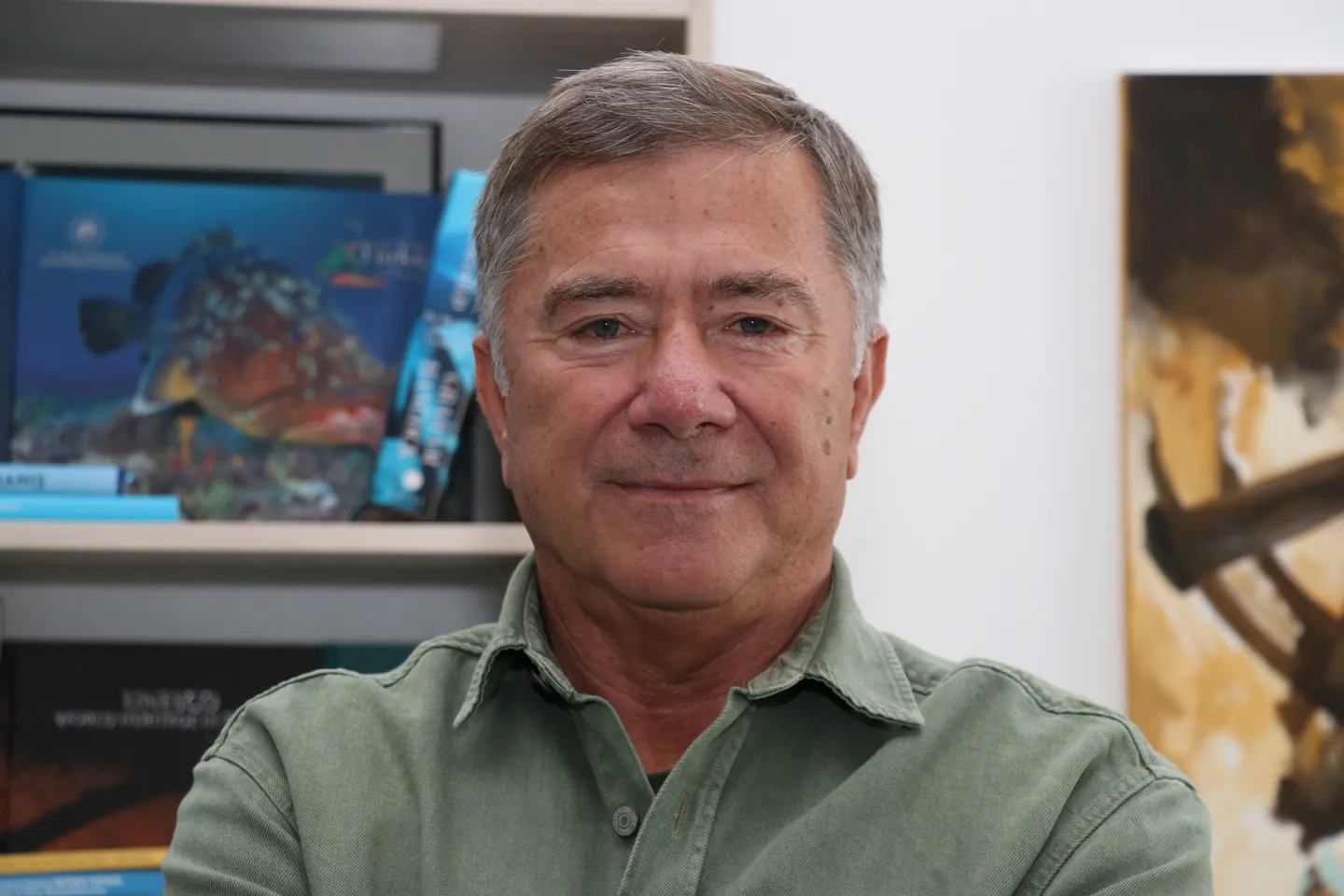
And the man behind the discovery is Professor Hakan Oniz of Akdeniz University, who led the Mediterranean Archaeology Association expedition.
“This is a very important discovery because it gives us direct evidence of maritime trade between the Levant and other parts of the Mediterranean,” Oniz says.
The shipwreck found off the Kekova Island in Antalya has stirred excitement among historians who study ancient civilisations and how they interacted.
It could possibly provide clues about the movement of goods and the commercial relationships that connected ancient coastal settlements that existed around the time the Great Pyramid was being built.
It’s no coincidence that Oniz is at the helm of the find. The oars of fate set him on this trajectory when he was just a child.
A lifelong fascination
For Oniz, the discovery is also the culmination of a lifelong interest in the history hidden beneath the water.
“My story with underwater archaeology began when I was five or six years old,” he said. “My father bought me a large diving mask that covered my entire face.”
Born in Eskisehir, he says he has always spent holidays by the sea.
Even as a child, he was fascinated by the objects he encountered beneath the surface.
“When I found colourful stones and fragments of pottery underwater, and realised that they were things left behind from earlier times, it excited me enormously,” he says.
“I have been interested in underwater archaeology and historical objects beneath the sea ever since.”
That early fascination eventually shaped his academic career. He studied archaeology, completing his master’s degree and doctorate at Selcuk University in Konya.
However, Konya is far from the sea, making it less than ideal for developing a field centred on underwater research.
“Underwater archaeology needed to continue at a university closer to the sea,” Oniz said. “With the support of Munir Karaloglu, who was then president of the Turkish National Commission for UNESCO, we had the opportunity to move the infrastructure we had developed in Konya to Antalya.”
This helped establish underwater archaeology activities at Akdeniz University, where the field had not previously been developed in the same way.
The university’s Department of Mediterranean Underwater Cultural Heritage Research now provides specialised education in underwater archaeology. According to Oniz, it is the only department of its kind in Türkiye, with around 50 students enrolled in the programme.
“This is where Türkiye’s underwater archaeologists are being trained,” he says.
The department’s work also extends beyond education. A laboratory within the university allows artefacts recovered from the sea to be conserved and restored, helping ensure they can be studied and preserved for future generations.
It was conservation efforts like these that have helped researchers estimate the age of the shipwreck found off Kekova Island.
A tale of two shipwrecks
The discovery was not immediately recognised for its significance. When the team first found the wreck around four years ago, the pottery vessels scattered across the seabed appeared to belong to a much later period.
“We initially thought that this might be a more recent shipwreck, perhaps from the Ottoman period,” Oniz says “The amphorae, or clay containers, did not resemble the familiar pointed or rounded types that we know from other shipwrecks. They had flat bases, and vessels of this kind are generally associated with the Ottoman period, particularly the late Ottoman era.”
The team documented the site but did not immediately identify the true age of the cargo. The breakthrough came later, when researchers studying another shipwreck began examining archaeological sources from Egypt.
“Last year, while we were looking at Egyptian sources in connection with another shipwreck, we came across amphorae that looked very similar to those we had found at Kekova,” says Oniz.






The shipwreck found in Egypt is from a similar era, but the one found in Turkiye is believed to be much older.
The researchers obtained permission from Türkiye’s Ministry of Culture and Tourism to revisit the site. Their subsequent examination revealed that the vessels resembled amphorae associated with the Levant during the Early Bronze Age.
“When we returned to the wreck, we saw that the amphorae really were examples of the type found in the Levant,” he said. “They were flat-bottomed vessels with handles on the sides, characteristic of Levantine amphorae.”
The team used comparisons with similar pottery, alongside the vessels’ decoration and clay composition, to estimate their age and possible origins.
“Based on the typology and the decoration on the amphorae, we dated the wreck to between 2700 and 2400 BCE,” Öniz said.
He added that, according to the team’s current assessment, no other known shipwreck had been dated to the same period.
“Of course, another, older wreck might be discovered in a few years, or perhaps in 20 or 30 years. That is always possible. But, as things stand, this is what we know.”
A merchant’s cargo from the Levant
While the ship itself is no longer preserved in its original shape, the recovered objects offer more than an indication of the wreck’s age. Their differences may also reveal how the cargo was assembled before the ship began its voyage.
Although the recovered jars share a broad shape, they are not identical. Their decoration and clay composition vary, suggesting that they may have been produced in different settlements rather than at a single manufacturing centre.
“The amphorae are not exactly the same,” Oniz explains. “Their general typology is similar, but their decoration, patterns and clay differ.”
For the archaeologist, this variation offers a possible glimpse into the activities of the merchant who owned the cargo.
“It is possible that a small-scale trader travelled between different settlements in the Levant, collecting three amphorae from one place and four from another, before loading them onto the ship,” Oniz says.
The vessels may have originated in ports along the coasts of present-day southern Syria, Lebanon and Palestine, with some potentially produced in the Jordan Valley. They may have contained olive oil or wine, while resin was considered a less likely possibility.
The ship was apparently travelling westwards when it sank. Its intended destination remains uncertain, but Oniz suggests it could have been heading towards Troy or Crete, home to the Minoan civilisation.
The discovery is significant because the existence of trade between the Levant, Crete and Troy was already known from artefacts found at archaeological sites across the region. What had been less clear was precisely how some of those goods travelled.
“Until now, we knew about trade between these regions because we had found objects from one area in another,” Oniz said. “But this wreck gives us direct evidence that goods were being transported by sea.”
The long-lost sea road
One of the questions raised by the discovery concerns the relationship between maritime transport and overland trade.
Some theories have suggested that goods moving between the Levant and Troy travelled along a network of routes commonly described as a caravan road. Oniz said such routes may indeed have existed, and the wreck should not be interpreted as evidence that they did not.
“Perhaps there really was such a route,” he says. “Our colleagues believe in its existence, and there is evidence supporting it. That is a separate question.”
The shipwreck, however, demonstrates why the sea could have offered a more efficient alternative for transporting certain types of cargo.
“If you have 30 or 40 amphorae to transport, it is much easier to send them by ship than to carry them overland,” Oniz says.
Around 30 clay and ceramic objects have been identified at the Kekova wreck so far. Further work could provide additional information about the cargo and the scale of the voyage.
For Oniz, the significance lies in the opportunity to move beyond assumptions based solely on objects recovered on land.
“We already knew that there were commercial connections between the Levant and places such as Crete and Troy,” he said. “What this shipwreck shows us is that at least some of that trade took place by sea.”