 Zeynep Conkar
Every year, hundreds of thousands of cruise passengers step off their ships at Galataport and walk within meters of this 16th-century mosque and tomb without a second glance.
Few know they are passing the resting place of Kilic Ali Pasha, one of the most consequential naval commanders in Mediterranean history, a man born in a fishing village on the southern Italian coast, who rose to become Grand Admiral of the Ottoman fleet.
The Islamic-Ottoman social complex, kulliye, he commissioned from the empire's chief architect, Mimar Sinan, sits just off the Tophane shoreline, smaller than Suleymaniye and quieter than the Blue Mosque, easy to walk past without noticing.
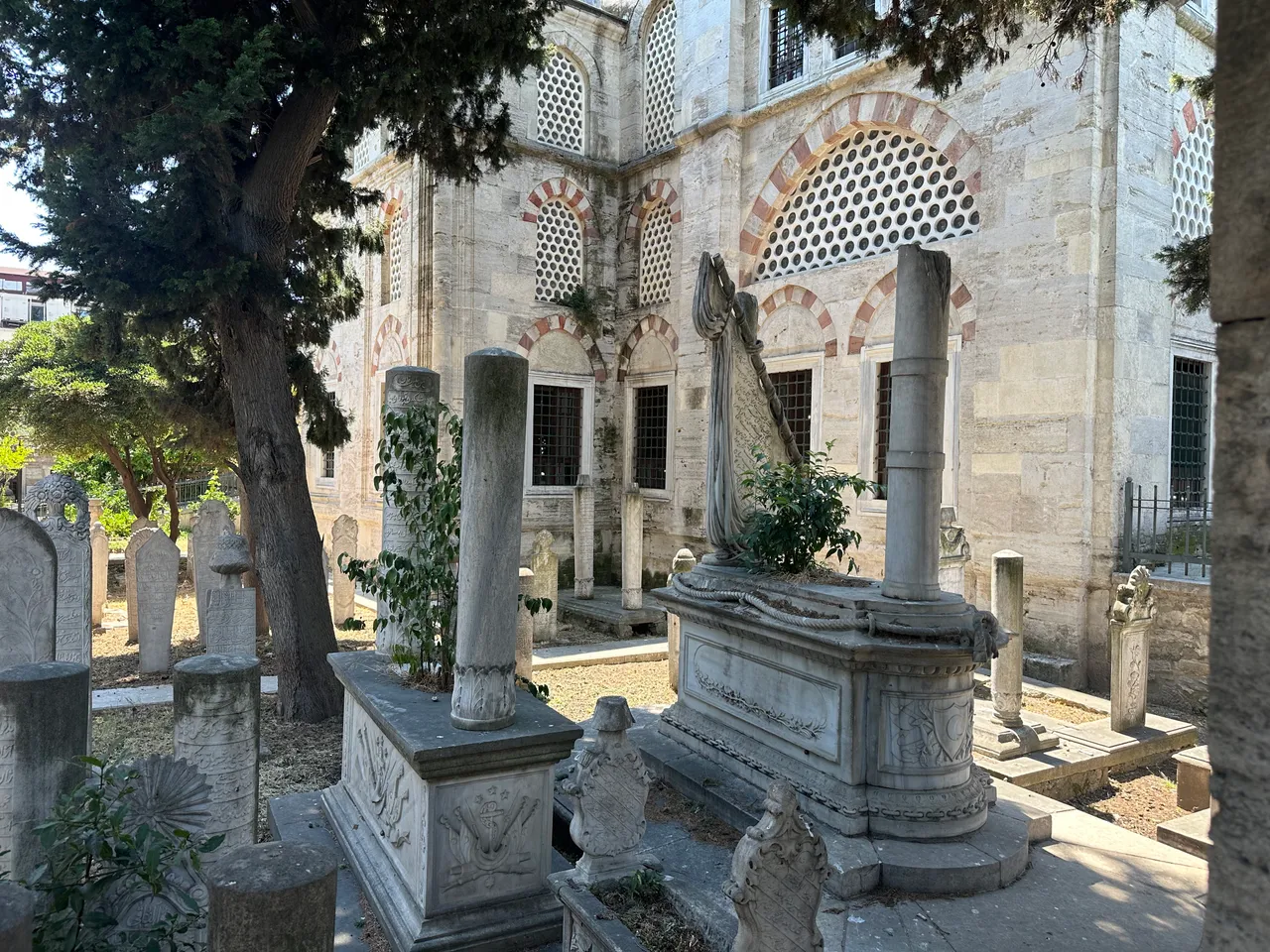
Step into the small graveyard beside the tomb, though, and the sea is everywhere, even in the stone.
Many of the headstones are carved with broken ship masts, torn sails, and coiled rope, marking the graves of great Ottoman naval officers, sailors, and captains buried here alongside the admiral himself.
Together, they turn a walk through the small cemetery into something closer to a maritime museum carved in stone.
According to Yadigar Murat Oruk, the mosque's muezzin, the site has an unlikely origin story.
Towards the end of his life, Kilic Pasha asked the Sultan for land to build a house of worship. But Sultan Murad turned him down, half-joking: "You are the commander of the seas, I won't give you a handspan of land. Go build your mosque in the sea, on the water."
“The Pasha took this as an order. He brought the matter to the great Turkish architect Mimar Sinan; they settled on this location on the Tophane shore; which, at the time, was actually open sea,” Oruk tells TRT World.
“This became the first mosque in history to be built directly on the sea.”
“In the mosque's inscription, Sinan himself writes something to the effect of: ‘I have set this on such a foundation that, Allah willing, even if the waves shake the dome until Judgment Day, nothing will happen to this mosque’ speaking to just how solid its construction is,” Oruk recalls.
Life and legacy of Kilic
Kilic Ali Pasha was born Giovanni Dionigi Galeni, the son of a fisherman in Le Castella in Calabria, a picturesque coastal region in southern Italy.
At seventeen, en route to Naples to study for priesthood, his path changed course when the fleet of Hayreddin Barbarossa, the Ottoman Empire's most famous admiral and then-Kapudan Pasha, took him into a world far from home.
He spent his early years at the oar, but it was there that his talent was noticed.
He converted to Islam, trained under the corsair-admiral Turgut Reis, and rose entirely on merit, earning the epithet ‘Uluc’, a title reserved for successful corsairs of non-Arab origin.
By 1568, he governed Algiers. Three years later, he would make history at sea.
This kind of social mobility, moving from captivity into another kind of life, was only possible in the Ottoman world at that time, according to Vera Costantini, an Italian Ottoman historian and assistant professor at Ca' Foscari University in Venice.
“The economic opportunities within the Ottoman Empire were vast, because it was such a powerful state with such extensive territory….despite starting from the very bottom, it was possible to rise to very high positions,” Costantini says.
“And our Calabrian made full use of these opportunities. So in terms of pattern and experience, he wasn't an exception. But eventually, he became something of an exemplary case in his own right,” she adds.
The battle that made him
On October 7, 1571 at Lepanto, or Inebahti, one of the largest naval battle the Mediterranean had seen ended in a defeat for the Ottoman fleet.
Commanding the left flank, Kilic Ali Pasha outmanoeuvred his Genoese counterpart Giovanni Andrea Doria and seized the flagship of the Knights of Malta along with its banner.
While the rest of the fleet was overwhelmed elsewhere on the line, he alone brought his ships home intact, gathering the fleet's scattered survivors and sailing 87 vessels back to Istanbul.
Sultan Selim II rewarded him with the honorific 'kilic,' meaning 'sword' in Turkish, and named him Kapudan Pasha, meaning 'Captain of the Seas,' the title of the Grand Admiral of the Ottoman navy.
"Lepanto became hugely significant in Christian historiography because Christian powers had generally lost every battle against the Ottomans until then; this was one clear Western victory," Costantini says.
“But actually, it wasn't a lasting loss for the Ottoman state; the empire was the largest state in the world, and within a year it had built an entirely new fleet, a new set of galleys.”
“But Christian Europe developed a strong rhetorical narrative against the Ottoman state, the Battle of Lepanto took on an outsized role,” she adds.





Kilic Ali Pasha then spent the next sixteen years rebuilding the fleet in the aftermath of Lepanto, modelling heavier warships on Venetian designs and retaking Tunis from Spain in 1574.
Pasha was viewed very negatively in Christendom, partly out of jealousy, because this was a man born into extreme poverty who became extremely wealthy and important, according to Costantini.
“In the Venetian Republic, government was reserved entirely for the aristocracy. A poor man could never enter government there, and this wasn't unique to Venice, it was true throughout the West.”
“His home village is an exception to this behaviour, people recognise his legacy and take pride in it, they even built a statue for him, right by the sea in Calabria.”
A hidden jewel of Ottoman Istanbul
As an Ottoman-Islamic kulliye, the complex brings together a mosque, a large madrassa, a hamam, the founder's own tomb, and a cemetery, all built around a shared courtyard.
A water fountain at the corner of the courtyard wall is often listed as part of the complex as well, though some architectural historians believe it was moved here later from a site across the street.
Inside the mosque, the resemblance to a much older, much larger building is hard to miss.
“Our mosque is, in a sense, a smaller reflection of Ayasofya. If you look closely, you'll notice the columns here, the sections around the mihrab, and the domes bear a strong resemblance to Ayasofya,” Oruk says.
“Once visitors step inside, many are mesmerised by its spiritual atmosphere; they can genuinely be captivated by it.”
With Galataport just steps away, the mosque now sees more foot traffic on a single afternoon than it likely did in its first century.
“When tourists come during prayer times, we specifically instruct our security staff to let them in, they're welcome to observe from a designated area where they can comfortably hear the recitation of the Quran, the tesbihat, and the call to prayer, and experience that atmosphere peacefully,” Oruk adds.
The Cervantes question
The detail most likely to catch a Western reader's attention is a literary one: Miguel de Cervantes names him directly in his classic Don Quixote, referring to his rise to power in Algiers under the name "Uchali."
A more romantic version of the story, repeated by tour guides and some popular histories, circulates that Cervantes, captured by Ottoman corsairs in 1575 and held in Algiers, was either personally freed by Kilic Ali Pasha or forced to labour on the construction of the mosque in Istanbul.
The claim isn't settled: Cervantes was ransomed from Algiers by Trinitarian friars around 1580, the same year the mosque in Istanbul was completed, and there is no confirmed record placing him in the city.
Four centuries later, Kılıç Ali Pasha’s tomb and mosque complex sit a short walk from one of the world’s busiest cruise terminals, largely unread.
Among the visitors passing through the complex one recent afternoon were Amalia Asgari and her mother, Sandra Messiaen, visiting from Belgium.
"It's very beautiful, we don't have such things in Belgium," Asgari tells TRT World, admiring the mosque's height and colours.
Neither she nor Messiaen had heard of Kilic Ali Pasha before stopping there.
Told that the Italian-born sailor once commanded the entire Ottoman fleet, Messiaen said she was surprised. "I got surprised too," Asgari added.
“At the entrance, where information about the mosque is provided on a plaque, we specifically included the fact that the Pasha was of Italian origin and later converted to Islam,” Oruk says.
“This detail draws particular interest from tourists; the idea that ‘he was actually one of us’ can be surprising to them, and it catches their attention. Of course, what tends to stay with people most is the architectural beauty of this grand structure,” he adds.
In interviews conducted for this piece, nearly a dozen visitors were approached outside the mosque; almost none could identify Kilic Ali Pasha.
And yet, visitors from a dozen countries moved through its courtyard within the same hour, drawn by its architectural beauty and peaceful atmosphere alone.