 Zulal Sema
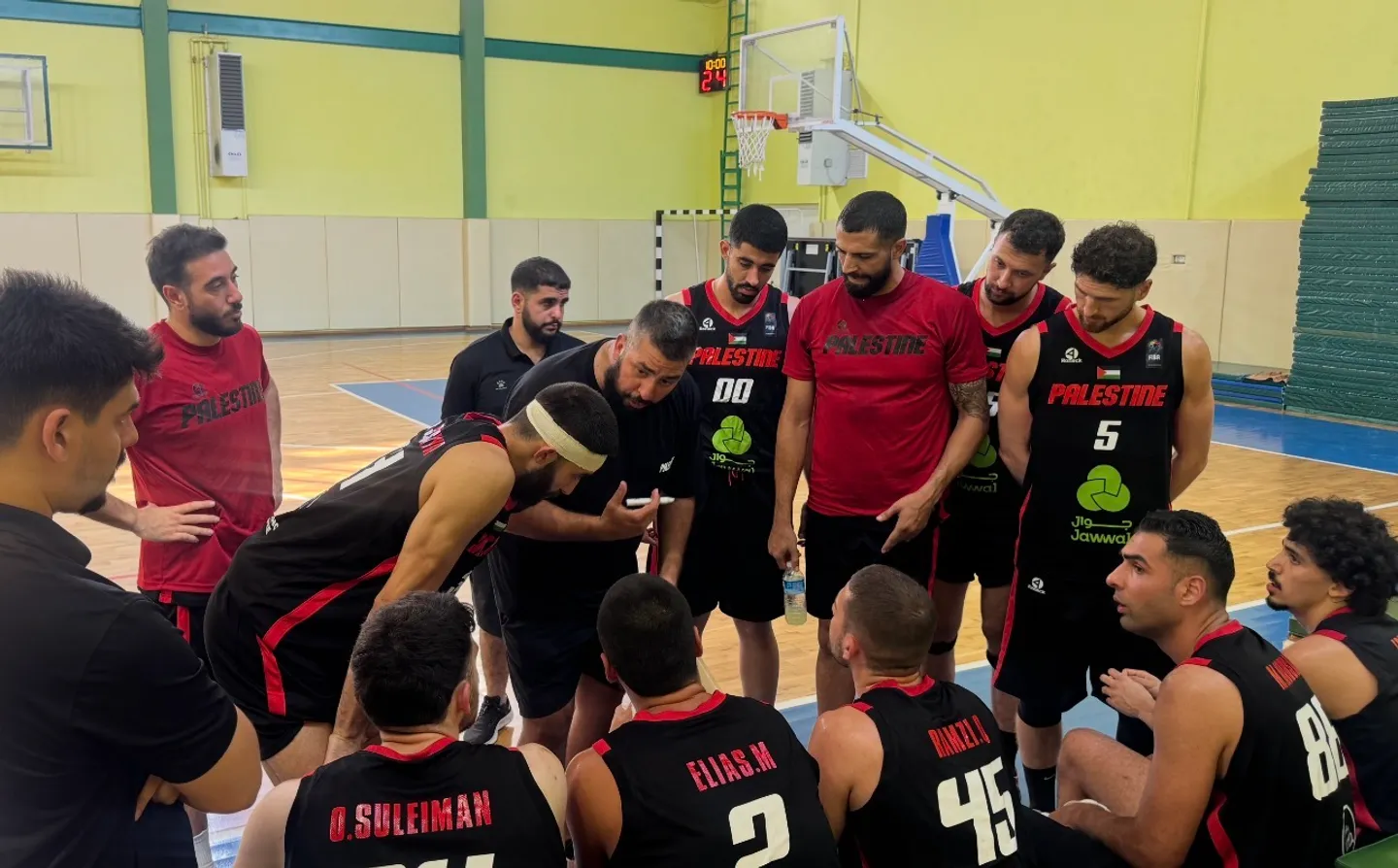
The ball hits the hardwood with a steady thud in an Istanbul sports hall. Shoes squeak, coaches call out instructions, and players move through drills as a single unit.
It looks like an ordinary national team training session. For Palestine's basketball players, however, simply getting everyone onto the same court is an achievement.
The Palestinian national team is based in Ramallah in the occupied West Bank, but its players are scattered across Palestine and several countries abroad. Checkpoints and movement restrictions make assembling the squad inside the occupied territory difficult, while some diaspora players cannot enter at all.
So, ahead of the FIBA Asia Cup 2029 Pre-Qualifiers, the team came together in Istanbul.
Türkiye's Ministry of Youth and Sports, through its Istanbul Provincial Directorate, hosted the camp and provided the team with training facilities. For a squad that spends much of the year separated, Istanbul became both a practical meeting point and a temporary home.
"Some of our players come from Europe, America and Vietnam, while others come from the West Bank," German-Palestinian forward Elias Marei, who wears No. 2 for Palestine, tells TRT World.
"Four years ago, we had players from Gaza, but that is no longer the case."
For those travelling from the occupied West Bank, reaching the team's camp in Türkiye means navigating a journey shaped by checkpoints, border controls and lengthy delays.
Palestine's No. 45 Ramzi Qumsieh made the journey from Bethlehem.
"Our journey was hard. We first go through the Palestinian border, then the Israeli border and then Jordan. From Jordan, we fly to Türkiye. We cannot travel directly from Palestine because of the borders," he tells TRT World.
Some players spent more than 12 hours reaching Jordan before they could continue to Türkiye, according to head coach Harry Savaya.
"My players came from everywhere, including the occupied territories," Savaya tells TRT World. "Travelling here was very difficult, and they faced many problems on the road to Jordan."
The difficulties are not confined to international travel. Even bringing players together for training inside the occupied West Bank can be a logistical exercise.
Before arriving in Istanbul, only seven players had been able to practise together. For some, reaching a training session can take four or five hours.
Journeys between the occupied West Bank cities that would ordinarily take about an hour can stretch to as long as eight because of checkpoints and road closures.
Players sometimes have to leave their jobs and families behind and stay in Ramallah for an entire week simply to train.
That makes the time they have together in Istanbul particularly valuable.
"Türkiye is like our second family," Savaya says.
"The people, the courts and the facilities make this one of the best places for us to be. This camp is very important because it brings the team together, helps us develop chemistry and prepares us for the qualifiers in the short time that we have."
The players trained for up to six hours a day under Savaya and his coaching staff, trying to compress months of preparation into the limited time they had together.
"Some of us have been together for five or six years, while we also have new players and new coaches," Qumsieh says.
"The coach is giving us a really hard time – we are practising for around six hours a day. But the coach is good, the staff is good and everyone is doing everything possible for us."
Their preparations also included an August 17 friendly against Qatar, which Palestine lost 89-72, giving the squad a competitive test before travelling to Kazakhstan.
For Mohammed Mousa, Palestine's No. 88, however, the importance of being together in Istanbul extends beyond preparing for the next game.
"This camp is very important because it brings together the Palestinian players who are in the homeland and the players who have come from the diaspora," he tells TRT World.
"We are preparing and training well. God willing, our hard work will not be wasted."
More than a jersey
For players who spend much of the year separated by borders and occupation, coming together also reinforces what it means to wear the Palestinian jersey.
When Abu Shamsiya pulls on his No. 34 shirt, he sees more than a basketball uniform.
"It carries a much greater meaning. We have lived under occupation since 1948, and we are trying to represent Palestine in the best possible way – not only to the Middle East, but to the whole world," Abu Shamsiya, who has represented the senior national team since 2023, says.
For him, continuing to compete internationally despite the circumstances facing Palestinians carries a message of its own.
"After everything that has happened, we are still standing and we will continue," he says. "Nobody can stop us. I am certain of that, and the whole team is certain of it."
That sense of responsibility extends beyond the players on the court. For a team representing a people scattered by occupation, war and displacement, playing for Palestine also means representing those who cannot be there.
Qumsieh describes the players as "sports ambassadors" for Palestinians at home and those forced into exile.
"We represent Palestine. We represent our people in Gaza, everyone inside the country and everyone outside it who was forced to leave," he says.
"We are the voice of every boy who wants to play basketball and every girl who wants to play basketball."
For Marei, a 24-year-old German-Palestinian professional who plays in Germany's ProB league, basketball offers another way to make Palestine visible internationally – one that is not defined solely by conflict.
"We can show our sport, and we can show our identity to the world," he says. "Sport is a good way to put Palestine on the map."
But Marei is reluctant to portray the players themselves as heroes.
"The real fighters and the real heroes are not us," he says. "They are the Palestinians living in the West Bank, Gaza; the occupied land. We are privileged simply to play basketball and to be able to represent Palestine."
For Mousa, the connection to Gaza is deeply personal.
He left the enclave in 2017, but his family remains there. His brother and brother-in-law have been killed during Israel's war on Gaza, along with many of his friends.
His brother, Firas Khaled Mahmoud Mousa, known as "al-Sharkh", was also a basketball player.
The 26-year-old playmaker had risen through school, university and youth teams before joining Khadamat al-Maghazi's senior side.
He also played for Shabab al-Maghazi and dreamed of reaching the occupied West Bank to compete for its clubs and represent Palestine.
He never got the chance.
Firas was killed on November 4, 2024, after an artillery strike hit the club's premises in the Maghazi refugee camp.
For Mousa, taking the court for Palestine is now also a way of honouring those he has lost.
"My brother was a basketball player with Khadamat al-Maghazi," Mousa says. "This is the least we can offer them – to bring them some happiness. May God have mercy on our dead, heal our wounded and free our prisoners."
Mousa's loss illustrates how deeply the war has reached into Palestinian sport. But even outside Gaza, occupation shapes whether and how Palestinian athletes can train.
Abu Shamsiya says players in the occupied West Bank contend with restrictions on movement, economic hardship and constant concern for their families, while sporting facilities themselves have not been spared.
"It is not only what is happening in Gaza," he says. "Many things are happening in the West Bank as well. Everyone is affected – the players, their families, businesses, the economy and life in general."
He recalls tear gas being fired near a national-team training camp and sports halls being bombed.
"Imagine being in a normal national-team training session and someone fires tear gas at you," Abu Shamsiya says. "You cannot do anything. This actually happened. No one can understand what it is like without living through it."
Qumsieh says conditions in the occupied West Bank cannot be compared with the devastation in Gaza, but even there, training can be disrupted by violence.
"We have courts where we practise, especially in Bethlehem and Beit Sahour," he says.
"But sometimes they fire tear gas, and sometimes there is shooting when things happen. Most of the time we are safer than the people in Gaza."

From Istanbul to Almaty
After completing their preparations in Istanbul, the players left the training court that had briefly brought the scattered squad together and travelled to Almaty, Kazakhstan, for Group B of the FIBA Asia Cup 2029 Pre-Qualifiers.
They began their campaign at Baluan Sholak Sports Palace on August 26 with a commanding 110-69 victory over Kyrgyzstan.
Palestine next faces Sri Lanka on August 27, host nation Kazakhstan on August 28, and the Maldives on August 30.
Twelve teams from the opening stage will progress to the second round, with the top four sides in each second-round group advancing to the main FIBA Asia Cup 2029 Qualifiers.
"We have not qualified for a long time, so our motivation is to win and reach the next round," Qumsieh says.
"We have been training together in Türkiye, and everybody – from the players and coaches to the federation president – is trying to do everything possible. We have no excuses."
For Palestine, however, the campaign's significance goes beyond qualification.
The Istanbul camp offered something the players struggle to find at home: a place where those from the occupied West Bank and the diaspora could simply gather, train and function as one national team.
They arrived there by different routes, after checkpoints, border crossings and flights. Some carried memories of family members killed in Gaza. Others had spent hours travelling between West Bank cities just to attend training.
For a few weeks in Istanbul, those separate journeys converged on the same basketball court.
Then they travelled to Kazakhstan wearing the same jersey.
"We are still standing," Abu Shamsiya tells TRT World. "And we will continue."