 Yusef Jalali
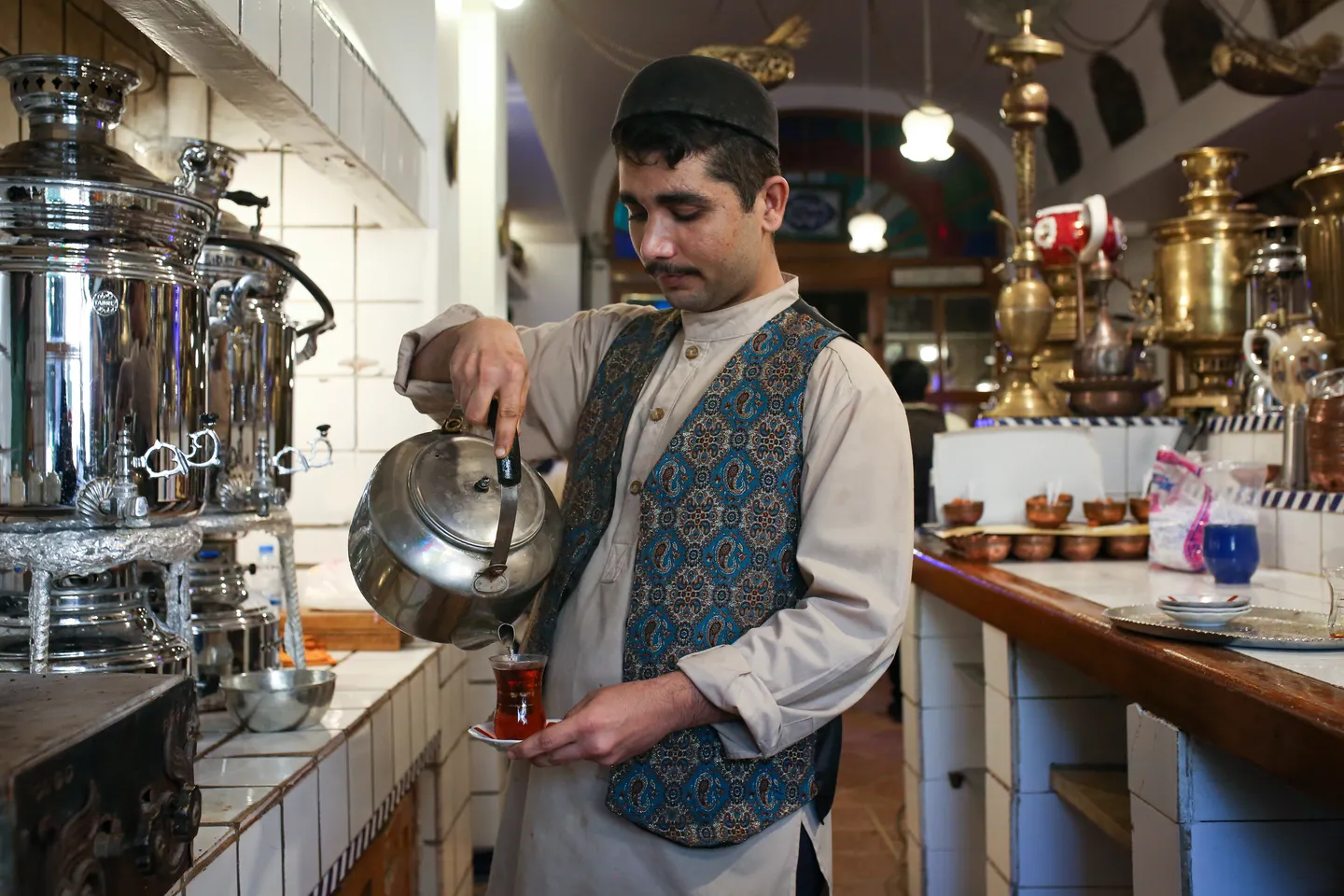
Nothing hits the spot like a hot glass of strong Persian tea after a rich plate of chelow kebab. The steam curls upward from a slim-waisted glass in front of me, its amber colour glowing under the dim lights of one of Tehran’s few surviving traditional tea houses, Azari Teahouse.
Finding this place wasn’t easy. Unlike around two decades ago, teahouses are no longer ubiquitous. Instead, as Persians say, as long as your eyes work, you can see cafes.
For a country known for its 'chai,' this shift is not just striking, it's worrying to teahouse owners like Hadi Azari, who runs Azari Teahouse.
“Once you could see one street with several tea houses,” Azari shares. “People would drop in three times a day to catch up. Now, I feel like I’m curating a museum.”
Azari and his brothers inherited this place from their father. He says his family has been running the tea house for eight decades.
As we talk, a row of brass samovars steam gently behind the counter. Along wooden benches, mostly older men chatter while drinking chai and smoking Ghelyoon - Persian hookah. This scene is typical of Iran’s traditional teahouses, which for decades have served as a rendezvous for friendly gatherings.
Azari teahouse is still a vibrant place, but people come from near and far, unlike in the past, when every neighbourhood had its own teahouse due to high demand.
To keep the business alive, the Azari family expanded the place into a traditional teahouse-restaurant, offering classic Persian meals such as Dizi stew, primarily served at lunchtime.
As I sipped another tea refill, I asked Azari why he wouldn’t include coffee on his menu to adapt to the growing trend of coffee consumption in Iran.
“We cannot break away from tea. It defines our identity,” he explains. “If the few remaining tea houses overhaul and turn to coffee, our culture will extinguish.”
Azari worries that an “unchecked increase” in coffee shops block by block is luring Iranians away from tradition.
Step outside his teahouse, and the change is undeniable. The higher you go into Tehran’s wealthier neighbourhoods, the denser cafes become. Sidewalks are lined with sleek cafes boasting neon signs and minimalist interiors. Instead of steaming samovars, you see espresso machines hissing, and baristas pull perfectly layered lattes instead of brewing black tea.
Breaking from tradition
Fereshteh Street, in upscale Tehran, buzzes with Gen Z hangouts and luxury leisure. I discovered a cozy cafe there, where I sat with Ali Zafari, founder of Iran’s Coffee School and vice chairman of the Tehran Coffee Shop Union. The soft hum of conversation and clinking cups set the perfect backdrop for our chat.
“We cannot ignore a social phenomenon,” Zafari says, gesturing at the packed tables.
Young groups clustered at tables, chatting over lattes under soft lighting that highlights the decor, while the rich aroma of roasted coffee beans fills the air. Nothing looks like what you typically see at teahouses. Even traditional Persian melodies played at teahouses are replaced with Indie music. Every corner seemed ready for a photo or a shared moment online.
The younger generation, Zafari says, is not rejecting tradition outright, but seeking to redefine it. “Young Iranians are tired of spaces that feel restrictive - socially, culturally, or even architecturally.”
This boredom did not appear overnight. Experts say it has been shaped over decades and centuries of male-centric traditions, which are now giving way to more inclusive spaces for women.
“Teahouses often carried a male-dominated atmosphere, where women did not feel comfortable. Cafes, by contrast, offer mixed spaces, music, and modern design. They provide an environment where young people - men and women alike - can study, work, socialise, and feel part of a global culture.”
Beyond cultural factors, economics play a decisive role. Tehran’s unforgiving pace of life, with long commutes, multiple jobs, and side hustles, has made coffee a functional necessity.
“Coffee fits into the modern Iranian’s daily routine, offering a quick pick-me-up during busy days,” Zafari notes. “For those working 12 hours a day or even more, it’s not a luxury anymore; it’s survival fuel.”
Iran's persistent economic crisis, driven by sanctions and an ever-depreciating local currency, has pushed many into juggling two or even three jobs. In such a climate, coffee, with its fast preparation and immediate energy, has become the drink of choice for a generation constantly hustling.
Sneaking into homes


The mesmerising brown drink is no longer confined to cafes. It is making its way into Iranian households. Coffee machines now stand side by side with samovars.
“Ten years ago, you would rarely see an espresso machine at home,” Zafari says. “Today, many families keep one in the kitchen."
What was once an urban luxury is now widely available. Roadside kiosks now serve espresso shots to passing drivers, and fresh coffee can be found even in remote villages, thanks to portable espresso makers that are in high demand.
“Coffee is no longer just a city drink or a fashion. It’s becoming a national habit. People’s taste is changing,” Zafari says.
Official data shows that Iran imported around 50,000 tons of green coffee in 2025 - a 52 percent jump from 33,000 tons in 2020. Per capita consumption is still modest at 600 grams a year, far below Türkiye or Europe, but the upward trend is steep. Projections suggest it could rise by 30 percent by 2028.
Whatever the reason, the growing acceptance of this imported bean has created rising demand and, with it, business opportunities.
The rise of coffee culture has spawned new entrepreneurial models. Mobile coffee vans are everywhere, often packed with customers enjoying a fleeting but quality moment. Book cafes, gaming cafes, and even barber cafes are popping up to attract young patrons.
Zafari says the industry already accounts for nearly a billion dollars in annual turnover in Iran, creating both direct and indirect jobs across the value chain, from importers to roasters, equipment sellers, and trained baristas.
“This has fuelled not just imports but also local roasting houses and emerging Iranian coffee brands, which are now eyeing regional and international markets,” he adds.
Tea: a timeless tradition
Despite the rise of coffee, tea still reigns as Iran’s drink of choice, though ironically, coffee once came first.
Pilgrims returning from Mecca introduced it during the Safavid era in the 16th century. Despite its bitter taste, coffee quickly became a heartbeat, valued for its energising qualities and the social gatherings it inspired.
By the late 19th century, however, tea began to eclipse coffee. Under the Qajar dynasty, imports from China flowed along the Silk Road.
More importantly, Iranians discovered tea could actually be cultivated in the humid, fertile slopes of the country’s northern provinces. This made it cheap, accessible, and perfectly suited for daily life.
Within a generation, tea became Iran’s drink of hospitality - the staple offered in every home, and the lifeblood of teahouses across the country.
“Tea has been with us for a lifetime,” says Azari, the teahouse owner. “It is what people drink when they celebrate, when they mourn, when they come together.”
So it was tea that first took over coffee's space. Many still call teahouses by their older name, 'coffeehouses.'
Today, coffee is making a comeback to reclaim its old foothold, but in modern, more diverse forms, appealing to a generation craving global vibes and open spaces.
“If teahouses innovate with menus, designs, and open spaces, they’ll draw the new generation,” he says. "Coffee is growing, but tea will always hold its central place as a national, locally cultivated plant. The key is to strengthen both, so tradition and modernity can coexist.”