 Baba Umar
Washington DC — For weeks, the Syrians in America had been planning a welcome worthy of a historic moment.
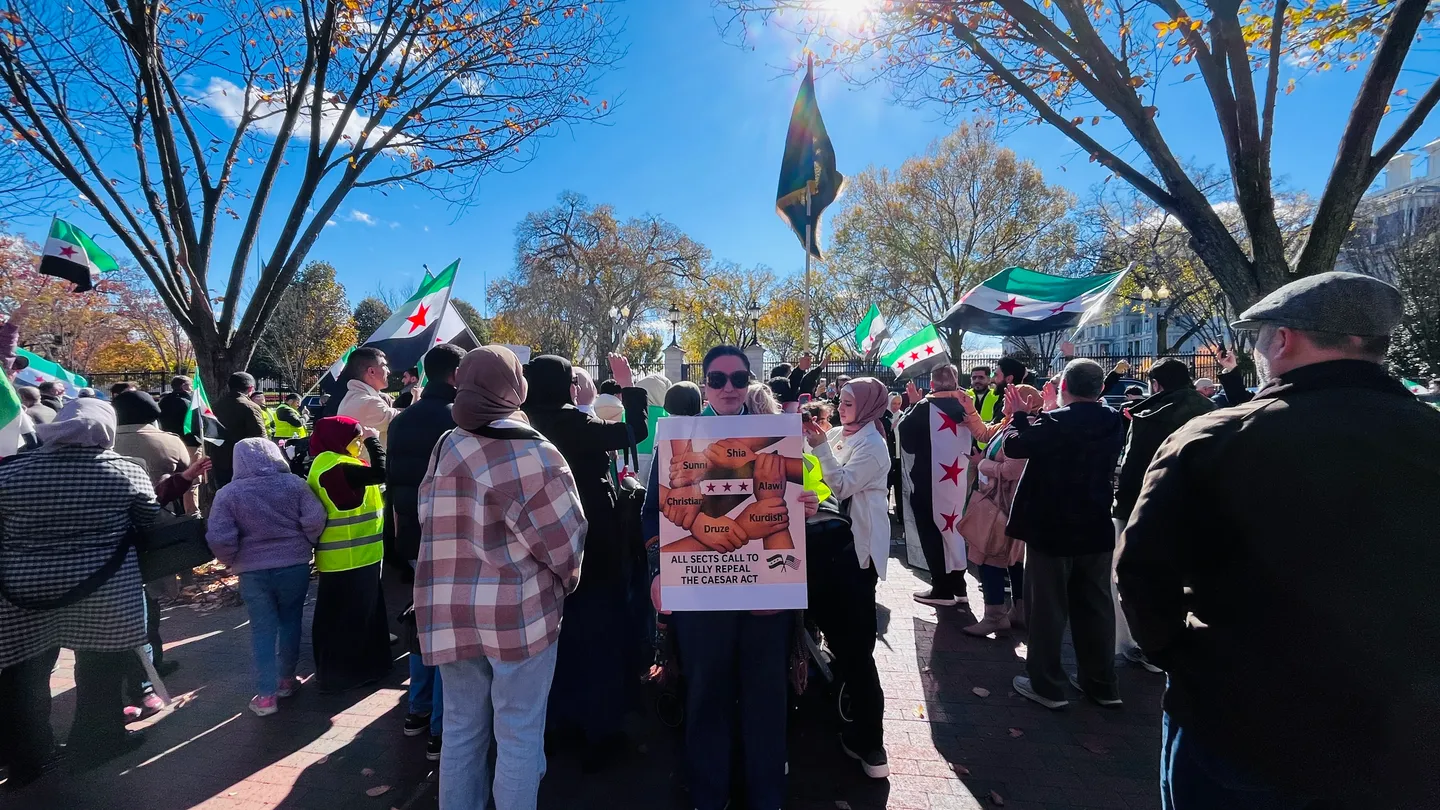
And on Monday, as Ahmed al Sharaa became the first Syrian President to visit the White House since the country's 1946 independence from France, their celebration erupted outside one of the world's most important residences.
The jubilant crowd waved flags, sang victory songs, and performed the Levantine dabke to celebrate what they called a "significant moment" for the Arab country devastated by around 14 years of civil war.
"This is the first time a Syrian president is received officially in a full capacity in the White House. That in itself is an accomplishment," Hussein Assaf, a Syrian businessman who came all the way from South Carolina, tells TRT World, adding, "We want to tell the world we are behind him [President al Sharaa]."
Assaf stated that years of struggle against Bashar al Assad's regime "finally enabled us to produce a president that is one of us."
"He represents us, and we want him to know that he has our support and our confidence."
Al Sharaa met with US President Donald Trump in a private White House meeting, inaccessible to the media.
However, hundreds of cheering Syrians, who waved placards and giant Syrian flags, managed to catch a glimpse of their leader as he left the White House.
The meeting between the two leaders yielded a significant immediate result: the US announced a 180-day suspension of the stringent Caesar Act sanctions on Syria.
The sanctions, imposed in 2019 against the former Assad regime, have severely constrained the country's economy.
While the Trump administration earlier this year issued an executive order to lift sanctions on Syria, the US Congress must vote to repeal what the Syrians are calling an "unfair" Act. The US sanctions on Syria began in the 1970s, and more were applied in 2004 and in 2011.
'Remove all the sanctions'
For many in the crowd, the suspension is a first step, but not the end goal.
"Syrians can rebuild the country from the bottom up, but it is really important for the United States to repeal and remove all the sanctions," says Noura Soufan, a businesswoman and activist, who came from Maryland to see the Syrian President.
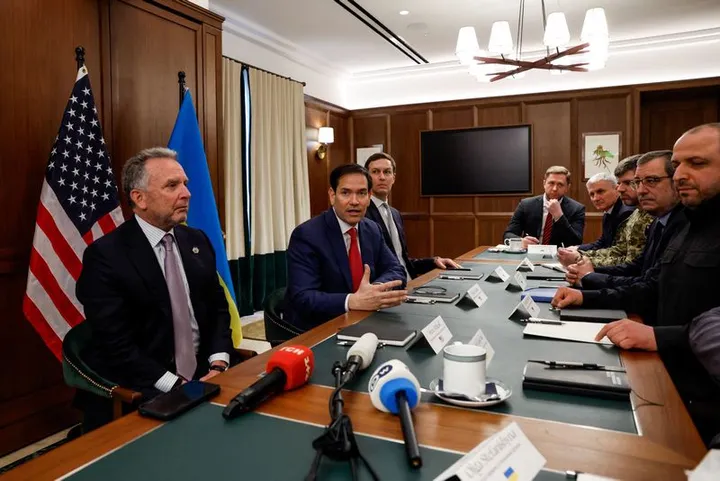


Since ousting the Assad regime last December, Sharaa has made a series of foreign trips as his transitional government seeks to re-establish Syria's ties with global powers that had abandoned Damascus due to Baath regime.
President al Sharaa, who leads a transitional government that toppled the Assad regime last December, has been seeking international funds for reconstruction. He estimates the cost of rebuilding the war-ravaged nation at between $600 and $900 billion. The World Bank has estimated a need of over $200 billion.
He's also been seeking US funds for his nation, which faces major rebuilding challenges after a devastating war that has caused half a million deaths and displaced millions.
Ramy Arwani, a Syrian physician from Michigan, expresses the community's hope.
"We've been celebrating freedom for the past 11 months after 60 years of tyranny. So, we're very hopeful that this meeting with President Trump today will bring a lot of good things to Syria," Arwani tells TRT World.
"We're hoping for the lifting of all US sanctions on Syria," he says, noting that Syrian-Americans and global investors are eager to assist in reconstruction once the financial barriers are removed.
'I'm going to Damascus'
On Sunday, President Al Shaara met with members of the Syrian community in Washington, DC.
"The many achievements that were made during this period, both internally and externally, demonstrate the determination of the state and its people to move forward in rebuilding and overcoming challenges," Sharaa told the meeting, which was also attended by the Syrian Foreign Minister Asaad al-Shaibani and US Special Envoy Tom Barrack.
Al Sharaa stressed Syrians' connection to their homeland and their role in conveying Syria's true image and defending its causes.
For Syrian-Americans like Soufan, the new president's message of national unity has replaced initial apprehension with confidence.
"He has been saying, 'We are not a sect. We are one union,’" Soufan says, noting that his strong, confident speeches convinced her of his plan for the country.
Inspired by the newfound peace under his administration, she now plans to return to a homeland she left in 1996, along with her 25-year-old daughter, who has never been to Syria.
"I'm going to Damascus," she says.