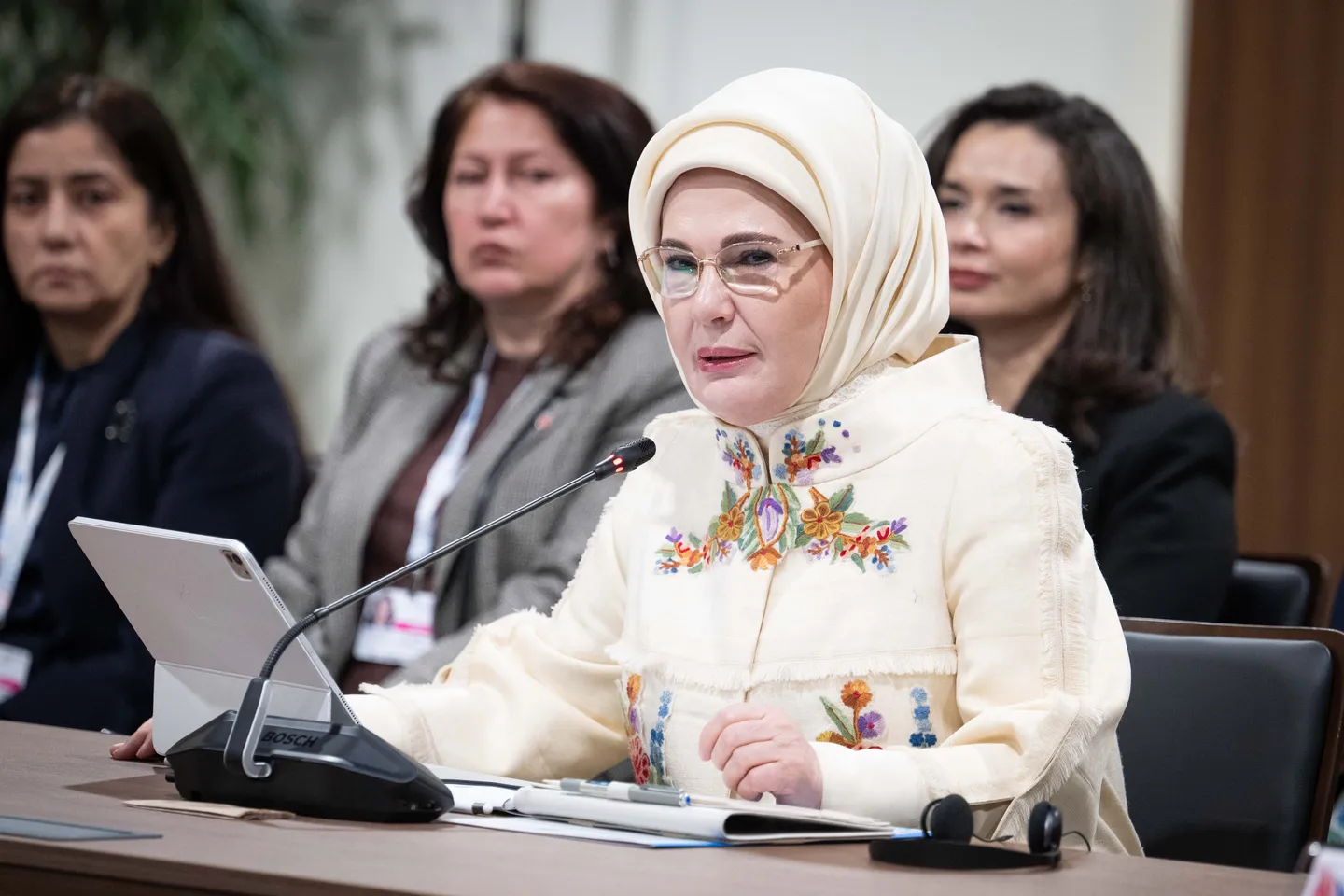
Türkiye’s first lady Emine Erdogan has launched the Global Zero Waste Alliance at COP31, calling for stronger international cooperation to turn shared environmental responsibilities into lasting partnerships and practical action.
Speaking at a high-level meeting of leaders’ spouses hosted by her in Antalya on the sidelines of the UN climate summit on Wednesday, Erdogan said the initiative would provide a platform for countries to exchange successful practices, develop joint projects and expand local solutions globally.
She said the alliance reflected a shared determination to move beyond commitments and translate environmental awareness into tangible results.
“Today, the Global Zero Waste Alliance we are introducing is an expression of our determination to turn this shared responsibility into lasting cooperation,” she said.
Erdogan, who chairs the UN Secretary-General’s Advisory Board of Eminent Persons on Zero Waste, stressed that the world must move beyond discussing climate threats and focus on implementing solutions.
“Now is the time to move beyond reports, warnings and targets that highlight the scale of the climate crisis,” she said, adding that the value of knowledge should also be measured by the decisions and actions it inspires.
She described COP31 as an “Action COP”, saying Türkiye wanted success to be measured not only by pledges but also by the changes they bring to people’s lives, cities and production systems.
Highlighting Türkiye’s Zero Waste Movement, launched nine years ago, Erdogan said the initiative had evolved from raising awareness in households into a nationwide system involving schools, municipalities, public institutions and factories.
She noted that Türkiye’s waste recovery rate had risen from 13 percent to more than 37 percent during this period, while environmental responsibility had become increasingly embedded in everyday life.
Waste prevention must come before recycling
Erdogan said one of the most important lessons from Türkiye’s experience was that waste began with decisions rather than at the rubbish bin.
She argued that the best way to tackle waste was to prevent it from being generated in the first place, rather than relying solely on recycling.
“ We must measure our success not only by the waste we recover but also by the waste we prevent from being generated,” she said, adding that achieving a higher quality of life with fewer resources should be central to development strategies.
She also called for greater scrutiny of global production and consumption patterns, pointing to the environmental costs of industries ranging from tobacco and textiles to digital technology.
Citing World Health Organization figures, Erdogan said the tobacco industry was responsible for the loss of 600 million trees and the consumption of 22 billion tonnes of water annually.
She also highlighted the fashion and textile industry’s estimated 92 million tonnes of waste each year, arguing that the increasingly short lifespan of products could not be attributed solely to consumer choices.
Erdogan said digital business models designed to keep people online for longer should also prompt questions about the energy and water demands of the infrastructure supporting them.

Call for greater corporate accountability
Turning to technological developments, Erdogan said artificial intelligence offered significant opportunities to reduce waste, improve production efficiency and develop solutions to environmental challenges.
However, she cautioned that technological progress should not be separated from its environmental costs.
“We cannot build the technologies of the future on the wasteful habits of the past,” she said.
She called for common international standards to ensure that major companies disclose their resource consumption, subject their environmental impact to independent assessment and strengthen accountability.
“The responsibility of companies operating on a global scale must also be global,” she added.
Erdogan also highlighted the devastating environmental consequences of armed conflicts, saying wars inflicted damage on nature that could last for generations.
Pointing to Gaza, she cited UN Environment Programme estimates that 61 million tonnes of rubble had accumulated across the Palestinian territory, while 97 percent of its orchards and olive groves had been destroyed and most remaining freshwater resources contaminated.
She warned that recovery from such destruction could take generations.
Against the backdrop of global military spending reaching a record $2.9 trillion, Erdogan urged the international community to consider what could be achieved if even a fraction of those resources were redirected towards shared humanitarian and environmental challenges.
“Cities could be rebuilt, degraded landscapes restored, and peace could become the climate of every continent,” she said.
Five priority areas for the alliance
Erdogan said the Global Zero Waste Alliance would focus on five priority areas: zero waste and the circular economy; plastic and packaging waste; zero-waste zones; food and organic waste; and education and youth.
The initiative will also work through three complementary structures, including an annual Zero Waste Forum to discuss shared priorities and solutions, alongside the Istanbul Platform to help turn proposals into concrete projects and partnerships.
The alliance, she said, would seek to bring together international organisations, local authorities, academia, the private sector and civil society around common objectives.
Emphasising that no country could tackle environmental challenges alone, Erdogan invited leaders’ spouses attending the meeting to become active partners in the initiative and share successful practices from their own countries.
She said the gathering should pave the way for new partnerships, joint projects and measurable progress, urging participants to return home with a commitment to continue working together.
The meeting brought together the spouses of several world leaders, including Brazil’s Janja Lula da Silva, Uzbekistan’s Ziroat Mirziyoyeva, Micronesia’s Ancelly Simina, Maldives’ Sajidha Mohamed and Mozambique’s Gueta Selemane Chapo.
Also attending were Nilden Bektas Erhurman, wife of the Turkish Republic of Northern Cyprus president, Francine Ntakarutimana of Burundi, Bangladesh Prime Minister’s wife Zubaida Rahman and Zainab Suleman, daughter-in-law of Pakistan’s prime minister.
UN Development Programme chief Alexander De Croo and UN-Habitat Executive Director Anacláudia Rossbach also addressed the gathering.