 Omer Abdulaziz Ozturk
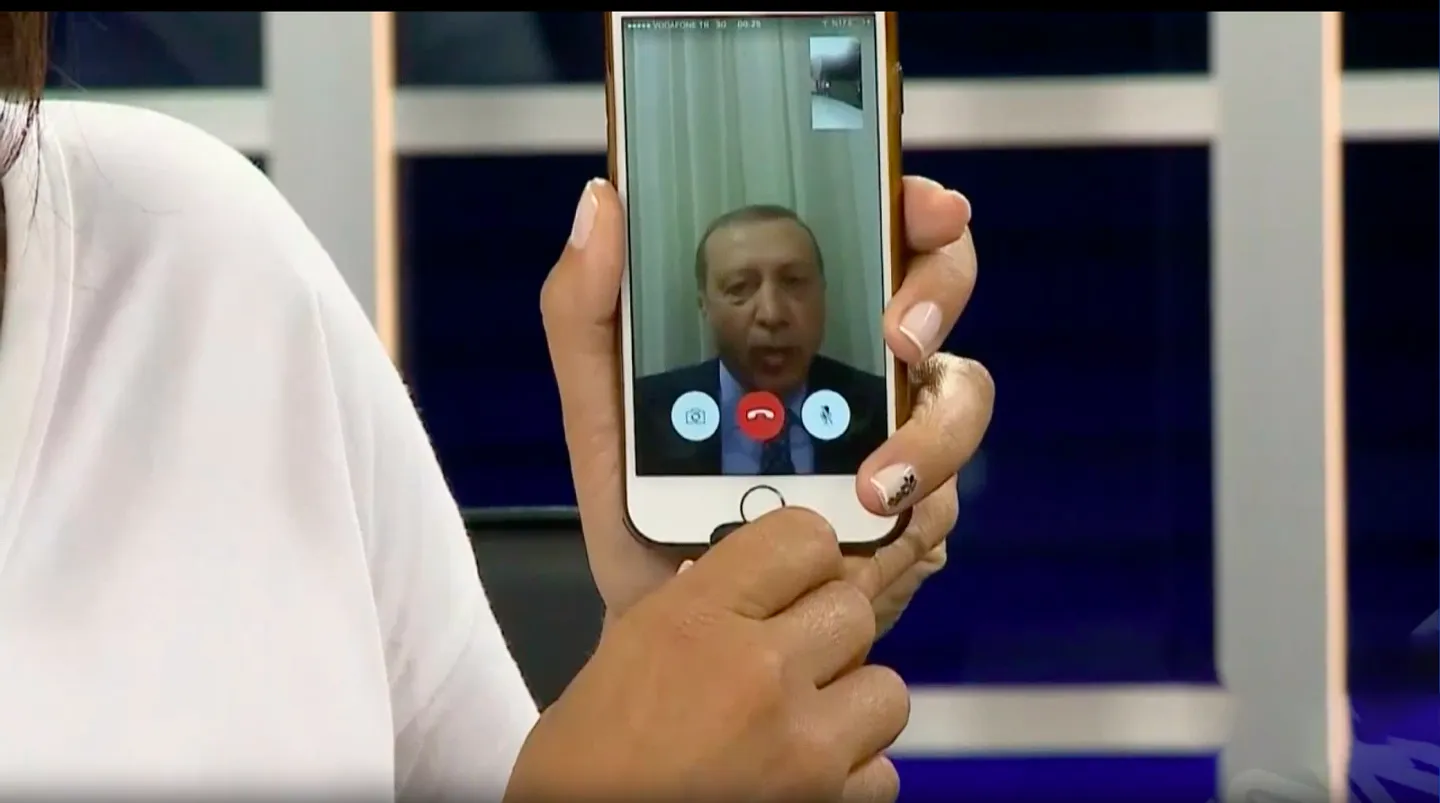
A phone held up to a television camera became one of the defining images of Türkiye's defeated July 15, 2016 coup attempt, when a rogue faction within the Turkish military loyal to the Fetullah Terrorist Organization (FETO) attempted to overthrow the democratically-elected government.
President Recep Tayyip Erdogan, his face visible on CNN Turk via FaceTime, urged citizens to take to the streets and resist the attempted military putsch.
It was neither a speech delivered from a podium nor a statement issued through the ordinary rituals of state.
It was improvised, intimate and unmistakably contemporary: a head of state addressing the country through the same device people used to call family members, follow breaking news and make sense of a terrifying night.
The significance of that moment was not merely technological. It was political, cultural and sociological.
At a time when the putschists sought to create the impression that events were already decided, the FaceTime interview disrupted the illusion of inevitability.
It made clear that the elected leadership was still speaking, that the public was still being addressed, and that the outcome of the night had not yet been decided.
That visibility mattered. Coup attempts depend not only on force but also on perception.
They try to persuade citizens, institutions and security actors that resistance is futile, that authority has already moved elsewhere, and that the safest response is silence.
President Erdogan's appearance challenged that perception in real time.
The image was modest in form but immense in effect: a small screen became a national signal that ordinary politics had not succumbed to coercion.
The attempted coup was shaped by an older logic of power. Tanks moved onto bridges, and soldiers tried to seize airports, streets and television studios.
The putschists understood, as coup plotters have long believed, that controlling the visible symbols of authority is important.
In the twentieth century, seizing a broadcaster could help create the impression that the state itself had changed hands.
But in 2016, Türkiye was no longer living in that media environment. The public sphere did not flow from a single studio, a single transmitter or a single official announcement.
It lived across millions of phones, timelines, messages, live streams and family groups. The attempted coup confronted not only political resistance but also a transformed civic culture.
This is why the FaceTime call should be read as more than a dramatic media event. It served as a hinge between broadcast media and networked civic action.
International media gave the call national visibility, but the message immediately spread through social media, messaging apps, phone calls and face-to-face networks.
What began as an image on television became a catalyst for action.
From digital networks to civic action
Social movement theory helps us avoid a superficial reading of that night. Social media did not "cause" the mobilisation.
It accelerated three elements that collective action requires in moments of crisis: a shared interpretation of what is happening, visible channels for mobilisation, and the confidence that others are also acting.
American sociologist and political scientist Charles Tilly taught us to pay attention to the changing repertoires through which people make collective claims.
On July 15 a decade ago, Türkiye's repertoire of civic action included not only gathering in squares and standing before tanks but also live-streaming, sharing locations, amplifying calls, recording events, and repurposing personal devices for public coordination.
The square did not disappear; it expanded.
Nor was this merely a story about platforms. The work of Alev Erkilet, a professor of sociology at Ibn Haldun University whose research spans urban studies and civic life, helps explain why the digital layer cannot be understood in isolation from Türkiye's moral communities, civic networks and forms of public belonging.
Twitter, Facebook, Periscope and messaging apps mattered because they connected to existing bonds of trust, responsibility and shared identity. Families called one another.
Neighbours warned one another. Mosques issued announcements. Television channels continued broadcasting. Political leaders and ordinary citizens amplified calls for resistance.
Digital networks and social networks worked together.
Carl Schmitt, the German jurist and political theorist, famously argued that sovereignty is tied to the power to decide on the exception.
A coup attempt is, in one sense, an effort to seize the exception itself: to suspend ordinary politics and impose a new reality by force.
On July 15, the public response refused to allow coercive power to become the sole author of political reality. Citizens did not merely receive information.
They interpreted the moment, acted on it and helped define what the crisis meant.
That interpretive struggle was crucial. The night could have been framed merely as a security emergency against the state, in which citizens should stay home and wait.


Instead, it came to be seen as an attack on democracy itself, one that ordinary citizens had a responsibility to resist.

President Erdogan’s FaceTime appearance was the key moment that shaped that understanding.
It gave a dispersed public a clear message at a moment of uncertainty: the crisis required not passive observation but civic action.
One person's video became another person's confirmation. One call to gather became a chain of mobilisation.
One image of resistance moved faster than the attempt to impose silence.
The importance of FaceTime, then, was not simply that it allowed President Erdogan to speak.
It was that the call entered a wider ecology of communication in which citizens could hear, repeat, verify, forward, and act.
Of course, the same instantaneity that made mobilisation possible also caused confusion.
Rumours spread. Contradictory reports circulated. Genuine footage appeared alongside unverified claims.
Any honest reflection on July 15 must hold both truths at once: digital platforms can generate extraordinary civic energy and serious information disorder, sometimes in the same feed and within the same hour.
But the decisive fact remains that online mobilisation returned to the streets.
The act that mattered most was not posting, but showing up: on bridges, in squares, outside airports, and in front of municipal buildings and media outlets.
Social media did not replace courage. It made courage visible, contagious and coordinated.
The making of a digital civic memory
A decade later, July 15 has also become part of Türkiye's digital collective memory.
Each anniversary brings archival footage back into circulation: phone videos, live broadcasts, screenshots, testimonies and hashtags.
The FaceTime image returns with particular force because it captures the night's broader meaning in miniature: a moment when political authority, public communication and civilian agency passed through a screen and moved back into the streets.
Some of this remembrance is organised through official commemoration, but much of it is also carried by ordinary users who repost what they saw, where they were, whom they lost, and what they remember.
This is collective memory doing the work that monuments, ceremonies and textbooks once did largely on their own.
The memory of July 15 now lives not only in public squares and official speeches but also in archived videos, family chats, old tweets, and images that reappear each year on the national timeline.
For many people, the memory of that night is inseparable from the devices on which they experienced it: the first alert, the first video, the first call from a relative, and the first live broadcast that made the danger feel real.
That cultural afterlife may be one of July 15's most enduring legacies. Platforms rise, decline, rebrand, and disappear.
But the civic habit revealed that night has endured: when faced with a national crisis, citizens turn to whatever channels are available to organise, document, interpret and remember.
This is also where July 15 speaks to contemporary debates about digital sovereignty.
The phrase is often used in technical or geopolitical terms: infrastructure, data, regulation, platforms and national capacity. Those questions matter.
But July 15 points to another dimension. Digital sovereignty is also about whether a society can preserve its public voice when coercive power seeks to monopolise the public sphere.
The answer that night did not come from technology alone. It came from the interaction among tools and people, screens and streets, and political leadership and civilian agency.
Türkiye did not simply go online on July 15. It used the online sphere as a route back into public life.
That is why the digital memory of July 15 remains so powerful.
It is remembered not only as a night of tanks and aircraft, but also as a night of phones held up in living rooms, of videos shared in panic, of messages sent to loved ones, and of citizens discovering, in real time, that they were not alone.
The attempted coup sought to undermine the democratic will by controlling space, instilling fear, and manipulating communication.
The public response showed that, in the digital age, civic life is harder to silence than it once was.
The square had expanded. It was in the streets, yes, but also in every hand that held a screen, every message that urged courage, and every citizen who turned information into action.