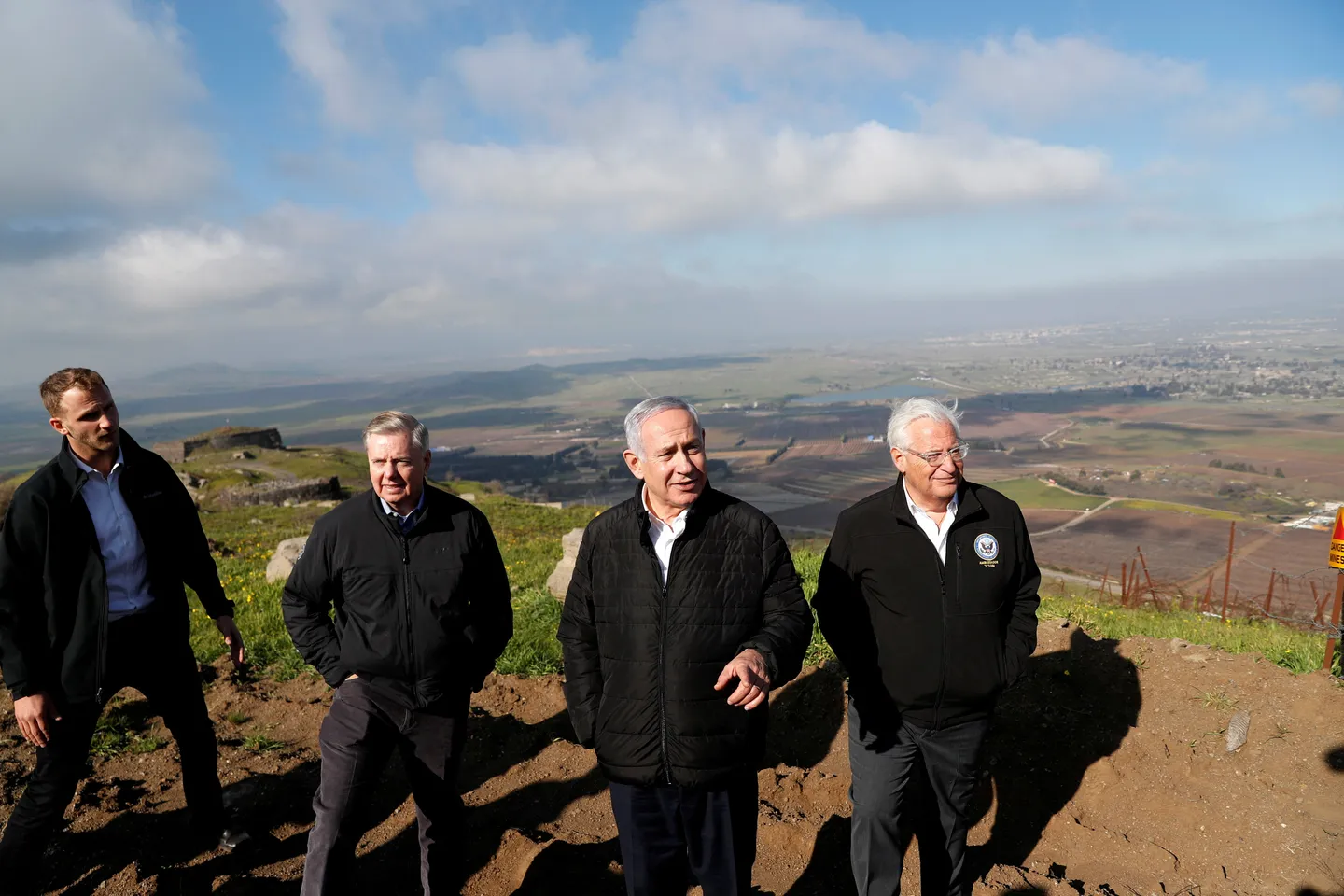
New recordings reported by The New York Times this week show Israeli Prime Minister Benjamin Netanyahu and the late US Senator Lindsey Graham privately coordinating a bipartisan group of lawmakers to denounce the International Criminal Court (ICC) just days before the 2024 US election.
The footage, part of roughly 400 hours filmed by British documentary maker Alex Holder for a planned project on Graham, captured two calls on October 29, 2024, weeks before ICC judges issued arrest warrants for Netanyahu and former defence minister Yoav Gallant.
Khan was removed from his post last week in a vote by ICC member states, a decision UN special rapporteur Francesca Albanese said lined up "neatly" with efforts to neutralise Netanyahu's warrant.
Israel has a documented history of pressuring, lobbying and undermining international bodies when their findings threaten its political or legal standing. Here are five examples.
1. The ICC and Karim Khan's removal
In the October calls, Netanyahu told Graham that a three-judge panel was close to a decision on his arrest warrant, and suggested that misconduct allegations then swirling around Khan could help delay it.
He proposed a letter from senators demanding a review before any warrant was issued, and asked Graham to secure Democratic signatures.
Graham delivered two, Richard Blumenthal and Ben Cardin, and the letter went out on 1 November.
It did not stop the warrants, issued three weeks later. Khan was cleared of wrongdoing by an ICC judicial panel in March 2026, but a bureau of member states voted to disregard that finding and removed him anyway.
Israeli Foreign Minister Gideon Saar reportedly set up a task force to lobby member states ahead of the vote.

2. The Goldstone Report retraction
The 2009 UN fact-finding mission led by South African jurist Richard Goldstone found that there is evidence indicating serious violations of international human rights and humanitarian law were committed by Israel, and that Israel committed actions amounting to war crimes, and possibly crimes against humanity during the 2008-09 Gaza war.
Goldstone faced sustained personal pressure, including an attempt by the South African Zionist Federation to bar him from his own grandson's bar mitzvah.
In April 2011, he published a Washington Post op-ed partially softening the report's conclusions.





His three co-authors refused to join the retraction, citing what they called extraordinary pressure on the commission.
The US Senate then passed a resolution calling on the UN Human Rights Council to rescind the report entirely.

3. Repeal of the ‘Zionism is racism’ resolution
The UN General Assembly declared Zionism a form of racism in 1975 under Resolution 3379.
Israel and Jewish organisations lobbied for over a decade to overturn it.
The reversal came in December 1991, after Washington made Israel's participation in the Madrid peace conference conditional on the resolution's repeal, according to research on the episode.
The United States made more than a hundred diplomatic demarches to foreign capitals in a single year to build support for the reversal.
4. UNESCO funding fight
When UNESCO admitted Palestine as a full member in 2011, a decades-old US law triggered an automatic cutoff of American funding to the agency, a law originally passed under pressure from pro-Israel lobbying to penalise any UN body that recognised Palestinian statehood.
The funding freeze weakened UNESCO for years and was cited by Washington as a factor in its eventual withdrawal from the organisation in 2018.
5. The UNRWA defunding campaign
Israel launched a disinformation campaign against UNRWA in January 2024, alleging that a number of the agency's staff took part in the October 7 attack.
More than a dozen donor countries suspended funding within days, before any independent verification of the claims. A UN review led by Catherine Colonna found that Israel had not provided evidence to support the allegations against the large majority of the staff named.
The Israeli campaign against the UN body predated the war: Israeli officials had pushed for years to dismantle the agency and transfer its mandate elsewhere, and the October 2023 war provided the pretext to escalate that effort.