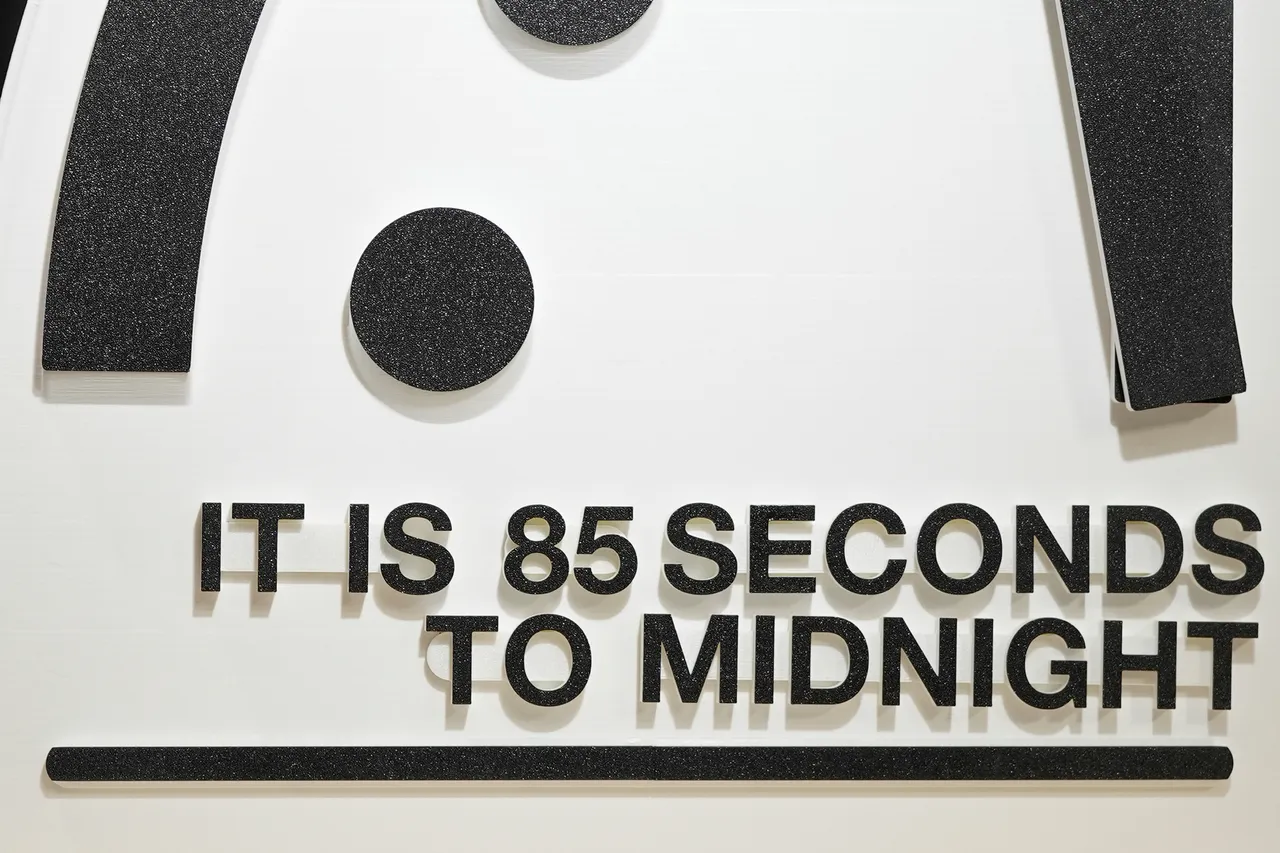
The "Doomsday Clock" representing how near humanity is to catastrophe moved closer than ever to midnight as concerns grow on nuclear weapons, climate crisis and disinformation.
The Bulletin of the Atomic Scientists, which set up the metaphorical clock in Chicago at the start of the Cold War, moved its time on Tuesday to 85 seconds to midnight — four seconds closer than a year ago.
The announcement comes a year into President Donald Trump's second term in which he has shattered global norms including by ordering unilateral attacks and withdrawing from a slew of international organisations.
Russia, China the United States and other major countries have "become increasingly aggressive, adversarial and nationalistic," said a statement announcing the clock shift, determined after consultations with a board that includes eight Nobel laureates.
"Hard-won global understandings are collapsing, accelerating a winner-takes-all great power competition and undermining the international cooperation critical to reducing the risks of nuclear war, climate change, the misuse of biotechnology, the potential threat of artificial intelligence and other apocalyptic dangers."
The Doomsday Clock board warned of heightened risks of a nuclear arms race, with the New START nuclear arms reduction treaty between the United States and Russia set to expire next week and Trump pushing a costly "Golden Dome" missile defence system that would further militarise space.
It also noted the record emission levels of carbon dioxide, the key driver of the planet's warming temperatures, after Trump sharply reversed US policy on fighting the climate crisis and a number of other countries also backtracked.
Rapture in global trust





Board members warned of a fracturing of global trust.
"We are living through an information Armageddon — the crisis beneath all crises — driven by extractive and predatory technology that spreads lies faster than facts and profits from our division," said Maria Ressa, the Filipina investigative journalist and Nobel Peace Prize winner.
"Of course, the Doomsday Clock is about global risks, and what we have seen is a global failure in leadership," nuclear policy expert Alexandra Bell, the Bulletin's president and CEO, told Reuters news agency.
"No matter the government, a shift towards neo-imperialism and an Orwellian approach to governance will only serve to push the clock toward midnight."
It was the third time in the past four years that the scientists moved the clock closer to midnight.
"In terms of nuclear risks, nothing in 2025 trended in the right direction," Bell said.
"Longstanding diplomatic frameworks are under duress or collapsing, the threat of explosive nuclear testing has returned, proliferation concerns are growing, and there were three military operations taking place under the shadow of nuclear weapons and the associated escalatory threat.
The risk of nuclear use is unsustainably and unacceptably high."
Bell pointed to Russia's continued war in Ukraine, the US and Israeli bombing of Iran and border clashes between nuclear rivals India and Pakistan rooted in their Kashmir dispute.
Bell also cited continuing tensions in Asia including on the Korean Peninsula and China's threats towards Taiwan, as well as rising tensions in the Western Hemisphere since US President Donald Trump returned to office 12 months ago.
The Bulletin of Atomic Scientists, founded by Albert Einstein, Robert Oppenheimer and other nuclear scientists at the University of Chicago, initially placed the clock at seven minutes to midnight in 1947.
It was moved closer last year but by only one second, amid guarded hopes on newly reinaugurated Trump's promises to pursue peace.