The US-led coalition carried out two sets of air strikes on Wednesday to block evacuation of Daesh militants from Syria-Lebanon border to eastern Syrian bordering Iraq, its spokesman said.
Hundreds of Daesh militants and civilians were evacuated on Monday from the border region between Lebanon and Syria under a ceasefire deal and were headed to an Daesh-held town near Syria's eastern frontier with Iraq.
A first set of strikes hit the road leading from the Syrian town of Hmaymah to the Daesh-held town of Albukamal further east, said coalition spokesman Colonel Ryan Dillon.
"To prevent the convoy from moving further east, we cratered the road and destroyed a small bridge," he told reporters.
The coalition then carried out a second set of strikes that "struck individual vehicles and militants that were clearly identified as Daesh" and appeared to be moving towards the convoy from Albukamal.
"If they continue to try to send people that way, then we'll continue to strike them. It could be a running tally," Dillon said.
"Daesh is a global threat; relocating terrorists from one place to another for someone else to deal with is not a lasting solution."
The evacuation deal was negotiated between Daesh and powerful Lebanese Shia movement Hezbollah, which has intervened in the war in neighbouring Syria to prop up the Assad regime.
Hezbollah fought a week-long offensive against Daesh on the Syrian side of the Lebanese border, coinciding with a simultaneous assault by Lebanese troops on their side of the frontier.
The battles ended Sunday with the announcement of the deal to bus Daesh militants hundreds of kilometres from Syria's western border with Lebanon to its eastern frontier with Iraq.
Civilians aboard convoy
Militants and civilians, including children, left the border region two days ago, but on Wednesday their buses were still held up at Hmaymah.

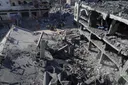
The Syrian Observatory for Human Rights said the convoy was looking for a "new route" to reach Albukamal after the coalition strike.
Dillon said the US-led alliance was monitoring the convoy in real time and its last known location was near Hmaymah.
"If we are able to strike them without harming civilians, then we will do so," Dillon said.
Asked whether the presence of civilians had prompted the coalition to bomb the road instead of the convoy itself, Dillon said that would be "consistent" with protocol.
There was no immediate reaction to the strike from Hezbollah or from Syria's regime.
The evacuation agreement earlier had sparked a furious reaction from the United States, and Iraq.
"Irreconcilable Daesh terrorists should be killed on the battlefield, not bused across Syria to the Iraqi border without Iraq's consent," said US presidential envoy to the anti-Daesh coalition Brett McGurk.
Iraqi Prime Minister Haider al Abadi on Tuesday also denounced the agreement allowing Daesh fighters to transfer from Syrian-Lebanese border to near Iraqi border.
"This act disturbs us and we consider it as abuse to Iraqi people. The transfer of terrorists to areas east of the Syria frontier to Iraq is unacceptable'' Abadi said on Tuesday.
After the move Lebanon relieved its Syrian border from Daesh, but Iraq fears it now has a new problem near its territory.
TRT World 's Iolo ap Dafydd reports on Iraq's reaction.