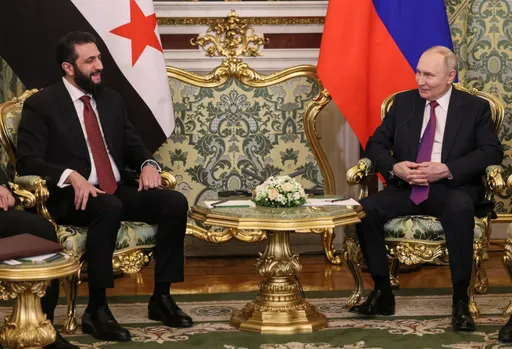
A Russia-hosted Syrian peace conference ended Tuesday with a plan to draft a new constitution as part of efforts to end the nearly seven-year civil war, but key opposition and opposition groups boycotted the gathering and it remained unclear if they would join the process.
The conference, held in the Black Sea resort of Sochi, was also overshadowed by renewed fighting in northern Syria.
There's an attempt to combine the work there with negotiations at the United Nations.
TRT World 's Andrew Hopkins reports from Sochi.
Russian Foreign Minister Sergey Lavrov hailed the Syrian Congress of National Dialogue in Sochi as an important step toward peace in Syria and sought to play down the opposition boycott.
"No one expected that it would be possible to bring together representatives of all groups of Syrians without exclusion," he told reporters after the talks. "There is no big tragedy that two or three groups weren't able to attend."
Lavrov said the conference participants agreed to form a constitutional committee that will be based in Geneva. He said groups absent from the Sochi talks will be invited to name representatives.
“The establishment process of the Constitutional Committee will be closely monitored by Turkey as the guarantor of the opposition,” Turkey's foreign ministry said in a statement.
“Turkey will continue to support, on all platforms, efforts for a political solution that will bring real political change to Syria in accordance with UN Security Council Resolution 2254.”
Staffan de Mistura, the UN envoy for Syria who has been leading Syrian peace talks in Geneva, said he would move quickly to set a schedule and a process for drafting the new constitution in Geneva "because Syria cannot wait."
De Mistura told reporters at UN headquarters in New York late Tuesday by audio link from Sochi that he believes talks on a new constitution could achieve results because countries with influence on the government and opposition appear determined to insist that both sides engage.
Alexander Lavrentyev, Russian President Vladimir Putin's envoy for Syria, said 1,393 delegates attended the congress. He said the Sochi organisers were aiming to help revive the UN-backed talks in Geneva, not to sidetrack them.
The Geneva negotiations have made little progress since they began four years ago.
The opposition's demand that regime leader Bashar al Assad play no role in a future political transition has been the main sticking point.
The Sochi talks, by contrast, were not intended to address Assad's fate, but to instead discuss constitutional reforms and future elections.
De Mistura said he is counting on the Syrian regime's allies Russia and Iran and opposition supporter Turkey to use their influence to implement the agreement they supported in Sochi, along with the UN and other influential countries.
"The devil is in the detail," he repeated twice. "It's going to be uphill. We all know it. But we are actually going to establish a constitutional committee."
De Mistura said he will come up with the criteria for participants and choose a maximum of 45 to 50 members for the committee.
Russia, Iran and Turkey have each submitted 50 names already, but he said there will definitely be "very substantial participation" from the opposition that skipped Sochi along with government, other opposition and independent representatives.
He refused to give a timeline.
Asked why the focus was on a new constitution ahead of a transition, De Mistura retorted: "Are we going to ignore the fact that there is an opportunity for actually having a constitutional committee that may ... write a new constitution and that will lead to possible UN-led or UN-supervised elections?"
Disrupting Sochi
Sharp disagreements among those attending the Sochi conference were apparent as it opened, with some interrupting Lavrov's welcome address by chanting pro and anti-Russian slogans.
"You are killing our people," an opposition supporter chanted before he was approached by security.
The main opposition umbrella group, a Saudi-backed coalition known as the Higher Negotiations Committee, has been representing the opposition in Geneva. It did not attend the Sochi meeting.
The Syrian civil war is far from over, despite major gains by Assad's regime and the expulsion of the Daesh from virtually all the territory it once held.
Turkish troops and allied Free Syrian Army are now fighting their way into the Afrin enclave, held by YPG which forms a major component of the US-backed Syrian Democratic Forces. Ankara considers YPG to be affiliated with terror group PKK.
The YPG declined to attend the Sochi conference, saying it holds Russia responsible for the latest Turkish offensive.