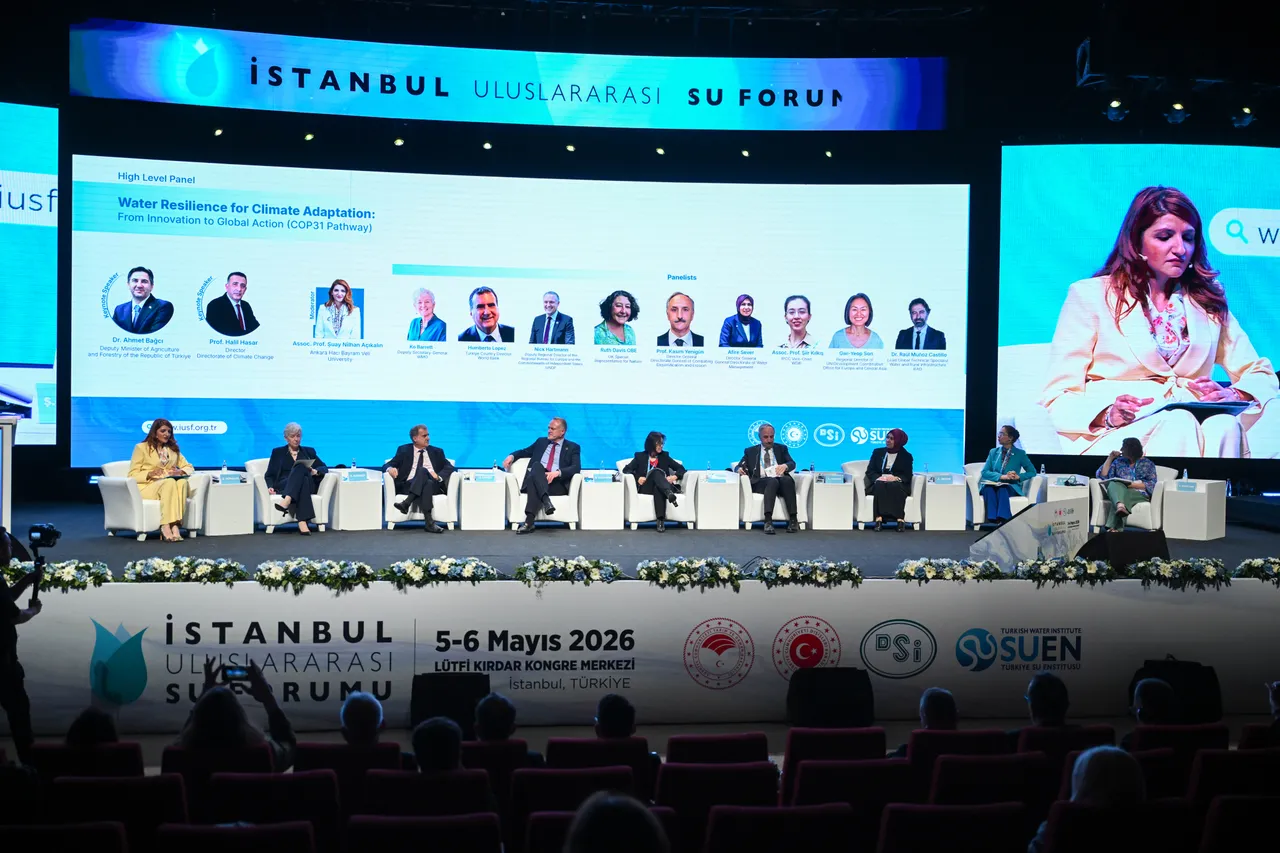
Türkiye's water security challenges are at the center of discussions at the 5th Istanbul International Water Forum, a three-day event taking place at the Lütfi Kırdar International Congress and Exhibition Palace, where officials and international experts are laying the groundwork for COP31, the United Nations climate summit that Ankara will host later this year.
A high-level panel on "Water Resilience in Climate Change Adaptation: From Innovation to Global Action (COP31 Roadmap)" brought together government ministers, UN officials, and climate experts to assess how water must become central to global climate action.
The water crisis is directly linked to climate crisis and economic development, panelists warned, as Türkiye prepares to shape international climate policy through its hosting of COP31.
Türkiye’s COP31 vision
Ahmet Bagcı, Deputy Minister of Agriculture and Forestry, said the country has a clear vision for COP31 that goes beyond traditional diplomatic negotiations.
"Türkiye is committed to bringing its experience in this field to international platforms and to making water, agriculture, and food systems transformation central to the COP31 process," Bagcı said.
Halil Hasar, Chair of Climate Change, emphasised that COP31 must be a turning point focused on implementation, not just negotiation.
“We expect COP31 to define the future of COPs. The first decade of the Paris Agreement was about ambitious commitments; now those targets must be turned into concrete outcomes,” Hasar said.
‘We must listen to water and plan according to it’
Afire Sever, Director General for Water Management at the Agriculture and Forestry Ministry, warned that climate change is intensifying both droughts and floods in Türkiye’s vulnerable Mediterranean climate zone.
“We must listen to water and plan according to it,” she said, stressing the need for improved water efficiency.
UN and other global agencies also underlined the urgency of coordinated action.
Gwi-Yeop Son of the UN Development Coordination Office for Europe and Central Asia said COP31 could strengthen water and climate diplomacy and promote regional solutions, while World Meteorological Organization Deputy Secretary-General Ko Barrett highlighted the increasing frequency of climate-driven droughts and their impacts on both ecosystems and public health.
“Actors and relevant stakeholders must develop cost-effective solutions based on meteorological data and reliable climate data,” Ko Barrett said.
‘Türkiye plays key role in COP31 water agenda’





Humberto Lopez, World Bank Country Director for Türkiye, said water is not a single-dimensional issue but one in which declining rainfall, rising temperatures, and growing demand need to be taken into account simultaneously
Despite decreasing rainfall, water demand is expected to rise by approximately 40 percent, Lopez noted. This means countries will experience both droughts and floods simultaneously, requiring new water management approaches.
The global water sector needs approximately $140 billion annually in investment, but current funding falls short of this, Lopez said. Private sector involvement must increase to close the gap.
Lopez highlighted Türkiye's opportunity as host of COP31, calling it an "implementation COP" that should showcase successful water management practices.
"The fact that this is happening in Türkiye is a very important opportunity because we are talking about a country that has been successful in this area," Lopez said.
Private sector key to water infrastructure investment
Siir Kilkis, Vice-Chair of the Intergovernmental Panel on Climate Change, said climate change's effects on water cycles are becoming increasingly apparent.
Flooding alone can cause countries to lose between 1.5 and 1.8 percent of their GDP, Kilkis said. Reducing water-related risks could improve outcomes by approximately 25 percent at both regional and sectoral scales.
"Water security must be strengthened through carbon-free and climate-resilient systems," Kilkis said.
Nick Hartmann, Deputy Regional Director of the UNDP Europe and Central Asia Regional Bureau, underscored that approximately 80 percent of climate impacts are water-related.
"The private sector can play a more effective role in water infrastructure, potentially contributing up to 70-80 percent of supply," Hartmann said.
Ruth Davis, Special Envoy for Nature to the United Kingdom and holder of the Order of the British Empire, emphasised water's central role in environmental, economic and social systems.
“If you manage clean water well, you have a chance to manage everything from ecosystems to economies,” she said.
The forum continues with panel sessions scheduled for the following day.