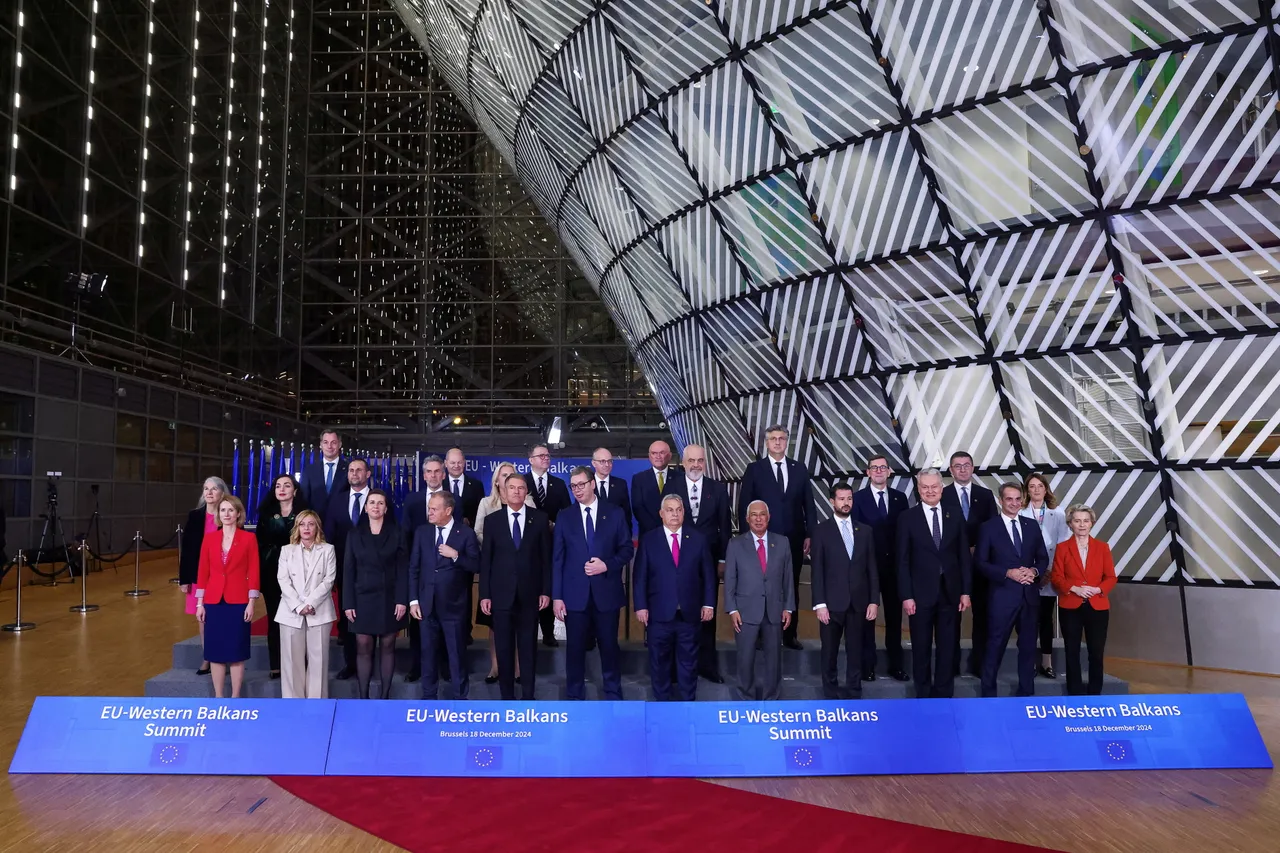
Leaders from across the European Union and the Balkans are gathering in Montenegro on Friday to discuss expanding the bloc to include countries in the region, seen as a key area in countering security and economic challenges posed by Russia and China.
The EU-Western Balkans summit, being held in the Adriatic Sea coastal town of Tivat, brings together European leaders, including President Emmanuel Macron of France, German Chancellor Friedrich Merz and Italian Premier Giorgia Meloni, as well as the heads of other EU candidate countries in the Balkans and European Commission President Ursula von der Leyen.
High on the agenda will be EU accession for Montenegro, a small, mountainous nation that was once a part of Yugoslavia and which marked the 20th anniversary last month of its declaration of independence from a union with neighbouring Serbia.
After joining NATO in 2017, the country of 623,000 people is set on fulfilling an ambitious agenda of becoming the 28th member of the EU in 2028. The motto “28 by 28” has even been inscribed on one of the planes of Montenegro's national airline.
The EU has already formed a working group to draft an accession treaty for Montenegro — a signal that membership is within reach. It is considered a frontrunner ahead of the region's other candidate countries of Albania, Bosnia-Herzegovina, Serbia, Kosovo and North Macedonia.
All are at different stages of the accession process, and the EU has recently sought to encourage reform in the candidate nations, fearing the growing influence of Russia and China.
Candidate countries must bring their laws into line in 35 policy areas or “chapters,” ranging from justice standards to farm and fishing rules. All 27 EU members must agree before each chapter can be opened, and then again for it to be closed.
Ukraine and Moldova are also among about ten countries aspiring to join the bloc. Iceland will hold a referendum in August on whether to apply.
The summit will be chaired by European Council President Antonio Costa, who, during a tour of countries in the Western Balkans this week, emphasised how serious the bloc is about enlarging.
As wars rage in Ukraine, Iran and the Middle East, and Europe's future security has come under question with the US considering troop withdrawals from Europe, EU countries have pushed to boost military capabilities and defend against Russia, which they view as increasingly aggressive.
Speaking in Serbia on Thursday after meeting with Serbian President Aleksandar Vucic, Costa said that in times of “global geopolitical uncertainty and economic instability” enlarging the EU is "not just an opportunity. It is a geostrategic necessity for Europe.”
Faruk Basic, a researcher at the Brussels Institute for Geopolitics, said the summit will likely result in a rapid movement for Montenegro to join the bloc in 2028. It will also likely see new safeguards to ensure member nations don’t break EU norms.
The summit will be the first to bring together EU leaders since the April defeat of Viktor Orban, Hungary’s former prime minister, who was often criticised within the bloc over his ties with Russia.
Following Orban’s repeated use of the veto in the European Council, the EU is devising new ways to use financial penalties or restricted access to the single market to pressure incoming nations to adapt to the bloc’s standards, Basic said.
“The EU is trying to find a way how to admit a country that isn’t fully ready to be admitted without losing the ability to hold it accountable after the fact,” he said, pointing to Ukraine’s accession bid as well as nations in the Western Balkans like Serbia and Kosovo.