 Zeynep Conkar
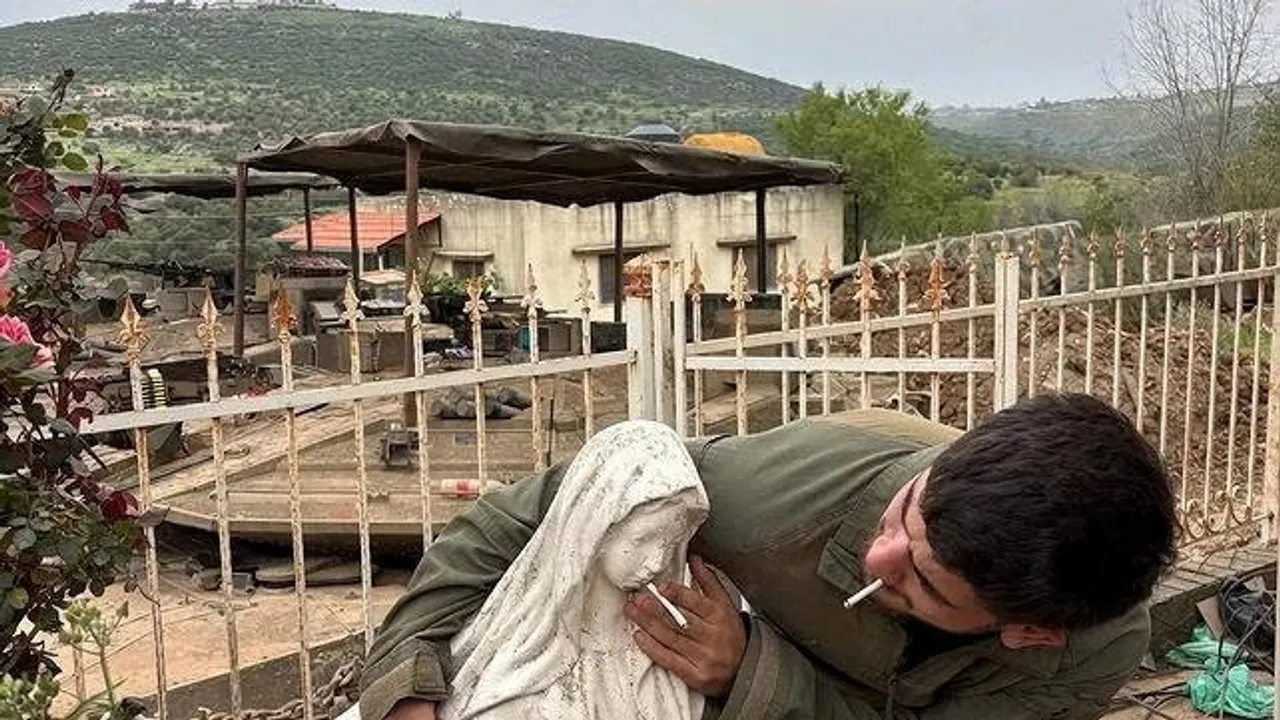
The Israeli military has once again been forced to confirm what it would prefer to explain away. A photograph shared online on May 6 showed an Israeli soldier holding a cigarette to the mouth of a statue of the Virgin Mary in Debel, a village in southern Lebanon.
Army’s spokesperson said the military "views the incident with utmost severity" and that the soldier's conduct "completely deviates from the values expected of its personnel."
It was, word for word, the same statement Israel issued less than three weeks earlier when another soldier was filmed destroying a statue of Jesus, also in Lebanon.
The language of official condemnation has become a ritual; predictable, hollow, and increasingly unconvincing to Christian communities watching a pattern take shape across Lebanon and beyond.
For some experts, the repeated desecration of Christian symbols and sites cannot be separated from the ideological foundations underpinning Israel’s conduct in the region.
“Zionism is an expression of settler colonial supremacism and is manifest in apartheid; separation, segregation, sequestration. It can only expand through ethnic cleansing and, where necessary, genocide,” according to Stephen Sizer, an expert on Christian Zionism and former vicar of the Church of England.
“The presence of indigenous people, seen as inferior, is problematic. Denigrating their ethnicity goes hand in hand with desecrating anything they hold dear, such as their faith,” Sizer tells TRT World.
“It is therefore not surprising that while Israel claims to protect and respect religious freedom, in reality it has, for more than a century, desecrated and destroyed Muslim and Christian places of worship,” he adds.
The latest desecration video by the Israeli army surfaced less than a month after another Israeli soldier was filmed smashing a statue of Jesus in Debel, a Christian village in southern Lebanon.
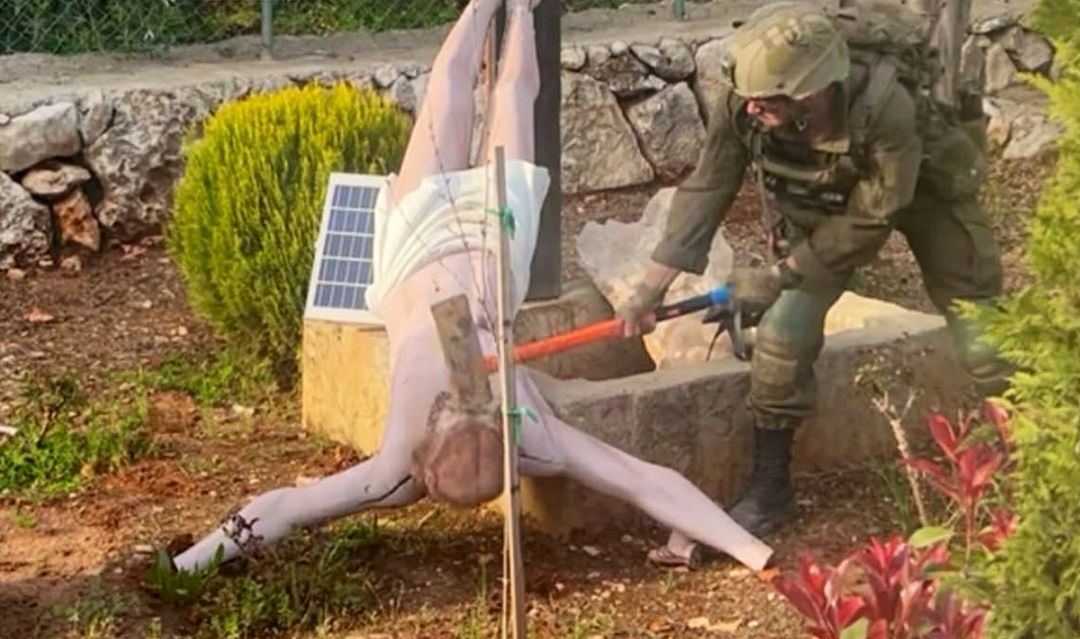
Following the previous incident involving the statue of Jesus, the soldier who smashed the statue and the soldier who filmed him were removed from combat roles and sentenced to 30 days in military prison.
Six other soldiers who witnessed it and did nothing faced only disciplinary discussions, a response critics called wholly inadequate for an act that drew global outrage.
In a statement signed by Cardinal Pierbattista Pizzaballa, the Assembly of Catholic Ordinaries of the Holy Land expressed its "profound indignation and unreserved condemnation," describing the act as a "grave affront to the Christian faith that adds to other reported incidents of desecration of Christian symbols by IDF soldiers in southern Lebanon."
The assembly said the incident reflects a “disturbing failure in moral and human formation wherein even the most elementary reverence for the sacred and for the dignity of others has been gravely compromised.”
Over 150 Jewish leaders from multiple denominations around the world also signed an open letter condemning the act, calling it "a chillul Hashem, a desecration of God's name," and apologising to the global Christian community.
“In the ongoing sectarian and religious wars in the Middle East and North African region, it is the minuscule and extremely vulnerable Christian communities who have faced the brunt of the attacks,” according to professor Amalendu Misra, scholar of International Politics at Lancaster University, and an expert on religious radicalism.
“It is particularly ironic given Christianity was born here and most of the civilisations and cultural vestiges of this once powerful faith have been treated with extreme intransigence,” Misra tells TRT World.
“The greatest loss to the world community is the destruction of many of Christianity’s ancient places of worship and critical symbols in the land where it evolved more than two millennia ago,” he adds.
A clear pattern
Between the two statue incidents, another episode compounded the picture.
The Israeli military confessed it caused damage to a building within the compound of a Catholic convent near the village of Yaroun in southern Lebanon, though it disputed the extent, claiming the structure bore "no external signs indicating it was a religious building".
The Catholic Church in Lebanon rejected the military's false framing. "These are not military bases. These are places to spread peace, love and education," said Abdo Abou Kassm, director of the Catholic Centre for Information.
The anti-Christian incidents which happened in the last weeks were very serious and are the work of a fanatic minority, according to William Shomali, Patriarchal Vicar for Jerusalem and Palestine.


“One of the worst, which has occurred recently, was the aggression against the Catholic French nun who was walking close to the upper room, not far away from David’s tomb,” Shomali tells TRT World.
“What should be done is to educate this aggressive minority to respect Christian and Muslim symbols since the Holy Land belongs to the three faiths,” he adds.
The incidents in Debel and Yaroun do not stand alone. During Israel's previous attacks in Lebanon in autumn 2024, soldiers filmed themselves desecrating a monastery in Deir Mimas, as well as a statue of Saint George in Yaroun.
In July 2025, an Israeli strike targeted the Holy Family Church compound in Gaza, the territory's only Catholic church, killing and wounding civilians who had sought shelter inside.
At the Saint Porphyrius Church compound, one of the oldest churches in the region, Israeli strikes caused deaths and injuries while civilians had taken refuge there.
According to the Religious Freedom Data Centre, a Jerusalem-based group, an estimated 181 incidents of harassment targeting Christians, Christian symbols, and Christian institutions were recorded in Israel in 2025 alone, with an additional 44 incidents between January and March 2026.
“There is deep respect within the Muslim and Christian communities, as well as among anti-Zionist Jews, for one another’s faith traditions, recognising that to live in peace and security involves love of our neighbours, a central Christian imperative,” Sizer says.
“Zionists may seek to divide and rule, but in reality, solidarity, for example between Muslim and Christian Palestinians, is greater now than ever before.”
“Lebanese citizens are well aware of the racist values underpinning Zionism, seen more graphically in the total destruction of Lebanese villages south of Beirut,” Sizer adds.
Apologies without accountability
International reaction has grown sharper with each new attack by Israel on religious symbols, yet what is conspicuously absent from the international conversation is any serious engagement with legal accountability.
Under the 1954 Hague Convention for the Protection of Cultural Property in the event of Armed Conflict, to which Israel is a party, the deliberate destruction of or disrespect toward cultural and religious property is prohibited.
Apologies and 30-day prison sentences for soldiers do not constitute the serious legal reckoning the convention envisions.
International law is absolutely clear regarding the rights of religious communities and their places of worship, according to Professor Misra.
“States have a moral, ethical and legal obligation towards the protection of religious groups and their religious cultural artefacts, symbols and monuments of worship,” Misra says.
“Many of the Jewish, Christian and Islamic architectural sites and places of worship in the Middle East are part of the UNESCO-recognised common heritage of mankind.”
“Any power or governing body consciously damaging or destroying these religious and cultural fabrics is committing moral and humanitarian crimes which have very little justification under current international law,” he adds.
Debel, a Maronite Christian village just five kilometres from the Israeli border, was among the Christian villages Israel exempted from evacuation orders, making the repeated misconduct of its troops there even more glaring and difficult to dismiss.
When violations keep occurring in the same village, against the same Christian community Israel publicly claims to spare from its “military targets”, the “isolated incident” narrative begins to collapse under the weight of repetition.
The implications should be clear, according to Sizer.
“Zionism, as a form of racism, must be repudiated internationally and expelled from the UN, while its leaders and officials should be arrested and charged with war crimes,” he explains.