 Kazim Alam
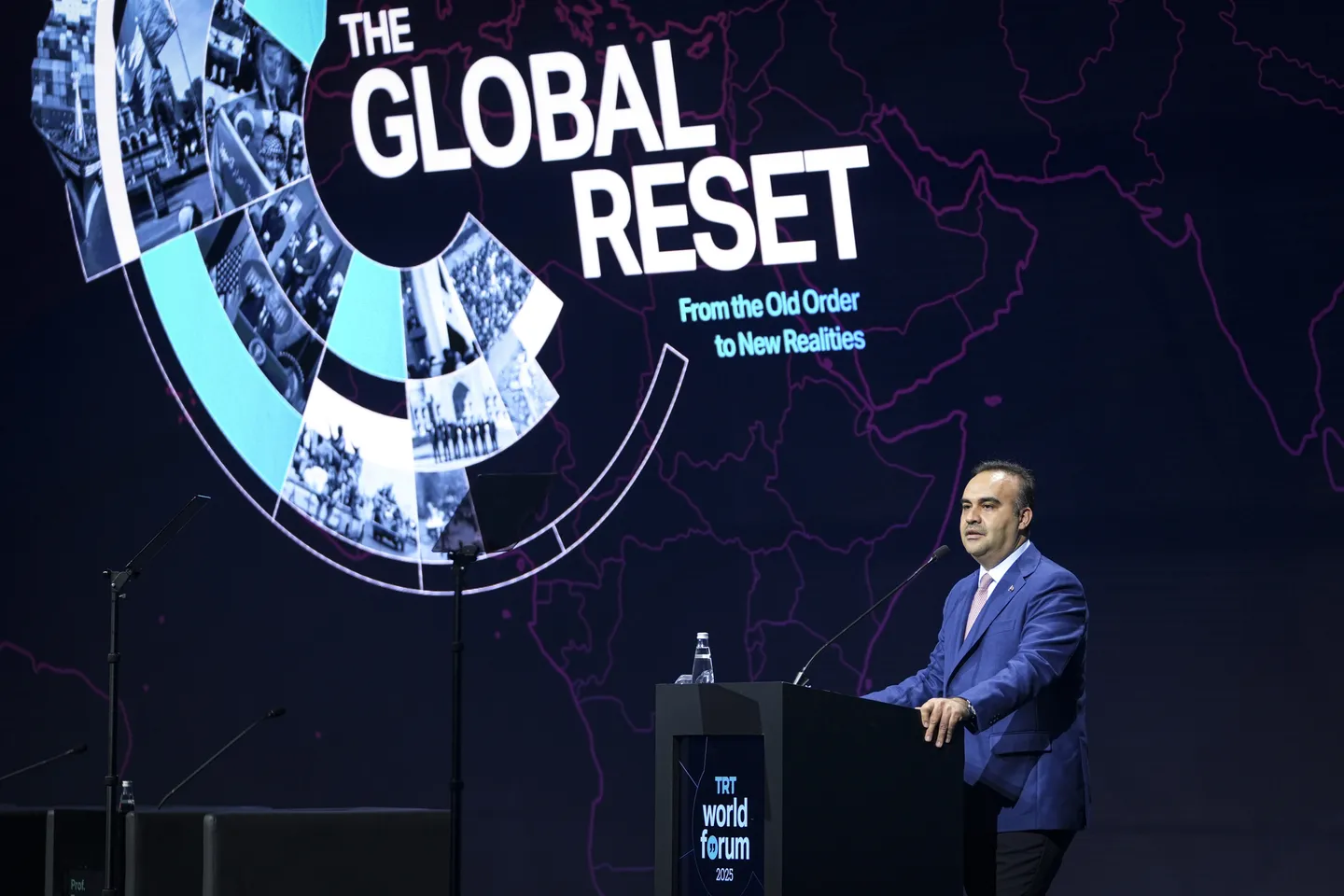
Mehmet Fatih Kacir, Türkiye’s Minister of Industry and Technology, had a stark warning for the participants of TRT World Forum on Saturday: Artificial intelligence (AI) has become a “lever of power” in international relations, concentrated in the hands of a few American and Chinese giants and wielded through profit-driven algorithms that risk erasing entire cultures.
In his keynote address ahead of a panel discussion titled ‘Beyond techno-feudalism: Democratising AI innovation, governance, and access’, Kacir painted a picture of a world split not just by wealth but by computational power.
“The development of AI today is steered by a small number of global tech giants guided by profit and market competition,” he said.
“Their market dominance is a clear indicator of the growing concentration of digital power,” he added.
Minister Kacir invoked the war in Gaza to underscore humanity’s deeper failures.
“Even when humanity faces a deep moral crisis, such as the tragedy in Gaza, the world cannot show a united stand,” he said.
“If we cannot find consensus on the value of human life itself, how can we expect to agree on the ethical limits of artificial intelligence?”
The minister reserved particular scorn for AI’s linguistic blind spots.
“Many widely used AI models fail to understand the nuances of different languages,” he said.
This not only leads to cultural erosion, but also to a silent form of digital domination, where some voices are amplified and others are erased, he noted.
Deepfakes and biased algorithms have “blurred the line between truth and illusion, between injustice and justification”.
Türkiye would not remain a passive consumer of AI, the minister insisted. Ankara plans to expand the country’s national data centre capacity from 250 megawatts to one gigawatt by 2030 and is courting large-scale AI and cloud investments.
“We aim to ensure that Türkiye becomes a leading innovator, not only a consumer of AI technologies,” he said, while pledging to help craft “a global governance framework that places ethics, transparency, and accountability at its core”.
Speaking on the occasion, Imperial College Business School professor Tommaso Valleti said monopoly symptoms in the AI field are no longer theoretical.
“What a handful of companies are actually doing is building bottlenecks across the AI chain,” he said, ticking off chips, cloud services, models and data.
The result, he said, is not a textbook monopoly but something darker: “Techno-feudalism” or, in his preferred term, “portfolio capitalism,” in which a few gatekeepers make entry by new players “almost impossible”.
Valleti said that Nvidia, a leading US-based AI firm, dominates advanced graphics processing units (GPUs) and is “leveraging the dominance they have in GPU into control of software,” locking developers into its ecosystem.
Google, he noted, has folded its Gemini AI directly into search results, turning the world’s most popular gateway to information into “a privileged training and distribution channel” for its own model.




The conflicts of interest, he said, are dizzying. Microsoft owns 49 percent of OpenAI, the firm behind popular AI platform ChatGPT, while simultaneously supplying and competing with it.
Amazon and Google hold equity in Anthropic, another popular AI company.
“Will we allow Apple, Samsung and Huawei, the three biggest phone manufacturers, to have ownership among each other, in each other’s smartphone production?” Valleti asked. “No, they would never be allowed that.”

He dismissed the idea that fines alone can tame the giants. Google, he reminded the audience, earns about $300 billion a year from search advertising alone.
In his previous regulatory role in the EU, he had imposed a $10 billion penalty on the company, even though the regulatory action “didn’t change the behaviour of Google at all”.
AI infrastructure, he argued, is as essential as water or electricity. “We don’t ask ourselves, do we regulate water, should we regulate electricity? We do, because it’s essential for our lives,” he said.
“This is essential infrastructure, so regulation has to be there,” he said while referring to AI substructure.
Valleti also sounded a geopolitical alarm: 80 percent of the European Union’s digital infrastructure is controlled by American companies. “That’s worrying, if you think strategically, geo-politically,” he said.
“We have to start replacing the infrastructure, start to build alternatives.”
Kenzo Fujisue, a professor at Keio University in Japan, delivered a blunt statistical snapshot: The US owns half of the world’s giga-scale data centres used by AI platforms, while China owns 30 percent.
In research and development investments, the split is even starker: 70 percent American, 20 percent Chinese, 10 percent everyone else.
Ejup Maqedonci, Kosovo’s minister of defence, said that the AI revolution, unlike its industrial predecessor, requires no mines or factories.
“This is the reason the future in AI belongs to nonstate actors (rather) than state actors,” he said, suggesting that startups and individuals could outsmart governments.

Belen Sanz Luque, UN Women’s regional director for Europe and Central Asia, highlighted the gender imbalances in the digital sphere. In 2024, 70 percent of men used the internet worldwide compared with 65 percent of women. Smartphone gaps were even wider.
The data that gets generated by this lopsided use of the internet is then fed into AI models, which further widens the gender gap, she said.
Women make up no more than 25 percent of AI professionals, reinforcing the gender bias in the algorithms that now govern daily life, she added.