Anti-immigrant violence erupted across Belfast on Tuesday after a knife attack allegedly carried out by a Sudanese national, with masked mobs attacking homes, burning vehicles and forcing families to flee.
The unrest was fuelled by a wave of online agitation following the attack, with politicians warning that influential social media figures and anti-immigration activists helped inflame tensions.
Among them was tech billionaire Elon Musk, who amplified calls for protests after the incident, as authorities appealed for calm and condemned attacks targeting Black residents and immigrant communities.
Here's what we know.
What happened?
Masked men burned homes in Belfast, forcing families to flee, and torched a number of vehicles on Tuesday night after a video of the knife attack spread online.
Hundreds of protesters, many with their faces covered, attacked police and set vehicles alight in a number of locations across Northern Ireland.
Video broadcast by the BBC showed police helping a family escape from a burning house. Residents inspecting the aftermath on Wednesday found homes blackened by smoke, windows smashed and cars reduced to shells.
What role did online figures play?
Politicians and community leaders said online influencers and anti-immigration activists helped inflame tensions after the attack.
Labour Party chairwoman Anna Turley said online platforms were "playing a role in driving" the unrest. She suggested Musk was one of the "bad faith actors" inflaming tensions.
Musk was among a number of high-profile online figures who amplified anti-immigration narratives following the attack.

He reposted multiple messages criticising the UK and responded to a post by anti-immigration activist Tommy Robinson calling for protests after what Robinson described as "yet another invader attack on our people".
Musk said: "Only by protesting REPEATEDLY and LOUDLY will there be any change!!"
The tech billionaire even shared lists on X of locations where protests could take place.
Northern Ireland's Justice Minister Naomi Long told Reuters that "bad faith actors" who would have previously struggled to find the province on a map had sought to weaponise the understandable fear and anger sparked by the knife attack to target those who had the same skin colour.
"Do not allow your genuine concerns to be manipulated by bad faith actors," she said.
"We know in Northern Ireland the damage that can do when you demonise a whole group of people because of the behaviour of a few, and we do not want to go back there."

Claire Hanna, the leader of the opposition Social Democratic and Labour Party in Northern Ireland, described the violence as a "race based pogrom". "The online ecosystem that talked this up will move on now and the people of Belfast will be left picking up the pieces," she said.
Smaller protests also took place outside parliament in London while other gatherings were reported across Britain.
Vehicles burned across the city
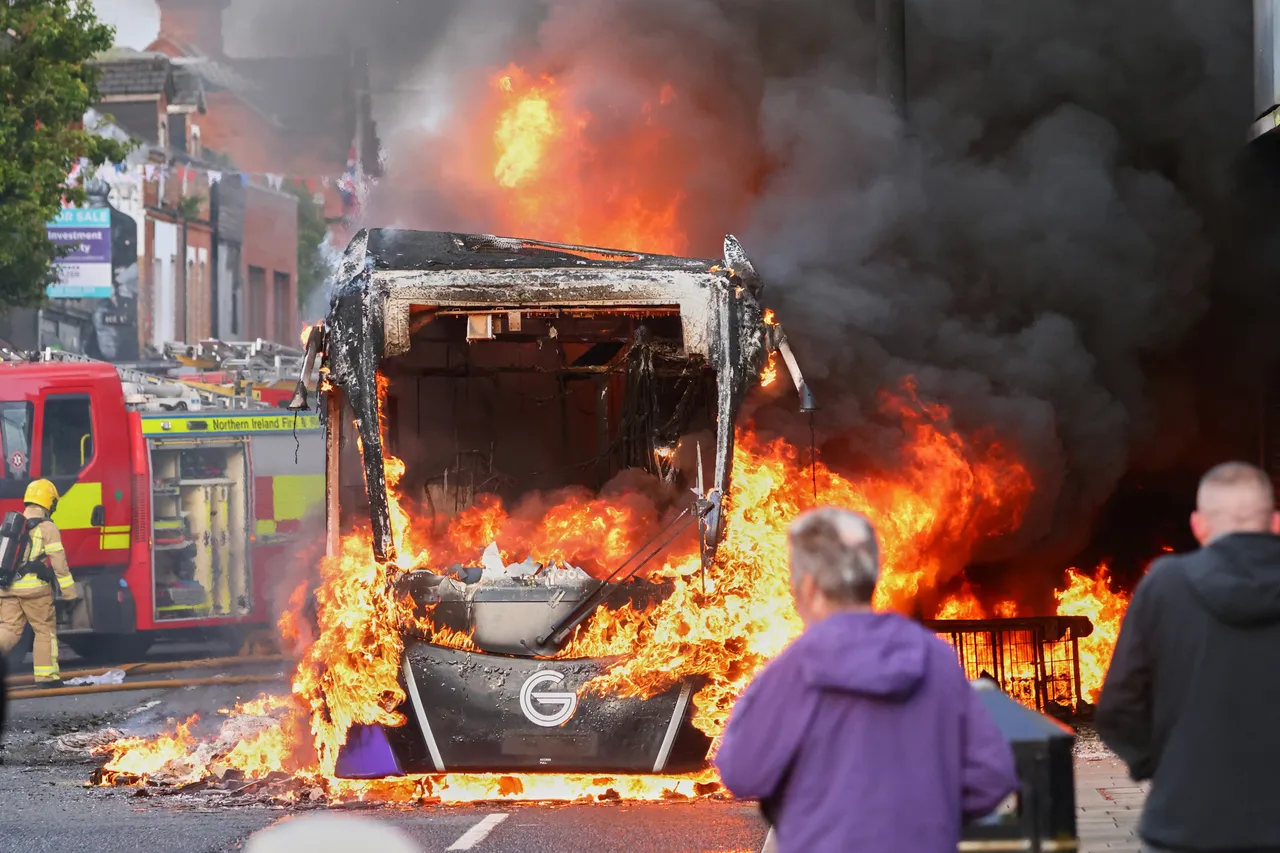
In Northern Ireland, masked youths gathered early on Tuesday evening at points across Belfast, with police responding by deploying armoured vehicles. Rioters set fire to a number of cars across the city, while a bus was engulfed in flames in east Belfast.
The BBC reported that a crowd of 100 men kicked in doors and broke windows of homes on a street in east Belfast.
"They're getting put out just because they're Black," Pastor Jack McKee told the BBC after attacks on homes in the north of the city.
What sparked the violence?
The knife attack that spurred the unrest took place in north Belfast late on Monday.
A 30-year-old Sudanese national has been charged with attempted murder, possession of an article with a blade or point in a public place and threats to kill.
The victim of the attack, a man in his 40s, suffered serious injuries including slash wounds to his face and back.
The suspect in the stabbing is due to appear at Belfast Magistrates' Court on Wednesday.
"There can be no excuse and no justification for these attacks," Northern Ireland's First Minister Michelle O'Neill said. "Groups of masked men burning families out of their homes is nothing less than disgusting cowardice."
British Prime Minister Keir Starmer had described the initial knife attack as "sickening".
The assault, which is currently not being treated as terrorism, comes at a time of heightened tensions in Britain following the murder of a student who was handcuffed by police as he lay dying from stab wounds after his killer, a Sikh man, falsely alleged a racist attack.
It also follows repeated protests about immigration, with populist parties saying Britain's asylum policy had allowed dangerous men into the country.
Northern Ireland was also hit by anti-immigrant rioting last year amid anger over an alleged sexual assault. Charges against two boys were later withdrawn by the prosecution service.