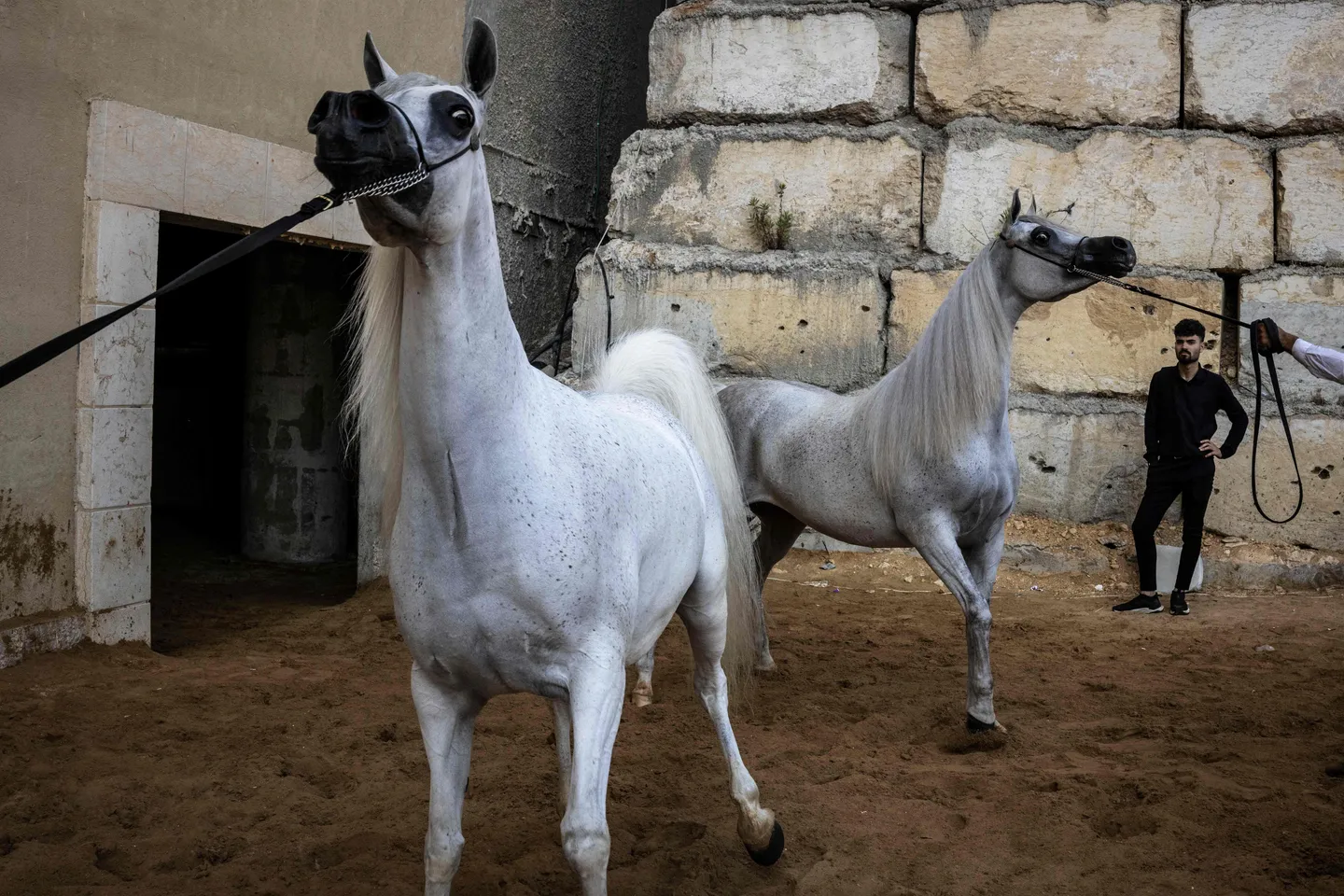
As Arabic rap thundered from loudspeakers and hundreds of spectators packed the stands in the occupied West Bank city of Rawabi, handlers put the finishing touches on gleaming Arabian stallions before leading them into the show ring.
"Palestinians have a huge passion for Arabian horses," said Abdelnasser Musleh, a 30-year-old breeder speaking to AFP at the horse beauty pageant.
"I think a big part of our identity, our culture, our presence is connected to horses. And we feel proud of this breed, the Arabian breed."
Even as open land becomes increasingly scarce and contested amid expanding illegal Israeli settlement construction in the West Bank, horse culture has emerged in unlikely nooks as a rare form of recreation that still draws Palestinians together, from urban neighbourhoods to rural villages.
Musleh himself has built something few would expect: an Arabian horse farm in the crowded Palestinian town of Kufr Aqab, north of Jerusalem on the West Bank side of the barrier built by Israel.
At the pageant, hard-faced men dressed in black tracksuits, gold chains glinting under the lights, carefully groomed their stallions as they waited for their moment in the spotlight.
Some applied glossy gel around the horses' large, expressive eyes; others brushed their thin coats -- two hallmarks of the Arabian breed, which Palestinians began reviving in the past few decades, according to Belgian competition judge Conrad Detailleur.
In a striking surge, around 25,000 purebred Arabian horses are now registered across Israel and the Palestinian territories, up from about 20 in the 1970s, according to West Bank breeder Ashraf Rabee.
Coming together
For Musleh, who has worked with horses for 13 years, the show is about more than competition, offering Palestinians a space to come together and exchange knowledge.
Despite limited land and densely populated neighbourhoods, breeders continue to raise Arabian horses in small urban spaces and makeshift stables.




Musleh's own farm is wedged between high-rise buildings near a major checkpoint between Jerusalem and the occupied West Bank. In occupied East Jerusalem, riders guide horses through crowded neighbourhoods before trotting across Mount Scopus at dusk.
In Nablus's old city, the sound of neighing echoes through narrow alleyways, revealing stables hidden inside centuries-old stone houses.
Passion for horses
Hundreds of spectators -- men, women and children -- filled the bleachers at the Rawabi show.
Some smoked shisha, while others sprinted towards the arena when a friend or relative's stallion won a prize.
Just before each horse entered the ring, handlers waved plastic bags beside the stallions to fire them up, encouraging the dramatic head tosses that make Arabian horses, in Musleh's words, "the most expressive of all breeds".
For many Palestinians, horse breeding is more than a hobby.
It is entwined with identity, heritage and a sense of belonging to the land. Poems, songs and graffiti celebrate horses and horsemen alike.
For breeder Rashad al-Sah from Arraba, horses remain a central part of Arab and Palestinian culture.
"You feel that the Arabian horse is part of you -- even if you don't own one yourself," said Sah, whose colt Shahed won a prize at the show in Rawabi. "It's in our blood."