 Kazim Alam
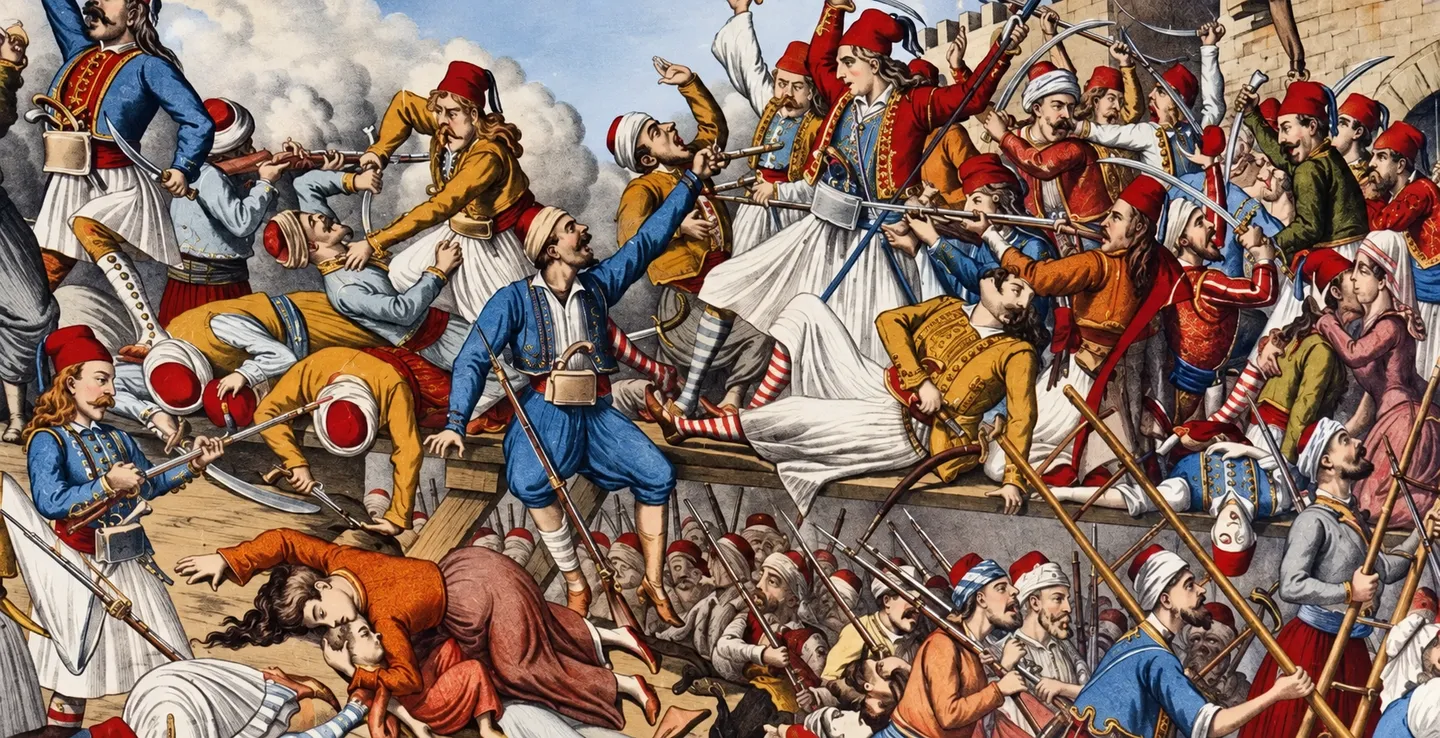
More than two centuries after Greek insurgents stormed the then-Ottoman administrative capital of the Peloponnese in southern Greece, the Tripolitsa massacre remains a historical wound that continues to fester in the collective psyche of the Turkish people.
The Greek revolt in the Morea resulted in the massacre of tens of thousands of Muslim Turks as well as Jews who had lived in the Peloponnese for centuries.
Independent historians put the number of civilians and soldiers – Turks, Albanians and others – slaughtered inside the overcrowded city of Tripolitsa, the historical name for the Greek city of Tripoli, as high as 40,000.
Following the beginning of the Greek Revolt in February 1821, Muslim and Jewish families from the surrounding countryside sought safety in Tripolitsa because the city was fortified.
But Greek rebel forces surrounded the city and eventually entered it to carry out a killing rampage as part of a wider campaign that emptied the Peloponnese of its long-settled Muslim and Jewish communities.
Ali Fuat Orenc, a professor of history at Istanbul University, says the Tripolitsa massacre was not a chaotic wartime excess, but a calculated atrocity.
“The massacres at Tripolitsa were an atrocity deliberately orchestrated by Greek gang leaders and insurgents,” he tells TRT World.
Although the city’s Muslim population agreed to surrender after months under siege, the Greek gangs failed to honour the agreement, he says.
“The Muslims were massacred en masse,” he notes.
That broken pledge by the Greek gangs was only the beginning of their atrocities against the long-settled Muslim and Jewish populations.
The city was then “looted down to the very last rusty nail”, followed by a cultural erasure.
“All historical artifacts, including Muslim tombstones, were destroyed, and the cultural heritage was obliterated,” Orenc says.
“There is absolutely no doubt that all of these were premeditated acts,” he notes.
Western commentators watched the massacre unfold, but raised few objections.
Afterwards, the massacre was downplayed, or even ignored, in European commentary, experts say.
“The primary reason why Western commentators and political leaders overlook or downplay the Tripolitsa massacre is that the Greek insurgents… enjoyed the unconditional support of Europeans,” Orenc says.
Europeans framed the Morea Revolt as a religious war and, therefore, extended “unconditional support for the Christian Greek insurgents against the Muslim Turks”.
Volunteer fighters from the European continent took part in the massacre.
“Europeans were complicit in the massacres,” Orenc says.
That European silence over the original complicity continues to date in some ways.
“Their ancestors were accomplices to the perpetrators of these killings,” he says, while referring to the present lot of philhellenes, a term reserved for the unsuspecting admirers of Greece and its culture and history.
‘An inhuman atrocity’
Independent-minded researchers who studied the massacre wrote about systematic killing, in stark contrast to the romantic image of a classical Greek revival painted by the so-called philhellenes.
“For three days, the civilian population was ruthlessly butchered,” wrote William St Clair, prominent British historian and author.
“Women and children were tortured and dragged through the streets before being killed,” he wrote.
According to George Finlay, a Scottish historian, the atrocities committed in Tripolitsa could not be justified by the necessities of war.
“Helpless and unarmed people, women and children, were systematically slaughtered for days. This was not a victory, but an inhuman atrocity,” he wrote.
In his memoirs, Theodoros Kolokotronis, leader of the Greek uprising, was unapologetic.
“From the time I entered the city until I reached the palace, my horse's hooves never touched the ground; all along the path, we were riding over corpses,” he wrote.
“Not a single living Turk was left in Tripolitsa,” he added.

Statements from the Turkish foreign ministry calling the killings a “black stain” on European history, coupled with scholarly work on the destruction of Ottoman culture, keep the subject alive in Turkish public life.
However, the massacre is described in Greek writings in a totally opposite way.
“In modern Greek textbooks, the period of the 1821 uprising is characterised as a revolution,” Orenc says.
In fact, it is placed “on par with the French Revolution”.
When the killings appear in textbooks at all, they are framed as the inevitable result of so-called “oppression endured under centuries of Ottoman hegemony”.
“Greek textbooks fail to provide sufficient information… about the Muslims and Jews living in cities across the entire Peloponnese (Morea) – all of whom were erased from history,” he says.