 Murat Sofuoglu
After five weeks of sustained aerial bombardment that failed to secure Iran’s capitulation to the Donald Trump administration, Washington has shifted its strategy towards economic coercion, imposing an economic embargo on Tehran’s exports and imports by imposing a double naval blockade at the Strait of Hormuz.
The blockade illustrates a wider effort to diminish Iran’s economic strength and reduce its ability to maintain long-term resistance.
This strategy aligns with the defiant stance historically associated with its late supreme leader, Ali Khamenei, who often emphasised endurance under pressure as a key element of Iran’s approach to countering Washington.
Experts warn that although the United States might have the upper hand militarily and economically in the short term, Iran’s long history under Western sanctions indicates it could withstand immediate shocks and prepare for a prolonged strategic contest.
This ongoing confrontation could challenge American patience as the toll of war and disruptions start impacting daily life.
“In the immediate military and economic sense, the US appears to have the upper hand, because it has greater capacity to impose pressure and shape the strategic environment,” Ali Mammadov, a PhD researcher in political science at George Mason University's Schar School of Policy and Government, tells TRT World.
But Mammadov adds that “the longer-term balance is still unclear and will depend less on the blockade itself than on the terms of any eventual agreement”, referring to the exchange of messages between the US and Iran and the possibility of a second round of talks in Islamabad, aimed at moving towards a comprehensive peace deal between the two archenemies.
Mammadov notes that if the US blockade forces Iran to come to the table and agrees to “a strict limitation” on its nuclear programme, it could be considered a major success for the Trump administration.
While the US calls for a 20-year ban on uranium enrichment, Iran has indicated it is open to a five-year suspension, suggesting that a compromise might be achievable on this major sticking point between the two countries.
Other unresolved issues include Iran’s missile program and its connections with Shia allies throughout the Middle East, from Lebanon to Iraq and Yemen.
If US-Iran negotiations result in a temporary delay or sanctions relief without major nuclear concessions from Tehran, “the outcome would look much more mixed,” says Mammadov, noting that “the current pressure gives the US short-term leverage, but the real measure of who has the upper hand will be decided politically, not just militarily”.
Iranian calculation
Throughout the conflict, analysts say, Iran’s strategy is to avoid defeat, while the US must achieve a clear victory to claim success.
Currently, the conflict indicates that “the Iranians have the upper hand," even though the US, with "the most advanced military in the world," has engaged Tehran in intense hostilities, says retired American General Mark Kimmitt.
While the Trump administration says its blockade of Iranian ports in the Persian Gulf is effective, maritime data show that some vessels continue to enter the Strait of Hormuz.
It remains unclear whether vessels moving between the Gulf and the Indian Ocean have any direct connections with Iran.
Oral Toga, a researcher at the Centre for Iranian Studies, sees that “despite the claimed blockade”, movements of vessels in the region “expose the enforcement gap between declaration and interdiction”.
“Iran operates from a different theory of victory. Its doctrine is not symmetry but cost imposition across domains — Hormuz disruption, proxy activation, missile and drone saturation, and fragmentation of the Western coalition,” Toga tells TRT World.
“In the first weeks the blockade favors the US; beyond that horizon escalation costs compound on both sides, and upper-hand dynamics become situational rather than structural,” the analyst adds. As a result, he believes that an analysis based on “the notion of a clear upper hand misreads the structure of this conflict.”
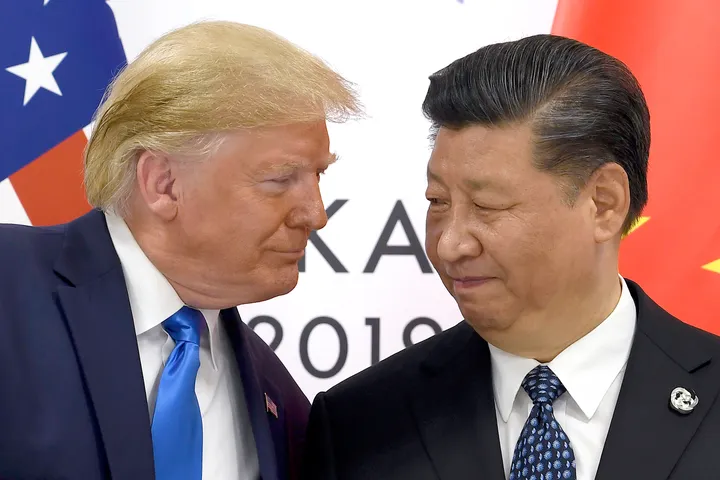

Other experts suggest that the US blockade might be effective in the short term as a pressure tactic, showing both Iran and the international community that Washington can control escalation, increase Tehran's costs, and send a message that any attempt to assert exclusive control over the Strait of Hormuz could have consequences for Iran.
Nevertheless, the double blockade has limitations because the US also aims to keep Hormuz open and prevent significant disruptions to global energy markets.
Mammadov notes that this pressure tactic is likely more of a signalling tool to strengthen the US position in negotiations than a long-term solution.
“It may be useful as leverage, but it is not something that by itself can resolve the broader conflict,” forcing Iran’s immediate capitulation, he says.
‘Strategic costs’
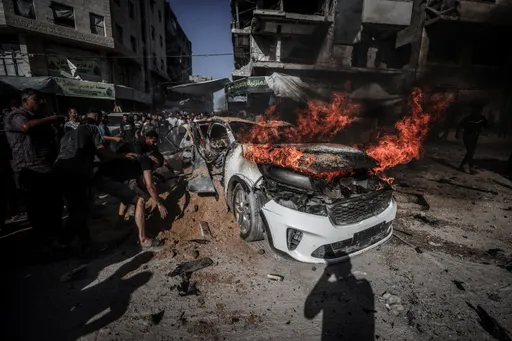
While US-Israel strikes hit Iranian military sites as well as its infrastructure and oil depots, leading to billions of dollars of damage to the country’s economy, Tehran has not shown any signs of surrender to Washington, which signalled that American tactical military supremacy has not translated into a strategic success.
This strategic problem the US faces may also apply to its blockade, says Toga, the Ankara-based political analyst.
“A dual blockade — a US-led interdiction layered onto Iran’s own restriction of traffic — is tactically feasible but strategically costly,” he says.
The Strait of Hormuz facilitates nearly 20 percent of the world’s oil and gas trade, along with a substantial portion of global fertiliser shipments.
Disruptions here could threaten food security. Iran’s restrictions have already driven up global energy prices, especially in Asian countries facing supply shortages.
“The UAE, Qatar, Kuwait, and Saudi Arabia face immediate revenue exposure, narrowing Washington’s coalition rather than widening it. A blockade may pressure Tehran, but it globalises the conflict and hands the country an advantage over the escalation ladder — mining, IRGC naval harassment, missile salvos against Gulf infrastructure — that it would not otherwise be achievable for Iran,” Toga tells TRT World.
He also highlights the resilience of Iran’s political economy, which has withstood almost fifty years of sanctions, a coordinated US-Israel military campaign starting from February 28, and repeated internal protests since the late 2000s, none of which have caused a regime collapse until now.
“The ruling system draws partial legitimacy from the resistance narrative, and public capitulation to an external blockade would generate an internal legitimacy cost greater than the external pressure itself,” the analyst says.
“The pattern observed in Iran since the 1980s is tactical flexibility combined with strategic continuity — Tehran concedes on calibrated items while preserving core assets such as the nuclear infrastructure, the missile program, and the regional network,” he adds.
After the failed Islamabad talks, US Vice President JD Vance stated that Iran did not accept American terms, which explains why the 21-hour negotiations yielded no concrete results echoing Toga’s analysis of Iran’s historical stances.
Toga argues that the maximalist demands Washington pursues are incompatible with Iran's survival strategy since the 1979 revolution. “A controlled retreat might be feasible, but strategic surrender is unlikely”.