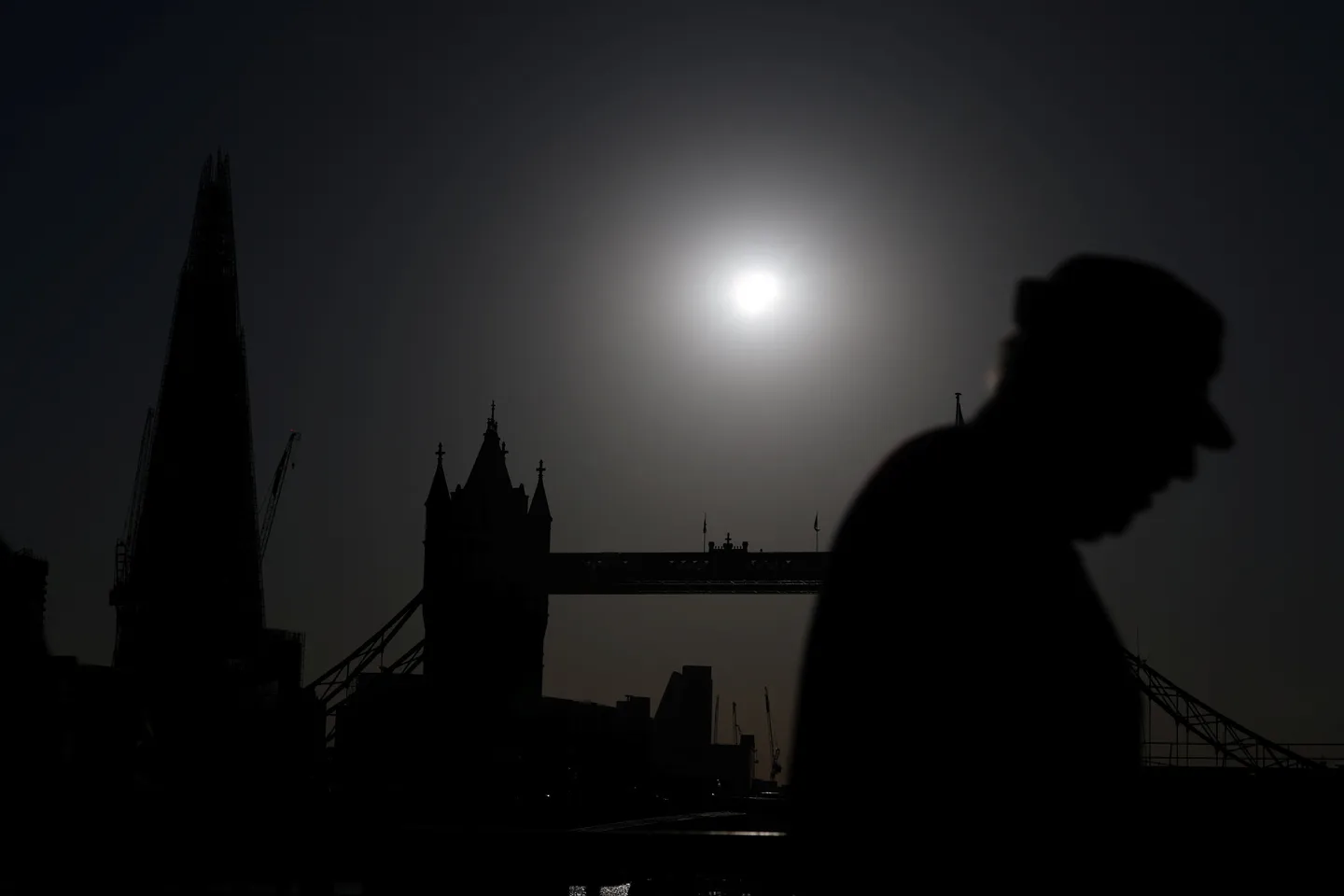
One of nature’s greatest spectacles, a rare total solar eclipse, cast its shadow, briefly turning day into night in Russia’s remote Arctic north and western Iceland before heading towards mainland Europe.
The Moon first blotted out the Sun at the northernmost tip of mainland Russia at about 1700 GMT Wednesday, leaving only the shimmering glow of its outer corona.
It raced south through parts of Greenland before total darkness fell over Keflavik, some 50 kilometres southwest of Iceland’s capital, Reykjavik, at 1747 GMT.
Reykjavik has not seen a total solar eclipse since 1433.
It was next due to hit mainland Europe, which has not experienced the dramatic natural phenomenon in 20 years, arcing diagonally in a narrow path from the northwestern Atlantic coast of Spain to the Mediterranean Sea in the south, where it is expected to fade at about 1830 GMT.
Spain has not witnessed a total solar eclipse in more than a century.
“It’s the first time, and it’s the last time, the only time I’m going to see an eclipse,” Yenny Guevera, a 50-year-old Peruvian living in France, told AFP excitedly in Burgos, northwest Spain.
“I like painting, and I really like light,” said Mercedes Bua, a 51-year-old engineer awaiting the eclipse’s passage in a park in Colmenar Viejo, some 30 kilometres (19 miles) north of Madrid.
“So I find it interesting to see how it’s going to look.”
In Iceland, total darkness swept over Keflavik, some 50 kilometres (30 miles) southwest of the capital Reykjavik, at 5:47 pm (1747 GMT).








It was the first time the rare phenomenon was visible in Iceland's capital Reykjavik since 1433, and attracted thousands of tourists and locals across the country.
Astronomer and popular scientist Saevar Helgi Bragason was among the most eager spectators.
He said he had been "waiting for this day for more than 10 years", after a partial solar eclipse over Iceland on March 20, 2015.
Speaking to AFP just before the event, he said he was filled with "excitement and heartbreak" because of the unfavourable weather forecast, which predicted that clouds would obscure the view of the moon blocking out the sun.
"It's almost like I've lost someone."
The total eclipse lasted the longest over the cliffs of Latrabjarg in the westernmost part of Iceland — about 2 minutes and 13 seconds — while further south in the centre of Reykjavik it lasted for just over one minute.
Throughout human history, eclipses have stirred amazement, fear and reverence, as they appear to momentarily halt the normal course of nature.
The shadow, or "umbra", cast by the alignment of the Sun and Moon creates a strange, eerie twilight during which temperatures drop, shadows appear at strange angles and some animals go to sleep.
But the phenomenon is fleeting, lasting just minutes.
Another total eclipse will cross southern Spain and northern Africa in August 2027, while an annular eclipse – when the Moon is not big enough to completely blot out the Sun, creating a so-called "ring of fire" – is due to visit the Iberian Peninsula in 2028.