 Kazim Alam
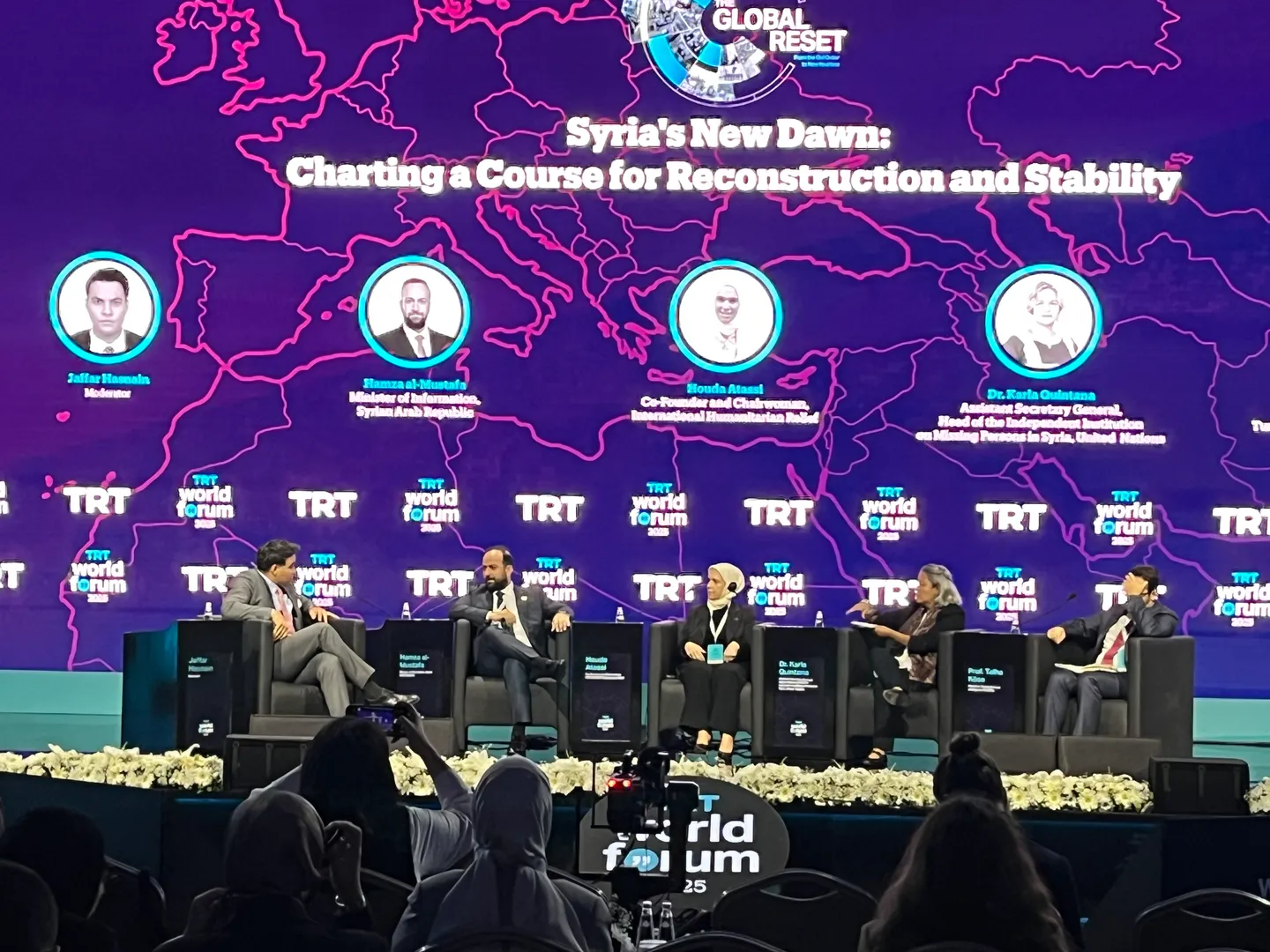
A year ago, Hamza al Mustafa of Syria – then an academic and researcher – addressed an august gathering in Istanbul, talking about the fractures of his war-torn homeland.
Back then, Syria’s future was uncertain, with whispers of disintegration hanging in the air. And Mustafa’s thoughts at the TRT World Forum 2024 reflected his anxiety.
On Friday, Mustafa returned to TRT Forum’s 2025 edition in a new role: as Syria’s newly appointed minister of information, tasked with steering the media landscape in the post-Assad regime.
“I’m here to represent my new Syria…In 14 years of civil conflict, Syria has had a lot of division. The ousted regime invested in this division as a survival strategy,” he said, while taking part in a panel discussion titled ‘Syria’s new dawn: Charting a course for reconstruction and stability.
Mustafa represents the Syrian Transitional Government led by President Ahmed al Sharaa, which has been operating under a temporary constitutional declaration that covers a five-year transition period since opposition forces toppled the decades-old Assad regime in December 2024 in a lightning-quick offensive.
The discussion, which drew a packed audience of diplomats, scholars and activists for its 90-minute intensity, focused on Syria’s most stubborn problem: fragmentation.
For decades under the Assad regime’s iron-fisted rule, the country had been engineered to splinter along sectarian, ethnic and communal lines.
The Assad era was marked by widespread atrocities – war crimes, enforced disappearances, and torture – that left deep scars on Syrian society. Power and resources funnelled to a narrow Alawite elite, while Sunnis, Druze and other groups were marginalised.
Taking part in the discussion, Talha Kose, president of Türkiye’s National Intelligence Academy, said the governance system in Syria under the Assad regime was “designed to be fragmented”.
“It was a divide-and-rule kind of system,” he said, noting that all power and resources were set aside for a single group of people.
“Other groups have been silenced. Their identity, their rights have not been recognised. So that has generated distrust among the population,” Kose, a Turkish expert on Middle Eastern security, said.
He urged the new Syrian government not to repeat Lebanon’s tragic mistake of formalising and institutionalising sectarian quotas into a “confessional” straitjacket, which eventually fuelled cycles of civil strife.
In the Lebanese confessional system, political and institutional power is proportionally distributed among religious sub-communities.
“Syria must not institutionalise the sectarian and other divides the way Lebanon did in the past,” he cautioned.
Instead, Kose urged the creation of inclusive institutions — political, social, educational, religious and even military — to rebuild Syria.
“You have to institutionalise this inclusivity of all groups,” he said. “It will be difficult because there’s a strong mistrust among the communities, but you can only bring this trust gradually,”
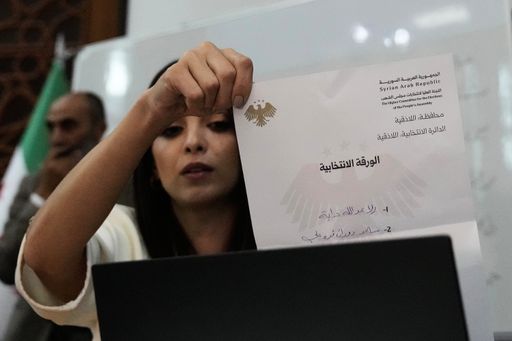
Responding on behalf of Sharaa’s transitional government, Mustafa said that Syria would chart a path different from Lebanon. “Foreign forces have always tried to divide Syria into small fragments,” he said, referring to the French mandate in the last century when colonial carve-ups sowed early discord.
“But Syrians reunited after the end of the French mandate,” he said.
He recalled how doomsayers had predicted the balkanisation of Syria as recently as a year ago. Yet the Syrian people, weary of the Assad era’s “survival strategy” that engineered rifts along sectarian and ethnic lines, chose unity over division.
“Syrian people decided to adopt the path of unity after decades of divide-and-rule politics of the Assad regime,” the minister said.
The Sharaa administration is holding dialogues to bridge communal differences, building cross-cutting institutions to dilute old loyalties, and making a collective push against external saboteurs, he said.
Towards accountability, independent media
The panel discussion steered towards the media’s role in mending old divides, as the Assad regime relied heavily on propaganda to maintain its grip on power.
Mustafa, who once analysed propaganda as a scholar, now oversees the dismantling of the Assad network of misinformation.
“Media under the Assad regime was a tool for propaganda and misinformation,” he said.
By the time the Assad regime fell in 2024, the number of independent media outlets had fallen to just seven, all of which were operating in exile, he said.
But the new government remains fully committed to ensuring that independent media operate freely in Syria, the minister said.
The Sharaa government is facilitating a pivot from state-run mouthpieces to independent media, Mustafa said. As an example, he said the government received over 600 applications for private, independent outlets.
“As a government, we decided that we have to expand the margin of freedom as much as we can,” he said.
The topic of accountability also came up for discussion as a cornerstone of Syria’s ongoing reconstruction.
The issue of “missing” people — those who vanished into the Assad regime’s torture centres over years of state brutality — stands out as a national sign of unresolved grief, said Karla Quintana, the UN assistant secretary-general and head of the Independent Institution on Missing Persons in Syria.
“No one would have thought a year ago that we’d be sitting here, and talking about how to look for the missing in Syria, with Syrians,” she said.
But post-Assad, the floodgates have opened, she said. From taxi drivers and food servers to pedestrians, “everyone has someone missing or knows someone that is missing”.
She said the scale of the problem is staggering: in a nation of roughly 22 million, scarcely a family is untouched. Quintana’s institution, mandated to probe the fates of tens of thousands disappeared in Syria since 2011, is partnering with the new national commission on the missing.
“When we talk about looking for the missing, we have to think of it as a collective effort,” she said.
Speaking on the occasion in Arabic, International Humanitarian Relief Foundation co-founder and president Houda Atassi recalled how civil society organisations were unable to operate effectively in areas once controlled by the Assad regime.
But now all aid organisations enjoy complete freedom to contribute to Syria’s reconstruction without any fear, she added.