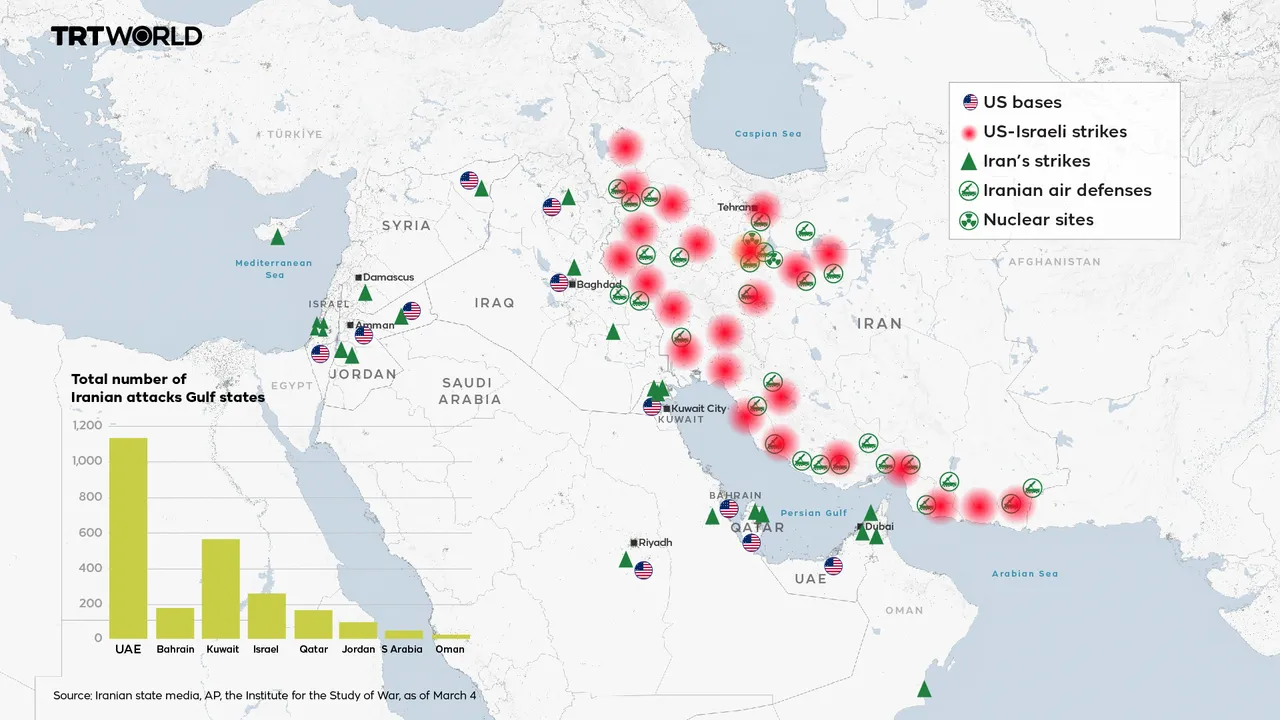
Iran has launched far more drones and missiles at Gulf countries than at Israel since the US-Israeli war on Tehran started, according to a US-based conflict monitoring project.
Iran has reportedly launched 255 drones and missiles targeting Israel since February 28. Compared to that, it has fired 2,171 drones and missiles towards Gulf states during the same period, according to a report by the Critical Threats Project (CTP), which is part of the American Enterprise Institute.
The figures suggest Iran’s retaliation has focused heavily on regional US allies rather than Israel itself. Of the 2,171 attacks targeting the Gulf, 1,138 were aimed at the United Arab Emirates, making it the most heavily targeted country in the conflict.
Iran also accused Israel of carrying out several strikes on energy and civilian sites in the Gulf, calling the attacks a calculated bid to spark regional fury and pull Arab states into the war against Tehran.
The Israel-US war on Iran has rapidly spilt into neighbouring Gulf nations, all of which host American military bases and maintain close security ties with Washington.
Analysts say Tehran’s strategy appears aimed at pressuring those governments to push US President Donald Trump to halt the war, but it appears Iran has miscalculated.
“The Gulf states now face stark choices: to join the United States more openly in its war effort… or risk further escalation on their own soil,” Abdulaziz Sager, chairman of the Saudi-based think tank, Gulf Research Center, told Reuters.
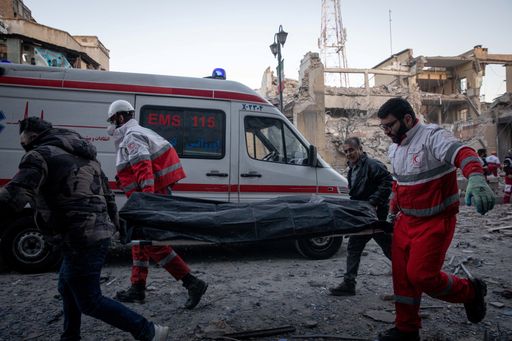
‘Active theatre of response’
Gulf countries are now warning Iran, and there are growing fears of collective retaliation against Tehran that would make the conflict a more dangerous and deadly regional war.
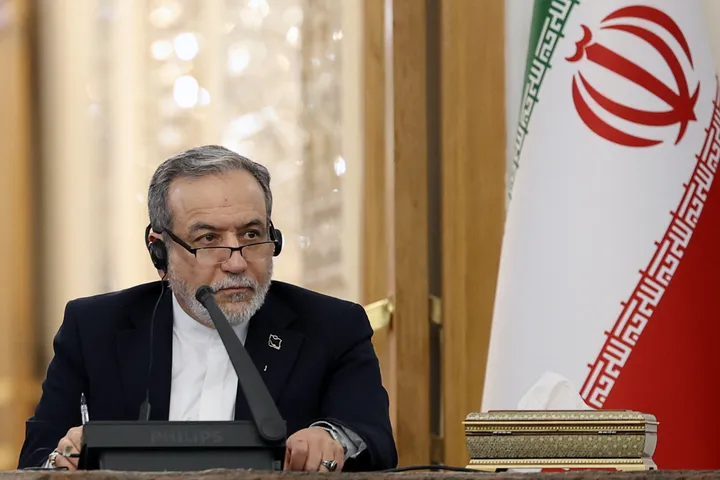
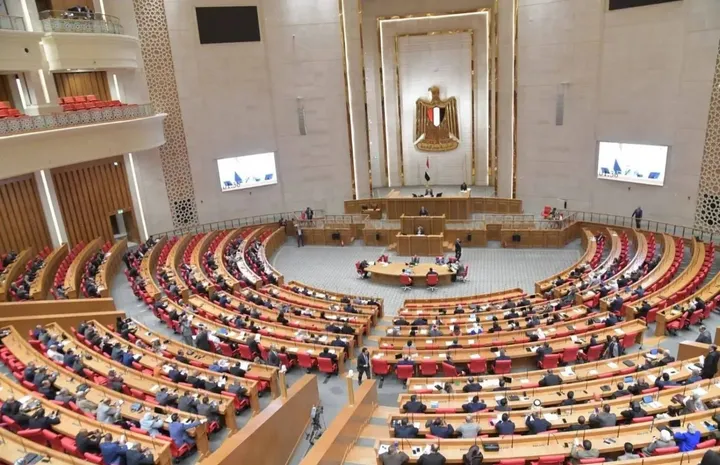
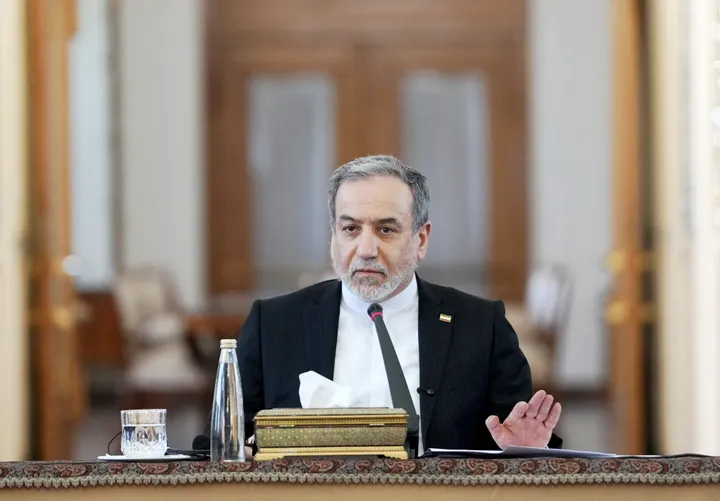


Saudi Arabia, the United Arab Emirates, Qatar, Bahrain, Kuwait and Oman held an emergency ministerial meeting of the Gulf Cooperation Council on Sunday, invoking Article 51 of the UN Charter and signalling readiness for collective self-defence.
The bloc warned Tehran that continued attacks could transform the Gulf from a defensive shield into an “active theatre of response.” At the same time, joint air-defence systems and reconnaissance flights have been activated across the region.
Officials in the UAE are also considering military action to stop Iranian missile and drone strikes, Axios reported, citing sources familiar with the discussions.
Qatar has also issued strong warnings. Foreign ministry spokesperson Majid al-Ansari said Iranian strikes on the Gulf state were “blatant” and warned that such attacks “cannot go unanswered.”
The conflict is spilling beyond the Gulf. Turkish defence officials said NATO air defence systems intercepted an Iranian ballistic missile heading towards Türkiye after it crossed Iraqi and Syrian airspace, destroying it outside Turkish territory on Wednesday.
Meanwhile, drones launched from Iran struck Azerbaijan’s Nakhchivan exclave near the Iranian border on Thursday, damaging infrastructure near the region’s airport and injuring two civilians, according to Azerbaijan’s foreign ministry.
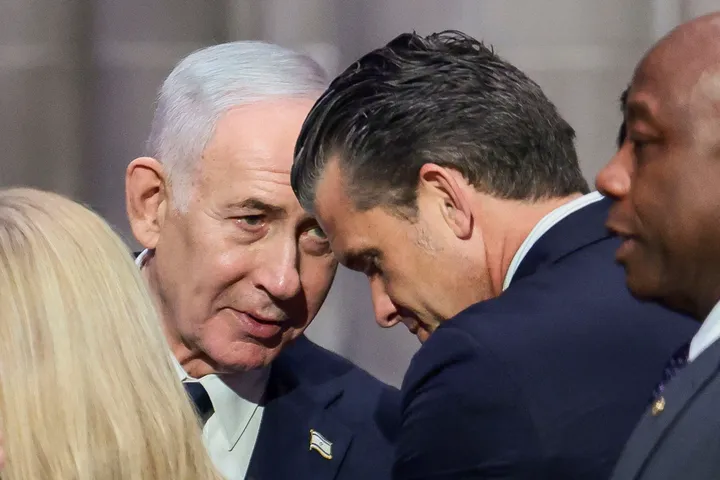
Despite the widening regional attacks, US officials say the intensity of Iranian strikes has recently declined. US Secretary of War Pete Hegseth said on Wednesday that Iranian attacks had decreased compared with the first days of the conflict, citing fewer launches of missiles and drones in recent days.
Still, the scale of Iran’s attacks across the Gulf underscores the growing risk that the war could evolve into a broader regional confrontation, experts warn.