 Kazim Alam
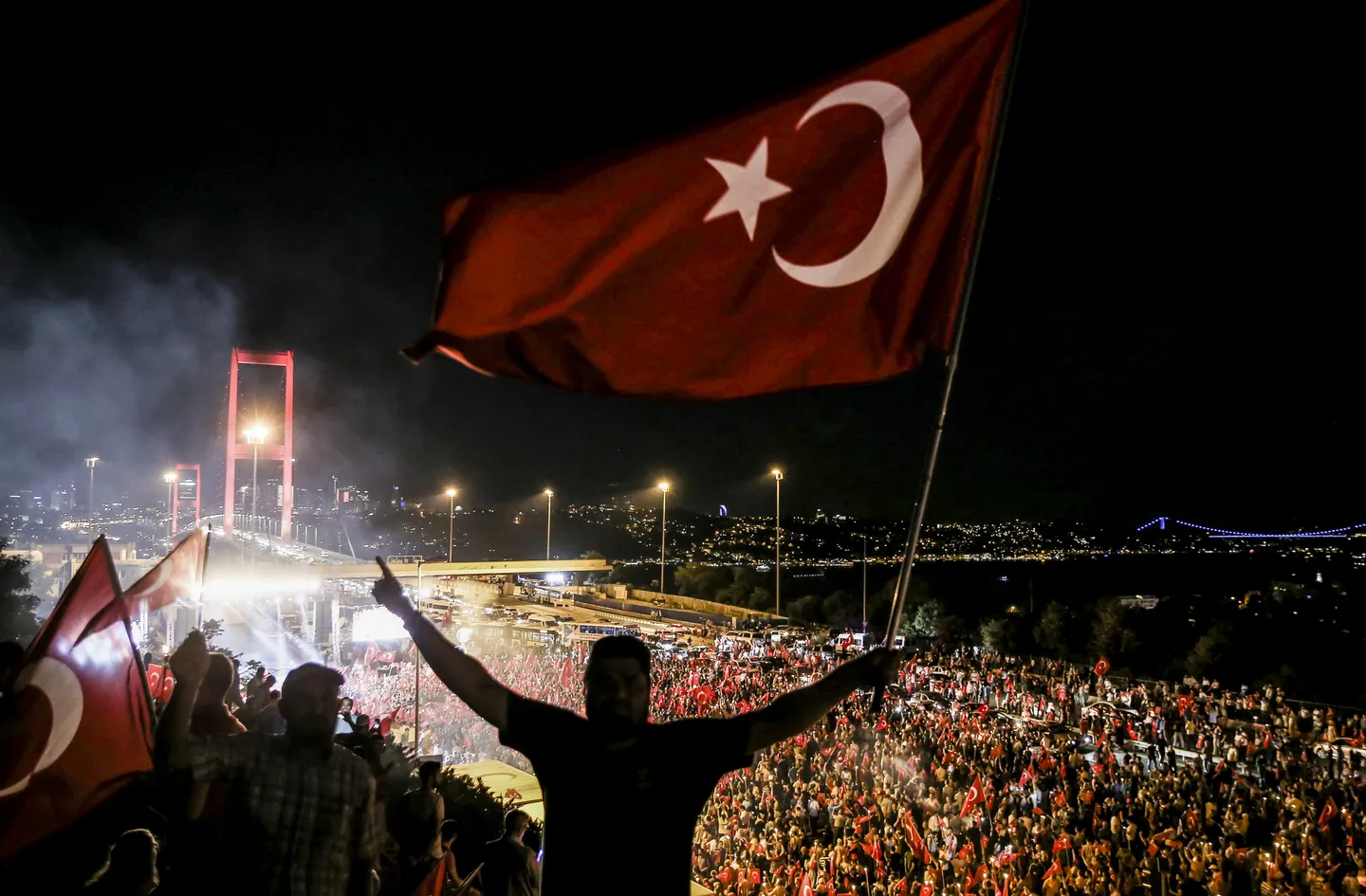
The image is stark, its meaning raw and unfiltered. Tanks and soldiers blocking one lane of the brightly-illuminated Istanbul Strait (Bogazici) Bridge in Istanbul.
In the foreground, a man is kneeling in front of a lifeless body – one of his fingers raised in the universal symbol of defiance.
A decade later, that image from the night of July 15 stands as one of the most iconic moments of the failed coup attempt and also as the symbol of people’s collective resolve to save democracy.
It is one of the many stories that the Istanbul Strait Bridge remembers from that eventful night.
The suspension bridge inaugurated in 1973 connecting the European and Asian sides of the city across the Istanbul Strait, was the scene of perhaps one of the most important battles on July 15 where people fought against a renegade group of soldiers loyal to the FETO terror outfit.
It has since been renamed as the July 15 Martyrs Bridge to honour the 253 people, many of them civilians, who made the ultimate sacrifice to protect the Turkish republic.
Experts say that long before steel cables and concrete connected the two continents, armies sought to bridge these waters with far humbler means.
The earliest recorded attempt dates back to 513 BCE, when Achaemenid King Darius I ordered a floating bridge, which uses shallow-draft boats to support a continuous deck, to move his troops against the Scythians.
Ali Burak Daricili, associate professor in the Department of International Relations at Bursa Technical University, tells TRT World that while no permanent structure existed at the precise site of today’s bridge during the Ottoman era, the strategic imperative of crossing or controlling the Istanbul Strait is ancient.
“The idea of connecting the two sides of the Strait… goes back a very long time in the history of Istanbul,” he says.

Daricili says that Ottoman strategy relied on fortresses rather than bridges.
Mehmed II, the sultan of the Ottoman Empire in the 15th century, built Rumeli Fortress on the European shore before the 1453 conquest, and paired it with Anadolu Fortress on the opposite side to dominate the strait and cut off Byzantine reinforcements from the Black Sea.
Ozgur Korpe, an academic affiliated with Türkiye’s National Defence University, tells TRT World that Ottoman engineers largely avoided spanning the Istanbul Strait because of its powerful currents and depth.
Instead, they constructed temporary suspension bridges across the Golden Horn, an inlet of the Istanbul Strait dividing the European side of the city into ‘Old’ and ‘New’ parts.
During the historic 53-day siege of present-day Istanbul in 1453, Sultan Mehmed II deployed such a floating bridge to move troops and artillery efficiently, he says.
A famous but unrealised design by Leonardo da Vinci in 1502 for Sultan Bayezid II also targeted the Golden Horn, not the Istanbul Strait itself, he notes.
When people prevailed against tyranny
Until the late 20th century, intercontinental movement relied on ferries and maritime routes, Korpe says.
The modern Istanbul Strait Bridge, inaugurated 53 years ago, finally realised the centuries-old dream of a permanent link between the Asian and European sides of the city.
Yet, its true transformation came on the night of July 15, 2016, experts say.
That evening, coup plotters identified as members of the FETO terror group launched a violent attempt to overthrow the democratically elected government of President Recep Tayyip Erdogan.

Putschists blocked Istanbul’s Istanbul Strait Bridge and the Fatih Sultan Mehmet Bridge at approximately 10pm as tanks and military vehicles took positions.
The timing and method proved disastrous for the coup plotters, experts say.
Korpe points out that the blockade began on a Friday evening during peak traffic hours using only a handful of light trucks.
“Deploying only a few light military trucks during peak traffic hours proved to be a critical strategic error,” he says.
“Rather than establishing decisive military control, the blockade stranded a large number of civilians, inadvertently alerting the public and facilitating rapid mobilisation,” he says.
Citizens responded immediately. Thousands of ordinary people rushed to the bridge and the surrounding streets.
Daricili recalls that ordinary people went to the bridge and stood against tanks, armoured vehicles and armed soldiers.
“Most of them were unarmed. This changed the psychology of the night,” he says.
Putschists opened fire on the unarmed crowds. Thirty-four civilians were killed that night on the bridge.
But people prevailed over tyranny. By dawn, the putschists on the bridge had lost control.
“As citizens responded to the government’s call and gathered at the bridge, the limited ground forces of the coup participants were quickly outnumbered,” Korpe says.
“Ultimately, the civilian resistance at the bridge undermined the psychological and operational momentum of the coup, demonstrating the failure of the faction to secure public or territorial compliance,” he adds.
According to Daricili, coups typically succeed through fear in the opening hours, when people stay home and institutions fall silent.
But the opposite occurred on July 15.
“People went out to the streets. They resisted in many places, including the Istanbul Strait Bridge. This broke the fear that the coup makers wanted to create,” he notes.
“The power of weapons faced the will of the people. The coup makers had tanks and guns, but they did not have legitimacy. The people had legitimacy, courage and determination,” he says.
Daricili says the renaming of the bridge is aimed at keeping the memory of that night alive.
Future generations will remember the bridge in two ways, he notes.
“First, as a great bridge connecting Asia and Europe. Second, as the place where Turkish people stood against the coup makers on July 15,” he says.
“This second meaning will become stronger with time.”