 Murat Sofuoglu
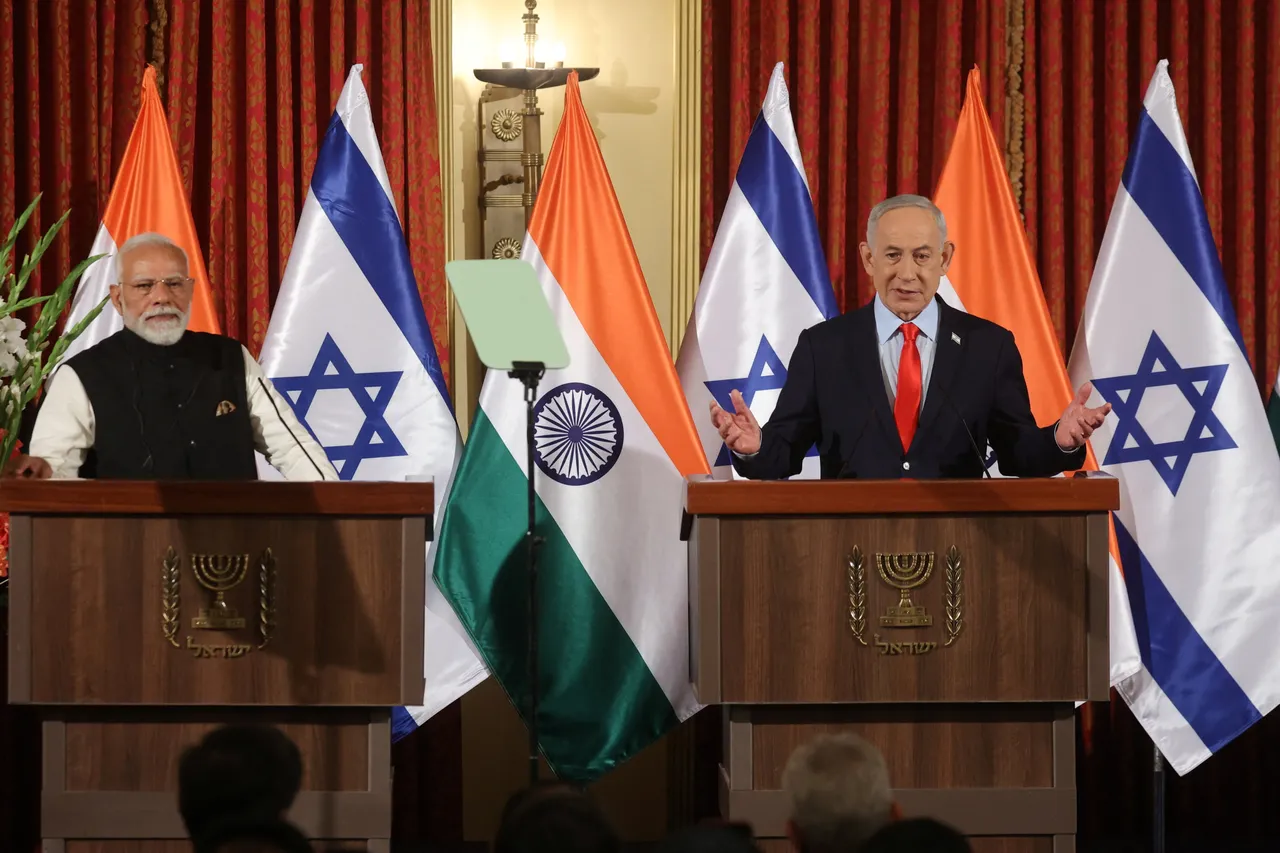
As tensions mounted in the Gulf ahead of what would later become a direct US-Israeli confrontation with Iran, Indian Prime Minister Narendra Modi’s visit to Israel signalled shifting regional alignments taking shape around Tehran.
Welcomed warmly by Prime Minister Benjamin Netanyahu last week, Modi did not comment on civilian casualties in Gaza, which Palestinian authorities say have exceeded 70,000, instead condemning Hamas’s October 7 attack as “barbaric”.
His trip coincided with Israel’s push to consolidate new strategic partnerships against what Israeli officials described as “radical axes” in the region, a framework widely understood to include Iran and its allied networks.
Netanyahu’s government has recently promoted the idea of a so-called “hexagon alliance” involving New Delhi, even as analysts question how such blocs redefine regional rivalries and draw new actors into Middle Eastern security dynamics.
The Israeli Prime Minister “needs a global and regional consent” in a time when he faces various accusations from genocide to crimes against humanity after his brutal conduct in Gaza, says Muhammed Athar Javed, a Copenhagen-based international security expert, referring to Modi’s visit to Israel.
“In the last decade, Modi has managed to create a special relationship with Israel,” Javed tells TRT World.
Also, unlike Russia and China, which have opposed any attack on Iran, India has not condemned the US military buildup in the Gulf, sending a positive signal to Israel, says the analyst.
In 2017, Modi, a Hindu nationalist, became the first Indian leader to visit Israel. Unlike previous Indian leaders, who supported the Palestinian cause, Modi has taken a different approach, strengthening relations with Israel across various sectors, from defence to technology and trade.
Behind the pragmatic trade-off between the two states, which benefits both countries, analysts recognise that an ideological factor is also influencing the deepening ties between the Middle East’s only non-Muslim majority state and the world’s most populous nation, which has a significant Muslim population.
“Delhi has now emerged as Israel's strongest non-Western ally. There is strategic cooperation and ideological convergence between the two, which actually strengthened during the course of this genocide,” Azad Essa, an expert on Israel-India ties and the writer of Hostile Homelands: The New Alliance Between India and Israel, tells TRT World.
“The visit was Netanyahu's opportunity to thank Modi for his support over the past two and a half years and to try to give the impression to Israelis that he is not isolated or without influential friends around the world.”
Zionism-Hindutva ‘conversation’
Essa highlights how the ruling ideologies of Netanyahu’s Israel and Modi’s India have been in political dialogue for decades, referring to Hindutva, a far-right Hindu nationalist movement, and Zionist nationalism.
“They both have expansionist and exclusionist goals and run on narratives of historical grievance and civilisational greatness,” Essa says.
Modi’s Bharatiya Janata Party (BJP) has been closely linked to Rashtriya Swayamsevak Sangh (RSS), a paramilitary organisation that promotes Hindutva, the concept of Hindu dominance and hegemony across India, aiming to “purify” the state from its Muslim population.
Conversely, Netanyahu’s current hawkish government includes members from Israeli parties who aim to completely expel Palestinians from their native lands, replace them with illegal settlers, and pursue Greater Israel, encompassing territories from neighbouring Arab nations.

India and Israel have been guided by similar ideologies, which allow them to deepen their ties, says Muhammed Karakus, an academic at Adiyaman University.
Both Hindutva and Zionism are anti-Muslim in their nature, seeking to either expel or suppress large Islamic-professed populations, Karakus tells TRT World.
While Hindutva aims to erase its Muslim-led Mughal legacy from the Indian landscape through various means, including its so-called “bulldozer justice”, Israel seeks to demolish Palestinian homes and Muslim heritage buildings to make way for illegal settlements under the guise of protecting so-called ancient Jewish culture, the academic says.



Both Hindutva and Zionist followers have been inspired by ancient history and texts, which they believe entitle them to extra-territorial visions: Eretz Israel and Akhand Bharat.
From this perspective, Hindutva advocates believe that India is a Holy Land (Punya Bhu) and their ancestral homeland (Petri Bhu), while Zionists believe the same thing as the Jews, for God’s chosen nation is entitled to claim Israel, their promised land, Karakus says.
As a result, Modi and Netanyahu find many commonalities in how they perceive their internal issues, which are largely related to suppressing large Muslim populations, according to Karakus.
“India’s Kashmir policies have copied Israel’s Palestine policies in many ways, from installing checkpoints to constant harassment of the local population across the Muslim-majority region,” he says,
Indian-administered Kashmir is a disputed region between India and Pakistan, whose part under Indian administration is called Jammu and Kashmir. In 2019, Jammu and Kashmir’s autonomous status and its right to self-determination, backed by international law, were illegally stripped by the Modi government. Since then, India has installed military rule in the region.
“They both see Muslims as outsiders and as a demographic threat. Both ideologies view Kashmir and Palestine as ordained through religious mythology,” Essa says.
India’s role in the hexagon alliance
Analysts say these ideological affinities, reinforced by expanding institutional cooperation across sectors including defence, technology, agriculture, cybersecurity and innovation, could deepen India–Israel collaboration, particularly in the context of Netanyahu’s recently proposed “hexagon alliance.”
“India is becoming the second most important country for Israel after the US,” Alon Liel, a former director general in the Israeli foreign ministry, tells TRT World.
India has long been Israel’s biggest arms customer, accounting for 34 percent of Tel Aviv’s weapons exports. Reportedly, New Delhi sold different weapons parts to Tel Aviv even during the Netanyahu government’s genocidal war on Gaza.
Aimen Jamil, an Islamabad-based political analyst, regards the proposed “hexagon of alliances” not as a formal military bloc but as a flexible, minilateral framework centred on coordination in security, technology, and economic integration among like-minded states.
“India’s importance lies in its scale, and economic weight. For Israel, India is both a defence partner and a global power with diplomatic reach,” Jamil tells TRT World.
Among other areas, India might play a critical role by securing “economic connectivity” to Israel by participating in the IMEC (India-Middle East-Europe corridor), she says.
The Western-led IMEC has recently emerged as an alternative to China’s Belt and Road Initiative, linking India through the UAE and Saudi Arabia to Israel and, from there, to Europe across the Mediterranean. Trump has strongly backed IMEC, reportedly urging Modi to join the initiative.
But Jamil believes that India will not engage in rigid bloc politics, which “could strain relations with the Gulf, affect energy security, or undermine its strategic autonomy,” she says.
“The framework offers Israel options amid uncertainty and gives India another avenue to secure high-value partnerships without formal alliance obligations.”
Analysts remain sceptical of Netanyahu’s new geopolitical strategy, saying his bloc is trying to promote a concept that does not yet exist in reality, and it only reflects Israel’s long-term ambitions.
“Netanyahu's hexagon bloc is an attempt to sell an idea that doesn't exist on the ground, at least at this point. It shows Israel's long-term desires,” Ali Akbar Dareini, a Tehran-based researcher and writer at the Journal of the Center for Strategic Studies, tells TRT World.
“I would call all this (hexagon alliance) part of Israel's neo-periphery doctrine, a foreign-policy strategy aimed at developing relations with actors beyond its Arab Muslim neighbours,” he says.