Italian aerospace company Leonardo and Turkish defence firm Baykar on Monday shared behind-the-scenes details of successful flight trials that saw a crewed aircraft and an uncrewed fighter fly together in autonomous formation.
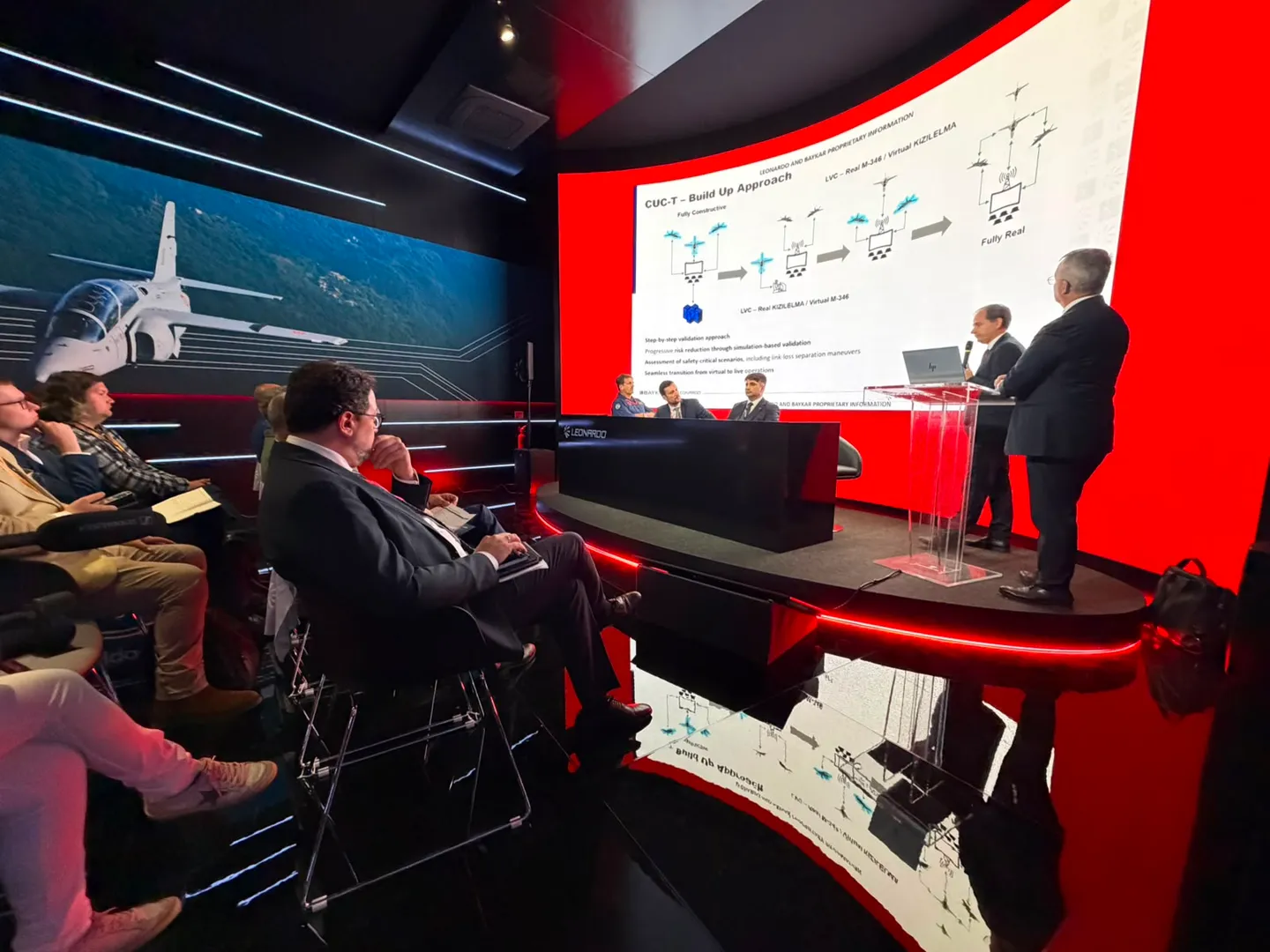
Engineers and pilots presented the findings from the K-SWARM programme at the Farnborough International Airshow in the UK.
The live flight tests were carried out in May at Baykar’s flight and test centre in Corlu, Türkiye, to test and validate Crewed/UnCrewed Teaming (CUC-T) capabilities for future air combat.
During the trials, the Bayraktar KIZILELMA uncrewed fighter performed an autonomous taxi and take-off before rejoining a Leonardo M-346 fighter jet in the air. A second aircraft, an Italian Air Force T-346A, acted as a chase plane.
Once airborne, the M-346 assumed control of the KIZILELMA using a newly developed integrated avionic suite and computing system.
Pilots aboard the M-346 issued commands that were autonomously carried out by the KIZILELMA, including position changes and separations.
Data sharing between the two aircraft was supported by a dedicated radio frequency system and protected in real time by Leonardo’s proprietary GCC Tactical Platform cyber defence system.
The live operation marked the transition of the project from laboratory simulation to real-world flight.
Development involved months of joint preparation between teams in Italy and Türkiye. Algorithms developed at Leonardo’s facilities in Turin and Venegono were integrated with smart fleet autonomy software created at Baykar’s Hardware-in-the-Loop Laboratory.
According to Baykar, KIZILELMA’s built-in autonomy helped simplify the integration process, enabling rapid deployment onto the live aircraft.
Autonomous flight and shared control
During the trials, the KIZILELMA aircraft carried out an autonomous taxi and take-off before rejoining the M-346 jet.
Using smart fleet autonomy algorithms developed by Baykar, the unmanned aircraft then operated under commands from the M-346.






The companies said pilots in the M-346 were able to command different flight formations, including position changes, separations and rejoins, which were autonomously executed by the KIZILELMA.
Collaborative combat operations are increasingly seen as a key component of modern air defence, designed to lower pilot workload and increase mission effectiveness while keeping human decision-making at the centre.
Data gathered from the Corlu flight campaign will be used to prepare for more complex operations where crewed and uncrewed assets work together "as one" toward mission objectives.
Further flight tests with expanded capabilities and higher operational complexity are scheduled for the coming months.
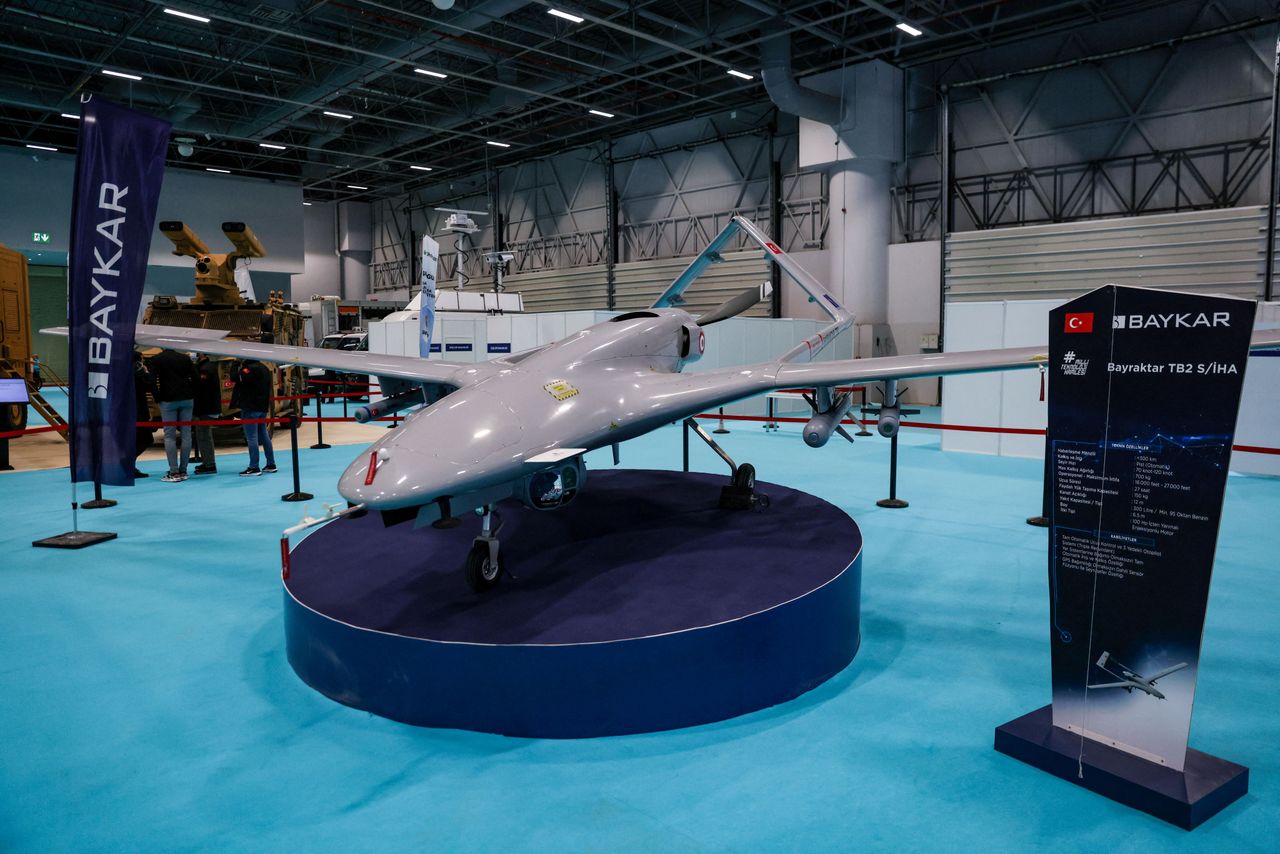
Baykar also displayed the Bayraktar TB3 unmanned aerial vehicle at the airshow. Designed to operate from short-runway platforms, the TB3 has become one of the flagship platforms supporting the European market ambitions of LBA Systems, the joint venture established by Baykar and Leonardo last summer.
The exhibition of the Bayraktar TB3 is expected to demonstrate that the companies' cooperation extends beyond experimental trials and is being backed by mature, near-production platforms in the field of unmanned aerial systems.
Partnership combines complementary capabilities
The partnership between Baykar and Leonardo began with the signing of a memorandum of understanding in Rome in March 2025. The companies formalised the cooperation by signing the joint venture agreement for LBA Systems at the Paris Air Show that June.
Headquartered in Italy and owned equally by both companies, LBA Systems focuses on the design, development, production, and support of unmanned aerial systems.
The partners aim for the venture to play a leading role in shaping the future of unmanned aviation.
Under the collaboration, Baykar contributes its expertise in designing and developing advanced unmanned platforms, while Leonardo provides state-of-the-art electronic systems and mission payloads, supports the development of manned-unmanned teaming and swarming capabilities, and contributes to qualification and certification activities.