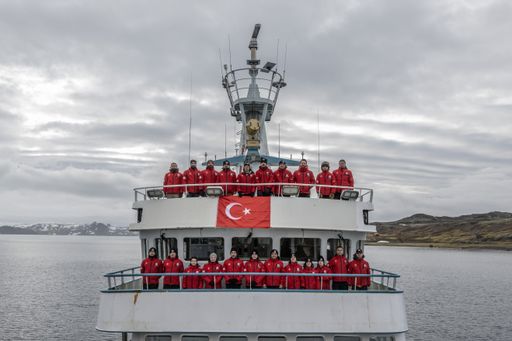
Turkish and Bulgarian geologists participating in Türkiye's 10th National Antarctic Science Expedition have launched a joint research initiative to uncover Antarctica's geological history and assess its implications for future climate change.
The expedition is coordinated by the Scientific and Technological Research Institution (Tubitak) of Türkiye's Marmara Research Center's Polar Research Institute under the Industry and Technology Ministry and the Turkish Presidency.
Researchers are examining what they describe as Antarctica's geological memory to understand how the continent transformed from a temperate landmass into a frozen environment over millions of years.
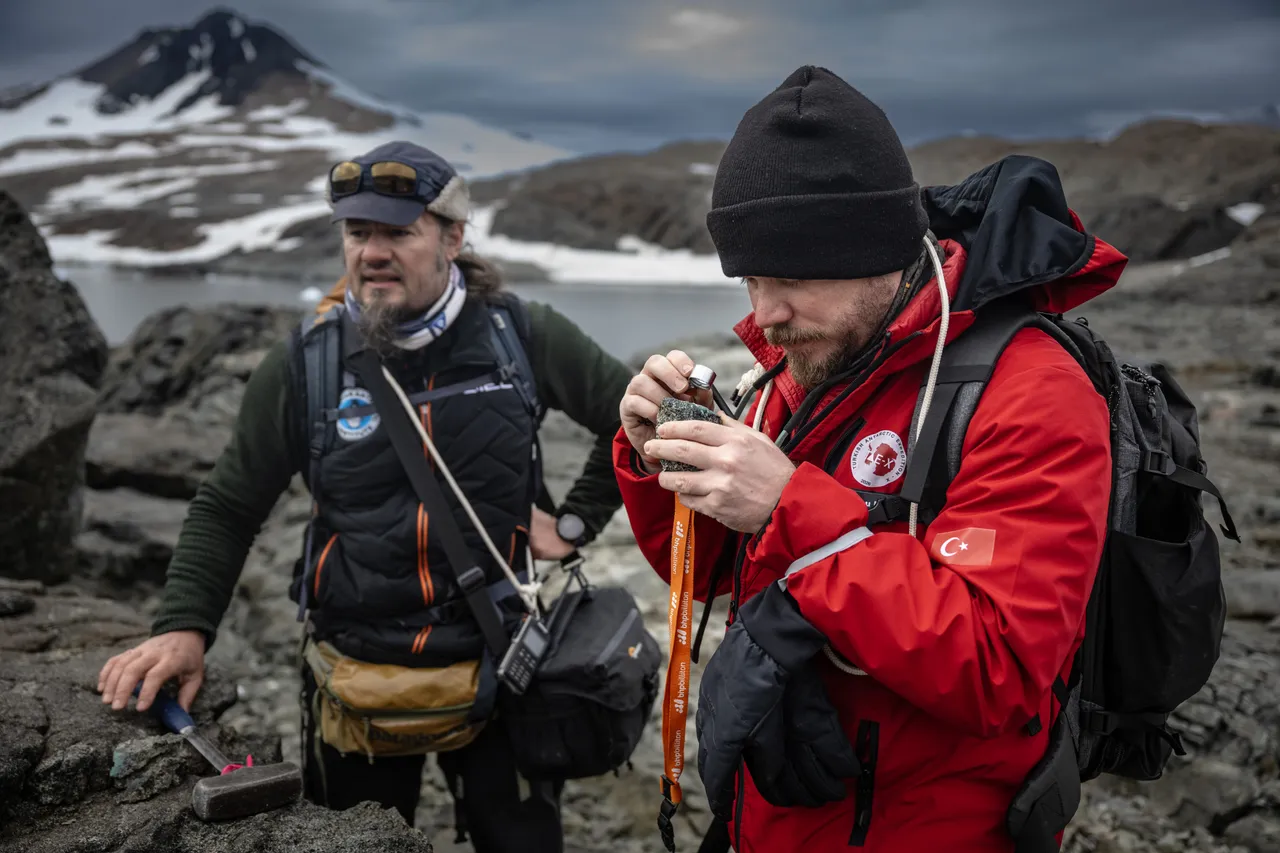
Goksu Uslular, deputy leader of the expedition, is working alongside Stoyan Georgiev, an associate professor at the Bulgarian Antarctic Institute, on geological fieldwork on Horseshoe Island, where Türkiye's Antarctic research camp is located.
Uslular said the joint effort focuses on mapping the island's magmatic history, which she said would significantly advance understanding of Antarctica's geological evolution and the long-term effects of climate change.
"Horseshoe Island, located in West Antarctica, hosts rocks from different magmatic phases that bear the races of this long geological evolution," she said.
"Jurassic-Cretaceous magmatic rocks are especially widespread on the island, and additionally, pillow lavas, agglomerates, and various volcanic units formed in submarine or shallow marine environments are also found in this region."







Uslular said these rock formations offer important paleoclimatic evidence and help experts understand the large-scale glaciation process that began about 34 million years ago.
Georgiev said he joined the Turkish research team to examine mineralisation patterns on the island, adding that his fieldwork identified notable gabbro outcrops containing copper mineralisation.
"The most prominent structures visible in the field are thin veins of green malachite and green azurite minerals — these have developed as oxidation products of copper minerals," he said, noting that they represent a shallow epithermal system unique to the area.
The mineralisation is linked to an extensive magmatic history spanning from the Jurassic period, about 176 million years ago, to the Cretaceous period, around 76 million years ago.
Georgiev said these complex formations developed through subduction zones and slab rollback tectonic processes over long geological timescales, adding that the diverse magmatic phases observed on the Island suggest distinct metallogenic characteristics that remain largely unexplored.
The findings are expected to contribute to understanding long-term climate change by reconstructing past environmental conditions.
Samples collected during the expedition will undergo detailed analysis through international collaborations to refine the geological timeline of the region.