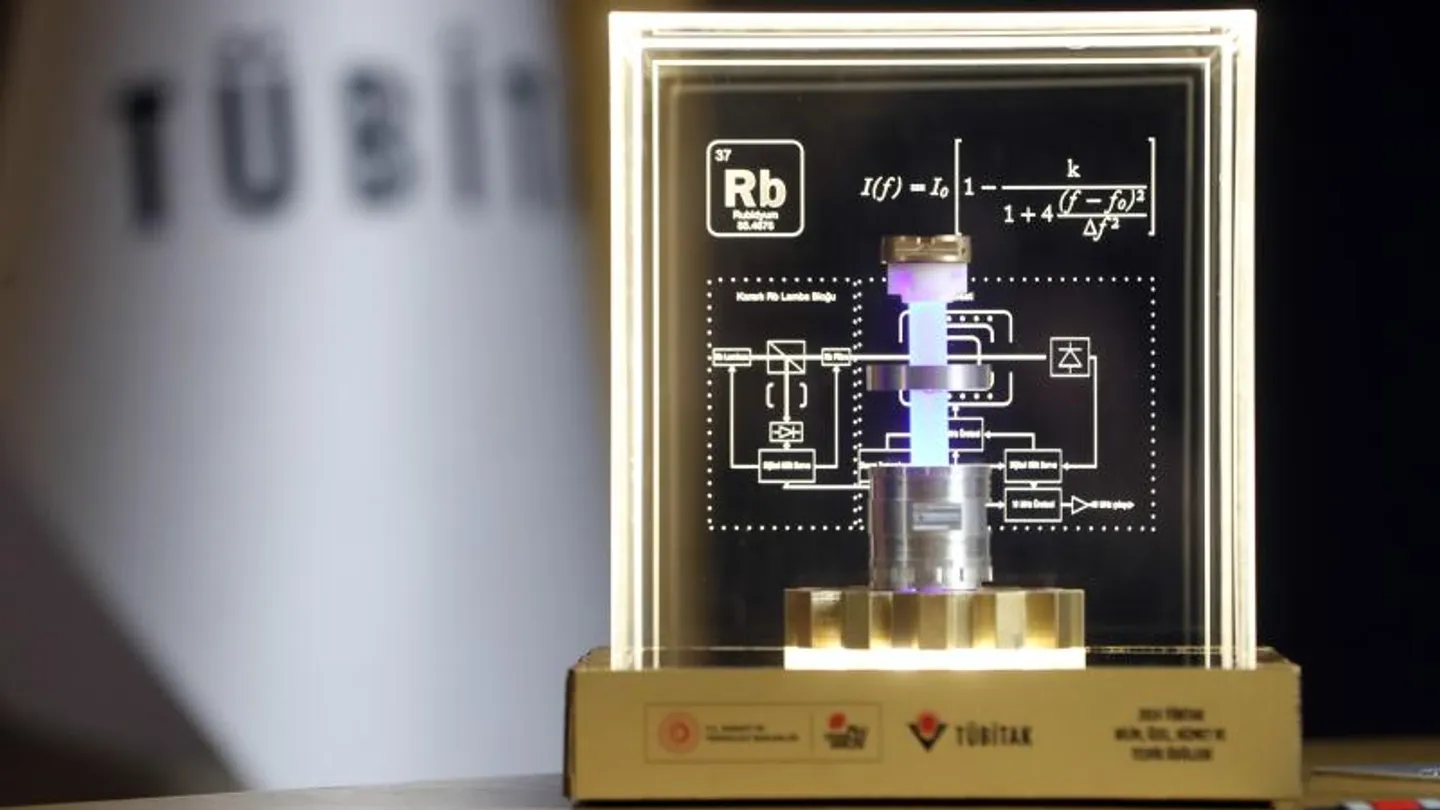
Türkiye’s domestically developed rubidium atomic clock has been launched into space aboard SpaceX’s Transporter-17 mission, Industry and Technology Minister Mehmet Fatih Kacir said.
Kacir said on Thursday on X that the first signal from the spacecraft carrying the Rubidium Atomic Frequency Standard, or RAFS, had also been successfully received.
“The Rubidium Atomic Clock, which is critical for the regional positioning and timing system included among the strategic objectives of our National Space Program, was successfully launched into space as part of SpaceX’s Transporter-17 mission,” he said.
Atomic clocks measure time with extremely high precision by using the constant resonance frequency produced as atoms transition between energy levels. A rubidium atom oscillates 6,834,682,610 times per second between two such levels.
The clock was developed under the leadership of the Turkish Space Agency, with the Scientific and Technological Research Council of Türkiye’s National Metrology Institute serving as the main contractor. TUBITAK Space Technologies Research Institute and ITUNOVA also contributed to the project.
The technology will be tested aboard a CubeSat under conditions in space, providing data for future satellite systems, communications infrastructure, navigation applications and scientific missions.








Kacir said the project marked an important step in strengthening Türkiye’s domestic capabilities in space-based timing and frequency technologies.
Once the orbital validation process is completed, Türkiye will join the countries possessing space-proven atomic clock technology, he said.
“Until now, this critical technology has been procured from abroad,” Kacir said, adding that domestic production would reduce foreign dependence while offering cost and supply advantages to satellite manufacturers.
He said the engineering, testing and operational experience gained through the project would also strengthen Türkiye’s capacity to develop next-generation satellites and space technologies.