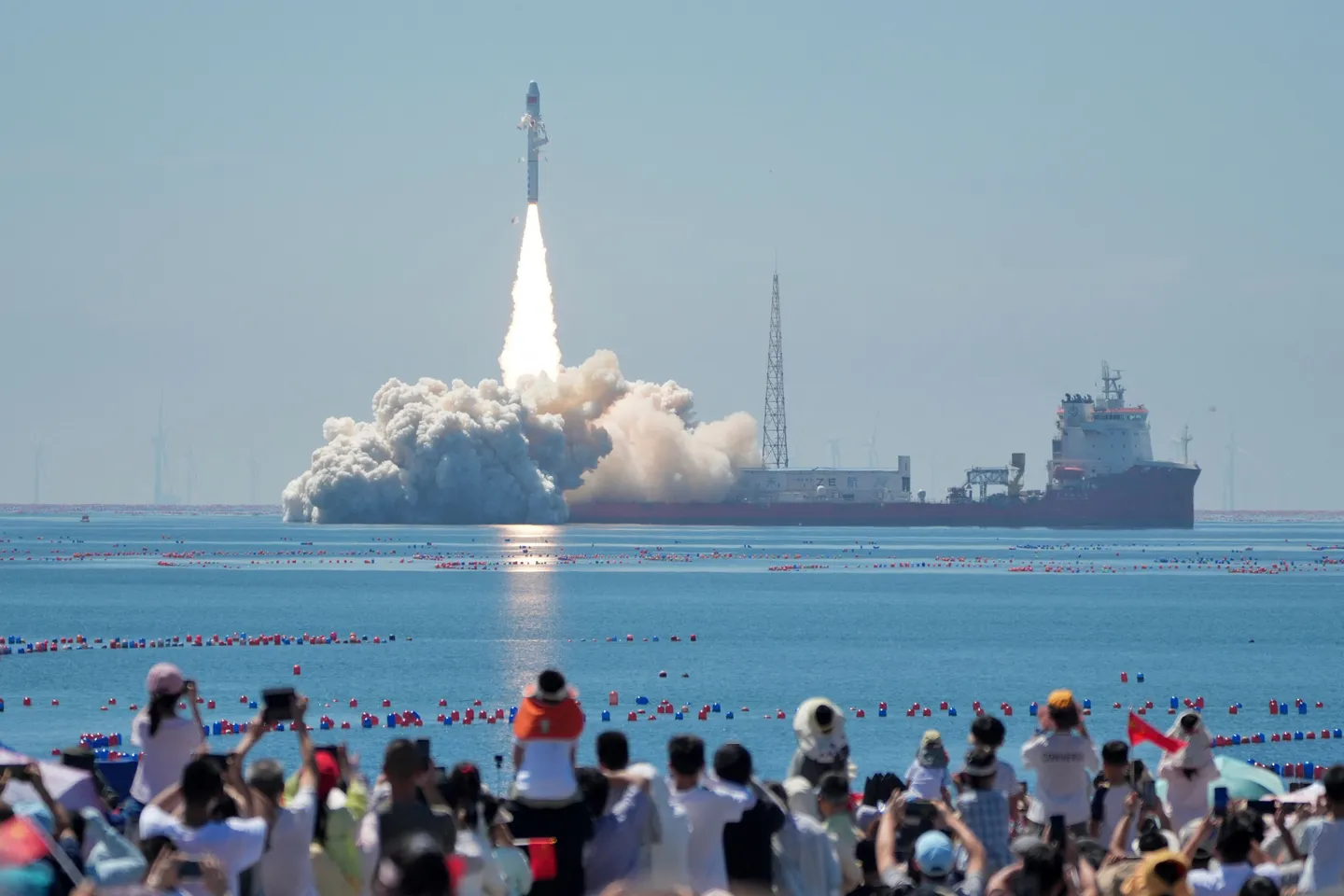
China has successfully launched 10 satellites aboard a Zhuque-2E Y4 carrier rocket, including eight designed to advance artificial intelligence computing capabilities in orbit, state-run Xinhua News Agency reported on Wednesday.
The rocket lifted off at 7.40 pm local time (1140 GMT) from the Dongfeng commercial space innovation pilot zone in northwestern China, placing all 10 satellites into their designated orbits, according to Xinhua.
Eight of the satellites belong to the second group of the Star Compute project, developed by Chinese commercial aerospace company ADAspace.
Designed to operate in dawn-dusk orbits, the satellites carry high-performance computing systems, laser communication equipment and low-light cameras.
They will test technologies including 10,000-watt liquid-cooling systems, large deployable cooling structures, space-based laser communication networks and the training of AI foundation models directly in orbit.
ADAspace said the mission would accelerate technological development and commercial applications of space-based computing.








Plans for orbital AI network
The company aims to establish an orbital AI infrastructure network comprising 2,800 computing satellites.
The first group of 12 satellites was launched in May 2025. In January, ADAspace announced that it had deployed Alibaba’s Qwen3 AI model aboard its orbital computing network, enabling AI processing directly in space.
The company plans to establish a 1,000-satellite network by 2030 and complete the larger constellation by 2035.