 Sadiq S Bhat
Washington, DC — As the Republican Party heads into the final weeks of the US midterm elections, they are working to protect several competitive Senate seats.
Meanwhile, Democrats are hoping to use their national poll lead to gain control of Congress.
Only 10 days remain before the crucial November 3 elections.
According to the most recent RealClearPolitics national average for congressional polling, Democrats currently lead Republicans by 50.5% to 42.4%.
Both the New York Times/Siena and CNN polls show Democrats leading Republicans by 11% and 10%, respectively.
These numbers indicate that Republicans face a difficult national environment. However, they don't determine who wins each state-by-state and district-by-district election.
David Schultz, Distinguished Professor of Political Science and Legal Studies at Hamline University in Minnesota, believes the true test is whether Democrats can connect voter dissatisfaction with the administration to viable solutions for voters' daily problems.
"Stronger Democratic candidates are combining opposition to Trump with issues such as affordability, opposition to the war, and concerns that are particularly relevant to voters in their own states and districts," Schultz told TRT World.
That combination could be crucial in states where Republican loyalty is high, but individual Democratic candidates are finding a way in.
Americans are going to elect all 435 members of the House of Representatives and fill 35 of the Senate's 100 seats.
The results will determine whether Republicans maintain control of Congress for the remaining two years of US President Donald Trump's term.
While the math appears simple, the election process is not.
Democrats must defend their competitive seats while also winning several seats Republicans currently hold. Narrow polling leads provide opportunities, but also leave enough room for either party to prevail.
Breadbasket of America
Schultz is closely watching Kansas, often called the "Breadbasket of America."
The Midwestern US state is rarely considered a major opportunity for Democrats in the Senate.
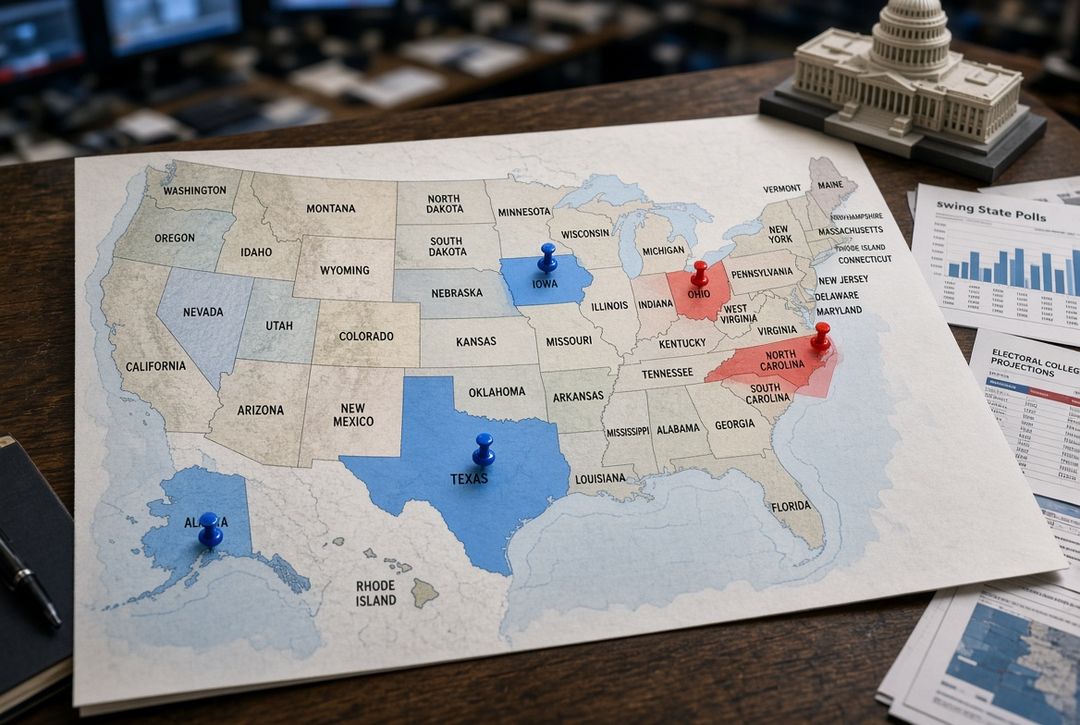
However, the Politix+ polling average shows Democrat Adam Hamilton 0.8 percentage points ahead of Republican Senator Roger Marshall.
In neighbouring Iowa, Republican Ashley Hinson leads Democrat Josh Turek by just 0.1 points.
Both races are virtually tied in those averages. Such small differences cannot provide a reliable advantage.
"For me, however, Kansas may be the most telling state," Schultz says. "Kansas has not been on many people's radar screens as a major Democratic opportunity."
He points to the state's 2022 referendum as an example of voters deviating from Republican positions on a major issue. In his view, that willingness to cross party lines helps explain why national political labels do not always accurately reflect voters' choices.
A Democratic Senate victory would be a significant result.
"It could indicate Democratic gains extending into areas that would typically not be considered competitive."
Schultz sees candidate quality as an important factor in both contests.
He believes Texas could become competitive sooner than he previously thought, though a narrow polling advantage does not guarantee a Democratic win.
"Perhaps 2026 will be the surprise year," he says.
Ohio, once a key presidential battleground, presents a different question: whether a well-known Democratic candidate can make the state competitive again.
"Democrats have a strong candidate there, which makes the race particularly interesting," Schultz says.
Alaska also remains close.







Democrat Mary Peltola leads Republican Senator Dan Sullivan by 1.8 points in the Politix+ average.
Schultz attributes Alaska's independent political streak to why competitive races there aren’t completely unexpected.
North Carolina displays a clearer Democratic advantage in current polling.
Roy Cooper leads Republican Michael Whatley by 10.3 points in the same average, making it one of the party's best opportunities to win a Republican-held seat.
Issues that matter to voters
However, the battle for Senate control also goes through states that Democrats must hold.
In Michigan, Democrat Abdul El-Sayed leads Republican Mike Rogers by 2 points.
Georgia's Democratic Senator Jon Ossoff has a larger advantage, leading Republican Mike Collins by 8.1 points.
To lose a Democratic-held seat, the party would need to win another Republican seat elsewhere.
Schultz also warns against viewing Democratic polling strength as an endorsement of every aspect of the party's agenda.
He says some voters support Democratic candidates while also expressing concern about the party's ideological direction. Candidates in competitive states often respond by focusing on practical concerns rather than national ideological arguments.
"Many Democratic candidates in these races are emphasising local issues and attempting to differentiate themselves from the Democratic Socialists of America, or DSA, wing of the Democratic Party."
This is a key feature of US elections: candidates with the same party label can campaign very differently based on the communities they wish to represent.
A message that resonates with voters in a heavily liberal district may have less appeal in a closely divided state.
"They need to discuss local issues that matter to voters," Schultz says.
Affordability is central to his assessment.
Republicans campaigned on reducing financial pressure on voters, and voters are now evaluating the party's performance in office. Schultz also identifies voter dissatisfaction with foreign military involvement as a factor influencing the campaign.
The governing party faces a familiar historical challenge. Presidents' parties generally lose ground in midterm elections; however, exceptions exist (such as Republican gains under George W. Bush in 2002).
Nevertheless, Schultz argues that dissatisfaction alone is insufficient for Democrats to obtain the seats they need. Their candidates must provide voters with reasons to vote for them.
The national congressional polling lead measures overall party preference. It cannot accurately predict how that support will translate into seats, especially when several Senate contests remain separated by only a few points.
A Senate roadblock
The outcome will also shape how Washington is governed.
A Democratic Senate could block judicial nominations and other presidential appointments requiring its approval. That authority would apply to a Supreme Court nomination if a vacancy occurred.
"Perhaps the most significant consequence would be the loss of presidential control over the confirmation process for federal judges," Schultz says.
Democratic control of both chambers would increase scrutiny of the administration and make Republican legislation harder to pass.
Trump would still have his veto power, and Senate Republicans could still use the filibuster to block bills.
However, a Democratic Senate could deny confirmation to his nominees, including any nominee for a Supreme Court vacancy.