 Sadiq S Bhat
Washington, DC — Texas has not elected a Democrat to the US Senate in more than 30 years. No Democrat has won a statewide election in Iowa since 2018.
Alaska elected its last Democrat to the US Senate in 2008, the same year voters elected a Republican president.
As of today, less than one month before midterm election day, all three states have turned competitive.
In addition, North Carolina and Ohio were two of the states that Donald Trump won in 2024.
These five races represent the path that Democrats believe will lead them back to controlling the Senate.
Mathematically, Republicans control 53 of the 100 seats in the US Senate.
The Senate is where presidential power meets its check, confirming judges and cabinet secretaries and giving America’s word abroad the force of law by ratifying treaties.
To regain control of the Senate, Democrats must gain four additional seats.
If the Senate ties (50-50), US Vice President JD Vance will break the tie in Republicans' favour.
That leaves Democrats with virtually no room to give ground. They must hold every seat they already have, from Jon Ossoff’s in Georgia to the open contest in Michigan, before looking across the map for the gains that could deliver a majority.
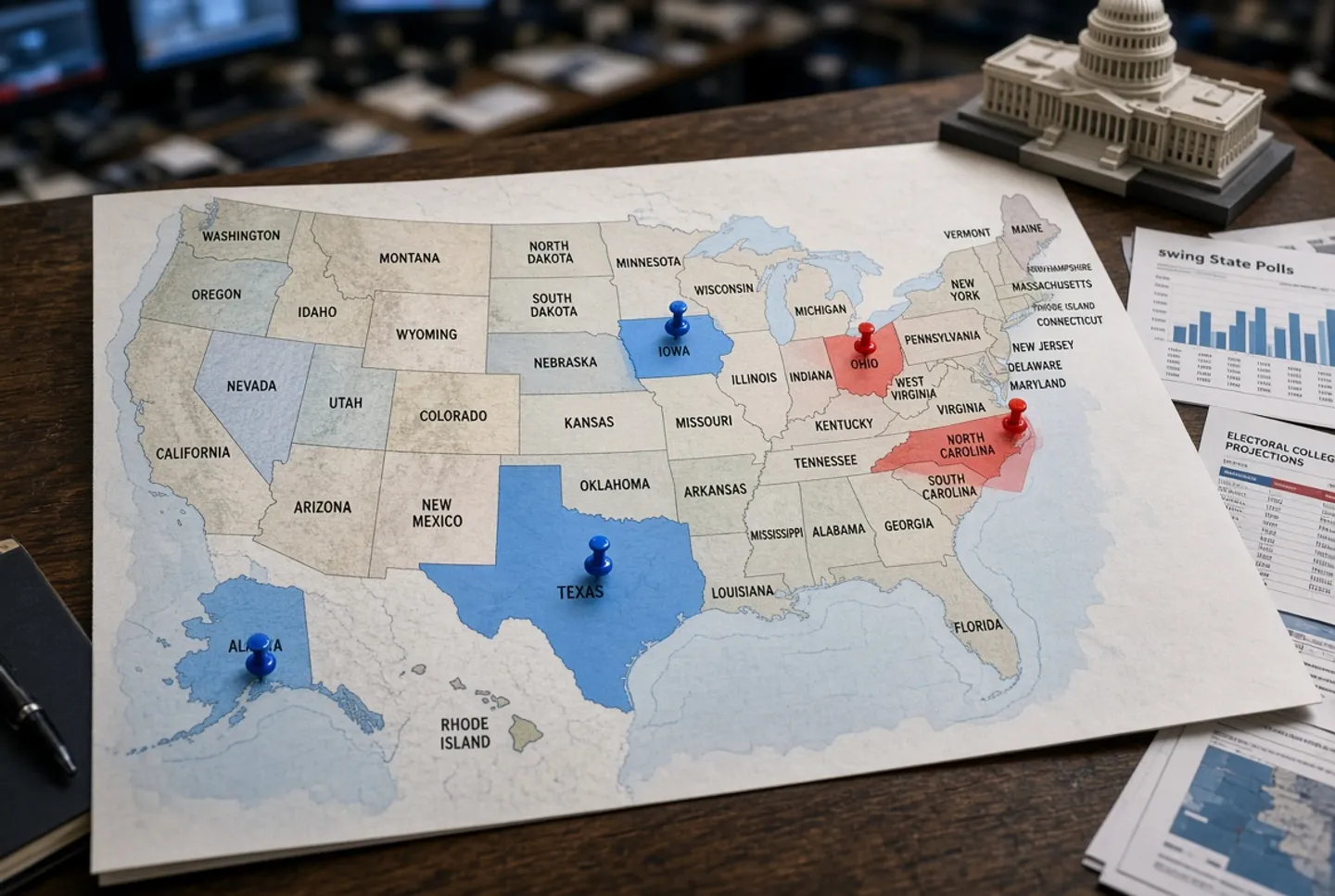
According to The Cook Political Report, a non-partisan organisation in Washington DC, North Carolina is now rated as leaning Democratic, and Alaska, Iowa, Maine, Ohio, and Texas are now rated as toss-ups.
Toss-ups are races either party could win.
Maine, where Republican Susan Collins is running for re-election, is the sixth target.
With a month to go until the midterms, here is the TRT World list of where the US midterm electoral map has changed the most.
North Carolina: most likely to flip
The prize Democrats covet most is North Carolina, where polling now suggests they have their clearest opportunity to take a seat from Republicans.
Democrats have recruited Roy Cooper, a two-term former governor who has never lost a statewide election.
Cooper is facing off against Republican Michael Whatley, a lawyer and former chairman of the Republican National Committee.
Whatley has never held elected office, and one of his own campaign ads starts off with that admission.
An Elon University poll conducted last month indicated Cooper led Whatley 49% to 38% among likely voters.
A Fox News poll indicated Cooper led by nine percentage points (53% vs 44%).
According to local reports on campaign finance filings, Cooper has raised more than $35 million compared to Whatley's $16.1 million.
Texas: the upset that everyone saw coming
This race would change the political landscape for at least a generation.
James Talarico, a Democratic state representative, is challenging Ken Paxton, the Republican attorney general, for the Texas Senate seat.
Paxton has a history of scandal. The Texas Senate impeached him and subsequently acquitted him in 2023 regarding allegations of bribery.
Four polls conducted in September showed Talarico leading. Marist Poll indicated that Talarico led Paxton 50% to 44% among registered voters.
Texas Public Opinion Research indicated that Talarico led Paxton by five percentage points (49% vs 44%), and Talarico led independents by 26 percentage points.
Emerson College and Texas Southern University each indicated that the race was tied at 47% vs 46%, within the margin of error.
The Texas Southern poll indicated that only 84% of Republicans supported Paxton, while 99% of Democrats supported Talarico.
More voters viewed Paxton unfavourably than favourably (55% vs 43%).
Ohio: the comeback kid
Democrat Sherrod Brown lost his US Senate seat in 2024. He wants it back.
This is a special election for the remaining two years of JD Vance's term, which expires in 2028.
Republican candidate Jon Husted, former lieutenant governor, is a well-known figure in Ohio politics who has also served as secretary of state and speaker of the Ohio House.







When Emerson College first tested the matchup in August 2025, Husted held a six-point advantage.
Since then, the race has shifted sharply.
By October 1, an InsiderAdvantage poll had Brown narrowly ahead, 44 percent to 43 percent, with the remaining support going to minor candidates.
Some members of Brown's old labour base have remained loyal. Some of Ohio's unions have endorsed Brown for the US Senate.
Republicans argue that Ohio’s recent voting history still favours them. But with the race tightening, the outcome is far from settled and could break either way.
Alaska: two Dan Sullivans vying for the same seat
Alaska may be the most unusual contest on the midterm map and potentially the one that determines which party controls the US Senate.
Republican Senator Dan Sullivan, in office since 2015 and endorsed by Donald Trump, is competing against Mary Peltola, a Democrat who won Alaska's only House seat in 2022 and became the first Alaska Native elected to Congress.
Peltola lost her House seat in 2024 and launched her US Senate campaign on a platform that she described as "fish, family, and freedom."
According to the Associated Press, Peltola received 48% of the vote compared to Sullivan's 42.8% during the August 18 primary, with 80% of votes reported.
A second candidate, Dan Sullivan (listed as Daniel J. Sullivan), also advanced.
State election officials launched an investigation after Republicans alleged that he ran to confuse voters. Peltola and the state Democratic Party have denied any involvement.
An Alaska Survey Research poll released on September 22 showed Peltola with a six-percentage-point lead over Sullivan among likely voters (50% vs 44%).
That has put the seat firmly on the Democratic radar, with the party increasingly eyeing the state as a possible pickup.
Iowa: open seat nobody expected
Republican Senator Joni Ernst's retirement created Iowa's first open US Senate race in ten years, and it has become much closer than her party anticipated.
Republican congresswoman Ashley Hinson secured her party's nomination in June with Donald Trump's endorsement.
Josh Turek, a Democratic state representative, secured his nomination on June 2nd and later received Barack Obama's endorsement.
Polling data has swung both ways.
A Fox News poll released in late June indicated that Turek led Hinson by four percentage points among registered voters (50% vs 46%).
Emerson College released polling data in August showing Hinson with a three-percentage-point lead over Turek (48% vs 45%).
A Suffolk University poll surveying likely voters indicated that Hinson led Turek by four percentage points (45% vs 41%).
Combined together, the average indicates a close race.
Cook Political Report moved this race to toss-up status on August 20 along with Texas.
Taking the Senate
Democrats do not necessarily need all five races to win control of the US Senate.
Any four would do, or three plus Maine, provided Georgia and Michigan stay in Democratic hands
North Carolina has been a swing state for decades. The other four states have not behaved like swing states in recent cycles, and their polling results are truly indicative of this cycle.
Republicans can still hold every one of these seats.
Ohio has broken late for them before, and Trump carried Iowa and Alaska by about 13 points two years ago.
But the party is now fighting for ground it used to leave alone.
In August, Ken Paxton, the Republican nominee in a state that has not sent a Democrat to the Senate in more than three decades, went on air with an urgent message for donors.
"We need help now," he said.