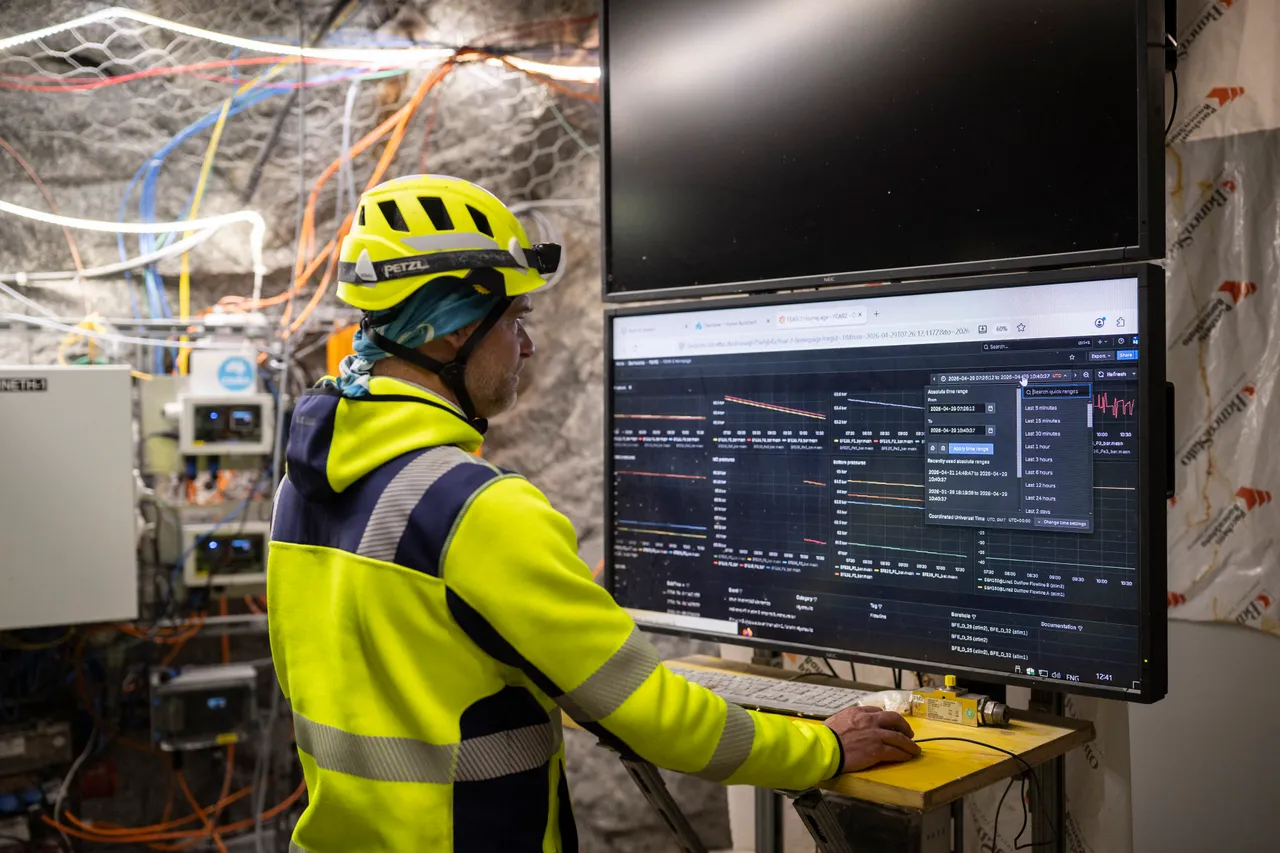
Researchers have made the ground shake in southern Switzerland, triggering thousands of tiny earthquakes in a monitored setting, as they seek to uncover insights into seismicity that could reduce risks.
"It was a success!" said Domenico Giardini, one of the lead researchers on the project, as he inspected a crack in the rock wall lining a narrow tunnel far below the Swiss Alps.
Wearing a fluorescent orange jumpsuit and helmet, the geology professor at the Swiss Federal Institute of Technology in Zurich (ETH Zurich) switched on his headlamp to get a better look.
"We had seismicity," he said excitedly, explaining that the goal was "to understand what happens at depth when the Earth moves".
Giardini was standing in the BedrettoLab carved out in the middle of a narrow 5.2-kilometre ventilation tunnel leading to the Furka railway tunnel.
Reached by specially adapted electric vehicles that slide along concrete slabs laid over a muddy dirt floor, the deep underground laboratory is the ideal location to create and study earthquakes, Giardini said.
"It is perfect, because we have a kilometre and a half of mountain on top of us... and we can look very closely at the faults, how they move, when they move, and we can make them move ourselves," he said.
Typically, researchers seeking to study earthquakes place sensors near known faults and wait.
In the BedrettoLab, by contrast, researchers filled a pre-selected fault with sensors and other instruments and then sought to trigger movement.
For the experiment, dubbed Fault Activation and Earthquake Rupture (FEAR-2), dozens of scientists from across Europe spent four days in late April injecting 750 cubic metres of water into boreholes drilled into the tunnel's rock walls, aiming to provoke a magnitude-1 earthquake.
"We don't create a new fault. We only facilitate that it moves," Giardini said.
During the experiment, no people were in the tunnel for safety reasons, with everything managed remotely from the ETH Zurich lab in northern Switzerland.
Small seismic events
In the end, some 8,000 small seismic events were induced along the targeted fault but also, surprisingly, along other faults running perpendicular to the main one, sparking local magnitudes ranging from -5 to -0.14.
"We did not reach the target magnitude that we had set, but we reached just below," Giardini said.
That alone was a huge success, he insisted, pointing out that although there had been previous efforts to create tiny earthquakes in lab settings, it was "never at this scale and never this deep".







"It's simply never been tried."
The findings, he said, would help determine the best injection angles for reaching magnitude 1 at the BedrettoLab when researchers next give it a try in June.
Magnitudes on the Richter scale are measured logarithmically, with each whole number increase representing ten times more in measured amplitude.
Magnitudes below zero are still palpable. Anyone standing near the fault during the largest triggered quakes, at -0.14, would have felt an acceleration of "1.5 G", or 1.5 times the standard acceleration due to gravity, Giardini said.
They would have flown "in the air with a big jump", he explained.
Safety
Nothing was felt at the surface, and Giardini stressed that by lubricating an existing fault, the team was adding only "about one percent of what is the natural risk".
The experiment, he insisted, was completely "safe".
Giardini explained the importance of the research, stressing: "If we master how to produce quakes of a certain size, then we know how not to produce them."
This was particularly important in connection with underground activities like excavation and extraction, he said, pointing, for instance, to quakes triggered by disposal of wastewater from the fracking industry in Texas.
He also highlighted South Korea's 5.4-magnitude Pohang quake in November 2017, triggered by water injections at the country's first experimental geothermal power plant.
"Without realising it, they started injecting and initiating induced seismicity on a large fault, (creating) a very serious quake," Giardini pointed out.
"We're not saying we should not go underground," he insisted.
"We need to learn how to do it more safely."