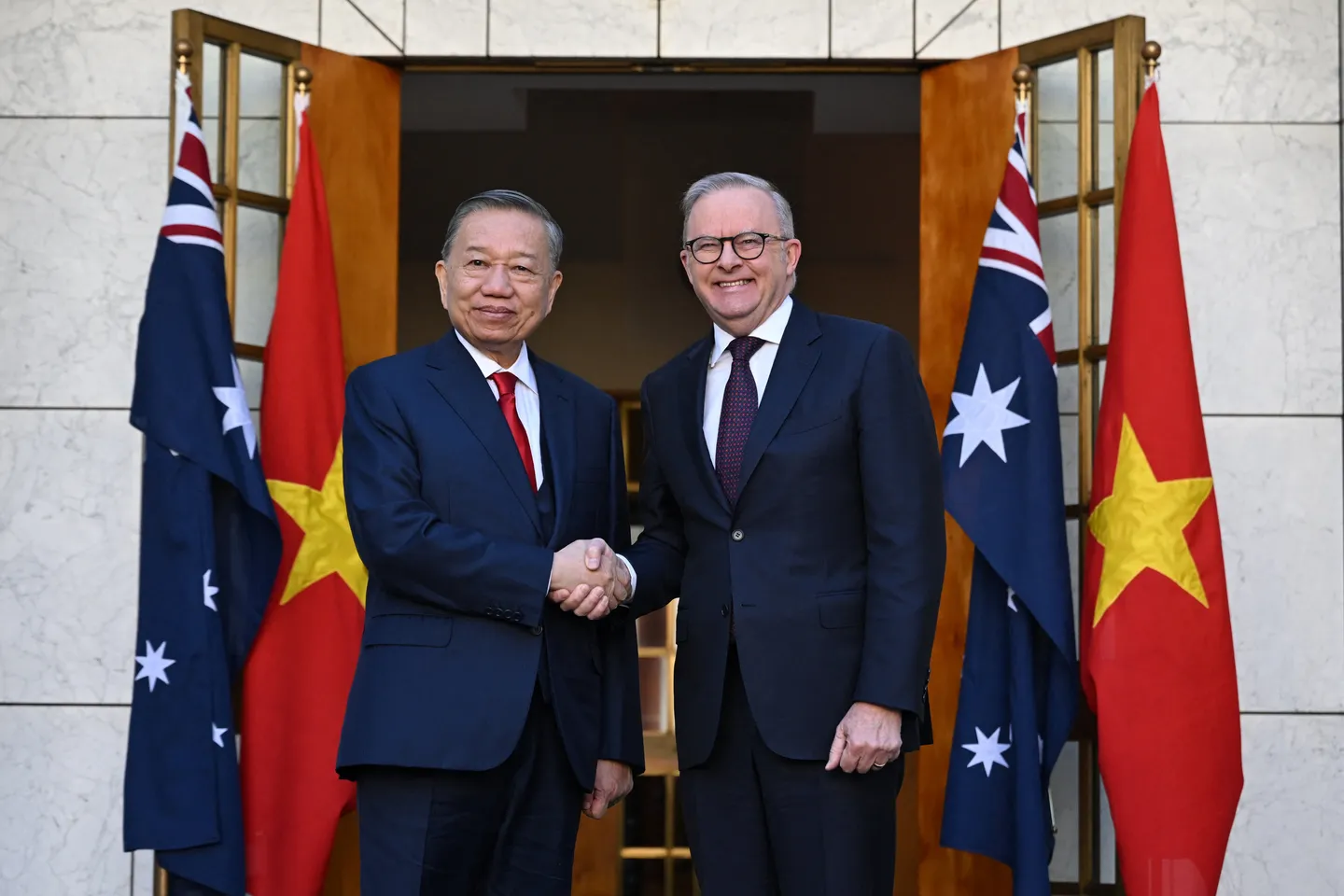
Australia and Vietnam on Tuesday agreed to deepen their comprehensive strategic partnership across defence, security, trade and clean energy during talks between Australian Prime Minister Anthony Albanese and Vietnamese President To Lam in Canberra.
The two leaders reaffirmed their commitment to a “peaceful, stable and prosperous Indo-Pacific” that is free from coercion and where sovereignty is respected, according to a statement from the Australian Prime Minister’s Office.
They expressed concern over developments in the South China Sea and stressed the importance of freedom of navigation and overflight, peaceful resolution of disputes, and adherence to international law, particularly the 1982 UN Convention on the Law of the Sea.
Albanese and Lam welcomed an updated joint vision for defence cooperation and agreed to expand collaboration in military training, maritime security, peacekeeping, search and rescue, information sharing and counterterrorism.

Cooperation in economy, tech




The two countries will also strengthen cooperation against cybercrime, online scams, drug trafficking, human trafficking and terrorism financing.
On economic ties, the leaders pledged to expand bilateral trade and investment, strengthen supply chains, and deepen cooperation in critical minerals.
They also welcomed agreements covering agriculture, vocational education, aviation, health, science and technology.
Both sides committed to accelerating renewable energy deployment and strengthening cooperation on climate change, maintaining their goal of reaching net-zero emissions by 2050.
The leaders also called for an immediate cessation of violence in Myanmar, unhindered humanitarian access, and inclusive dialogue, while reaffirming support for ASEAN centrality in the regional architecture.