Murat Sofuoglu
Azerbaijan and Armenia, the two uneasy neighbours in the troubled region of Caucasus, fought a bloody war over the disputed Karabakh territory two years ago and continue to have many political differences.
On Monday, Türkiye, which borders the two former Soviet republics, called on both countries to take concrete steps towards reconciling with each other through the forging of better communication channels in order to open the critical Zangezur Corridor.
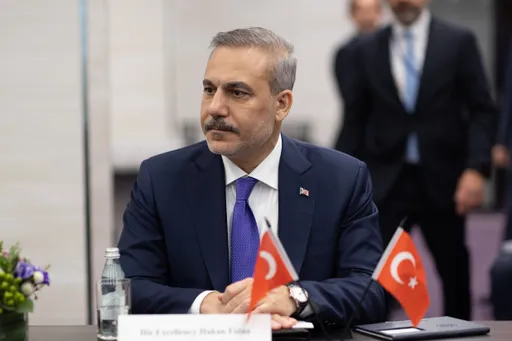
"We strongly support the Zangezur Corridor, which will provide a connection between the western regions of Azerbaijan and Nakhchivan," said Turkish Foreign Minister Mevlut Cavusoglu.
"We are expecting the opening of the corridor immediately," he added.
The corridor is part of a strategic transportation route extending from the Azerbaijani capital, Baku, to Kars, Türkiye’s eastern province, passing through Armenian territory near the country’s border with Iran. As a result, its opening is dependent upon the development of a comprehensive Armenian-Azerbaijani agreement.
At the end of 2020’s 44-day Karabakh War, which culminated with a triumphant Azerbaijan, the two countries signed a trilateral ceasefire agreement alongside Russia that consisted of sections on the opening of transportation routes.
As was stated in the ceasefire deal’s article 9, “All economic and transport connections in the region shall be unblocked. The Republic of Armenia shall guarantee the security of transport connections between the western regions of the Republic of Azerbaijan and the Nakhchivan Autonomous Republic in order to arrange unobstructed movement of persons, vehicles and cargo in both directions.”
Azerbaijan strongly believes that article 9 encompasses the opening of the Zangezur Corridor and although Russia, whose border guards are supposed to be responsible for overseeing transportation between Azerbaijan and Armenia, does not refer to the route as the Zangezur Corridor nor as a ‘corridor,’ it does support its opening.
While Armenians have not publicly embraced the idea of opening the corridor, Yerevan, the capital of the landlocked state, has recently begun to approach the project in a positive way, according to Azerbaijani officials and other sources.
What is the Zangezur Corridor?
Zangezur, which is currently part of southern Armenia, has been a disputed territory since World War I. Under the communist Soviet Union, the area, which is located between Baku’s Nakhchivan autonomous region and Azerbaijan, became part of the Armenian Soviet Socialist Republic (SSR). Today, Armenia considers the area its Syunik province.
During the Soviet era, Moscow built two railways to connect Nakhchivan with main Azerbaijani territory in a region that Baku now refers to as the Zangezur Corridor, sometimes called the Nakhchivan Corridor by Azerbaijani media and analysts. But these railways became unusable during the First Karabakh War, which began in 1992.




Baku now aims to rebuild the Soviet-era railways and to construct highways in the area to connect Azerbaijan with its Nakhchivan region. Furthermore, the corridor is also part of a big transportation project connecting Baku with Istanbul.
In a specific sense, the Zangezur Corridor aims to give Azerbaijan unrestricted access to its Nakhchivan enclave without any Armenian checkpoints while it passes through Armenian territory near the Tehran-Yerevan border. In a general sense, the corridor is a geopolitical project connecting Europe with Central Asia and China through the Azerbaijan-Türkiye route.
Why is the Zangezur Corridor a big deal?
The Zangezur Corridor plays a crucial role in increasing regional connectivity — not only throughout Caucasia, but also across greater Eurasia, joining Turkish, Russian, Central Asian, Iranian and Armenian territories and linking Europe to Asia.
The connectivity the corridor will enable will also help galvanise trade relations between different states. While NATO and Russia have been on different pages regarding many issues from the Ukraine conflict to the Middle East, both appear to have positive views on opening the transportation route.
According to Azerbaijani President Ilham Aliyev, the corridor, as part of the International North–South Transport Corridor, will also serve as a linking point between Russia and Iran, increasing Tehran’s access in the region.
But Iran, which has strong ties with Armenia, does not want to see the Zangezur Corridor functioning, according to experts. As a result, Tehran is concerned by a possible Armenia-Azerbaijan-Türkiye rapprochement, which Iran believes would weaken its political positions, compromising its national and regional interests.
“Iran considers Türkiye's land connection with Azerbaijan and its opening to Central Asia via Azerbaijan as a threat to its national unity and territorial integrity,” said Otabek Omonkulov, an Uzbek academic, who is an expert on Central Asia politics, in an earlier TRT World interview.
Türkiye’s land connection with Azerbaijan also means that Ankara will have better access to Turkic states in Central Asia, with which it has strong historical and cultural ties.
"The corridor that is going to pass through here is going to unite the whole Turkic world," said Aliyev last year. Aliyev repeated this point with conviction in November during the meeting of the Organisation of Turkic States.
"One of the most important aspects of the Zangezur Corridor is that it will connect the Turkic world. Thus, the geography of the torn Turkic world will be connected with transport and logistics projects," said Rashad Mammadov, Azerbaijani ambassador to Türkiye in May.
Besides improving connectivity between Central Asia, the ancestral homeland of the Turks, and Türkiye, experts believe the corridor will also link trade routes across a broad network from China to Europe, significantly boosting interregional connectivity far and wide.