 Smita Gupta
For 25 unbroken years, Narendra Modi has been in power: first as the top elected representative of the prosperous Indian province of Gujarat from 2001 to 2014. And then as the Prime Minister of the world’s most populous nation, preaching to over 1.4 billion people from his pulpit in Delhi.
For more than a decade, Modi has wielded absolute control over the country, controlling the political narrative through a pliant media and clever manipulation of social media.
He has used the coercive power of the state and the sophistication of technology to create shock and awe.
More recently, a stunning election victory in West Bengal swept a powerful incumbent out of power, and added to his air of invincibility.
But an unexpected and powerful movement led by students has broken the spell.
The subject of the seven-week-long sit-in – a broken education system, epitomised by repeated leaks of question papers, and a shrinking job market – was potent enough.
But it needed youth power, triggered by the unexpected appearance of the satirically named Cockroach Janata Party (CJP), to light the fire that spread rapidly across the country to far-flung towns and even villages.
The events of July 20, when the might of the state was unleashed on students marching to Parliament House, a stone’s throw from New Delhi’s 18th-century monument Jantar Mantar, the protest site, just made it easier.
As horrific images of students bravely facing a baton charge, tear gas, water cannons and, in a few cases, even receiving pellet gun injuries, resulting in 79 among them needing hospitalisation, filled the internet, anger spiralled.
Finally, on July 25, the Modi government buckled under pressure, and Education Minister Dharmendra Pradhan, whose resignation had topped the list of students’ demands, was forced to step down.
But this was not triggered by security concerns, the line the government pushed publicly.
Rather, it was “the erosion of political capital of the ruling party caused by the burgeoning, organic crowds at Jantar Mantar,” and the “critical and unsavoury social media chatter”, the daily newspaper The Hindu pointed out.
The next day, the government announced a high-powered Task Force under technocrat Nandan Nilekani to fix the examination system.
But it was too little, too late, especially as it is apparent that it is the entire public education system that needs a thorough overhaul.

Anger unleashed
But what makes this moment different? After all, this is not the first protest that the Modi government has faced.
In 2015-16, a nationwide student stir erupted after ‘lower-caste’ scholar Rohith Vemula committed suicide when Hyderabad University abruptly stopped paying his monthly PhD fellowship stipend; simultaneously, protests over free-speech and sedition at Delhi’s Jawaharlal Nehru University hit the headlines.
In 2019-20, there were nationwide demonstrations against the Citizenship Amendment Act (CAA) that discriminated against Muslims.
In 2020-21, hundreds and thousands of farmers imposed a year-long blockade along the borders of New Delhi, forcing the Modi government to completely repeal three controversial agricultural reform laws, the first real setback to the government.
But this moment is different. The impetus comes from the bottom, with students from lower-income backgrounds dominating the protests and with many among them erstwhile staunch Hindutva votaries.
But, simultaneously, the potency of the cause has united people across caste, class and religious lines, breaching the age barrier. Sikh and Muslim places of worship threw open their doors to injured students, offering them food and shelter.
For more than a decade now, the Modi government had successfully manipulated the narrative to portray previous protests as representing specific small sections of society – low-caste Dalits during the Rohith Vemula protests, “anti-national” Left-leaning students during the JNU stir and Muslims and “urban Naxals”, a pejorative term for big city left-of-centre intellectuals, when the anti-CAA protests broke.
It did not work this time. Despite the government’s best efforts to paint the current youth movement as “anti-national” and even “foreign-funded”, virtually everyone in India personally knows a “cockroach” — someone affected, or one likely to be affected, by the failing academic ecosystem.
Lawyers of the country’s top court publicly declared support for the students; doctors have come forward to offer help.





Indeed, visits to the scene of the seven-week sit-in made it clear that the themes of the protests of the last 12 years have all fed into the CJP-inspired movement.
Students carried posters of Rohith Vemula; farmers who had been the mainstay of the 2020-21 movement were there to demonstrate their support; Left-leaning students who were active during the JNU and anti-CAA stirs were on stage; Muslims, many among them young women, who have been demonised from the start of the Modi regime were there.
Modi and memes
It is not just the size, scale and reach of the current movement that makes it noteworthy.
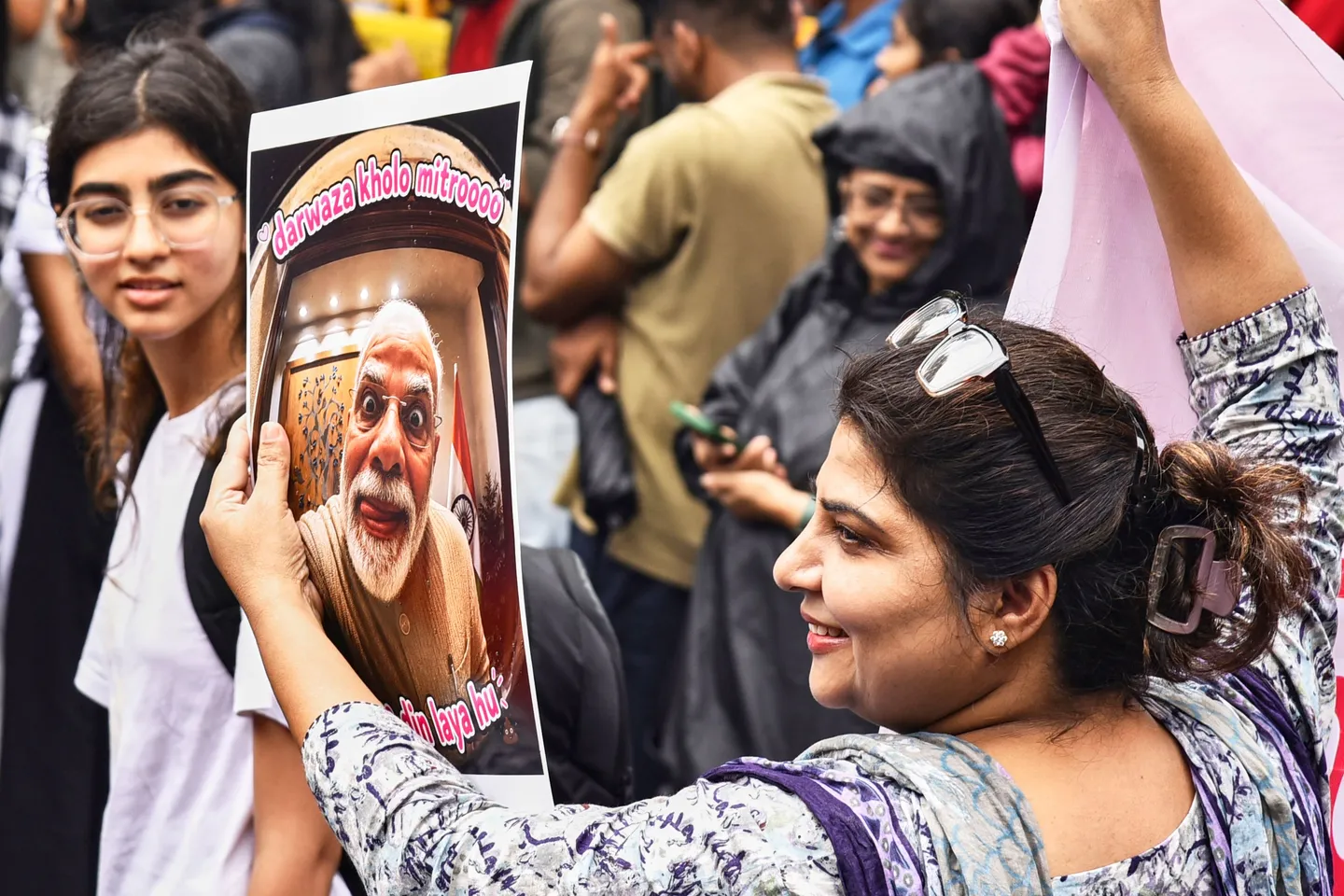
This is a generation that, far from being respectful about authority, has the audacity and courage to say it like it is. If Modi deployed technology to his advantage all these years, the students have beaten him at his game.
Indeed, when in sheer desperation, hoping to stave off Pradhan’s resignation, Modi addressed the student community through an Instagram video starting with a soft "friends," the internet weaponised it.
A massively viral spin-off edit juxtaposed his opening word with a sharp clip of three young girls staring blankly into the camera, replying: “No, we are not.”
The amusement intensified when news leaked from a Cabinet meeting that Modi had instructed his ageing ministers to "get active on Instagram and make Reels" to talk to the youth.
The image of senior BJP politicians scrambling to learn short-form video algorithms to suppress a structural education crisis has made a mockery of the government, replacing the fear that once existed.
Protesters also noted the irony of the Prime Minister trying to deploy "relatable" digital outreach at the exact moment his administration was actively ordering the suspension of mobile data around their physical demonstration sites.
Ultimately, the attempt backfired because Gen Z students — who had spent weeks building a massive, highly sophisticated digital protest ecosystem — simply chose to "answer him in his own language," turning the government's brand-new social media strategy into a canvas for satirical memes and spin-offs.
When a politician shifts from being an object of hatred to an object of ridicule, it represents a catastrophic loss of political power.
Hatred acknowledges a leader's strength and capacity to inflict harm; ridicule completely strips away his authority, dignity – and ability to instil fear.
What next?
Does this movement then spell the end of the Modi regime?
It will depend both on what the CJP leadership does after this victory, and whether the Opposition parties can channel the anger in the people to their advantage.
The CJP leaders have said that they will now structure their movement, travel across the country to spread the word, and create a platform.
They have, however, not yet clarified whether they intend to create a political party. As far as the Opposition is concerned, it is evident that they will have to work unitedly.
Will Modi lose the next elections?
The best answer came from Arun Kumar, a sociologist, teacher and former student activist who cut his political teeth in a movement that unseated former prime minister Indira Gandhi in 1977. If the elections are held now, he says, Modi will lose.
For one, the student movement has eroded the legitimacy and credibility of the government. Modi’s aura of invincibility is gone. How he responds politically will be crucial.
Abhijeet Dipke, the young founder of the Cockroach Janata Party (CJP), put the issue in perspective when he said, “It was said that no one resigns in this government. But the world bows to those who can make it happen.”