 Zeynep Conkar
Israeli National Security Minister Itamar Ben-Gvir presented a plan last week to ethnically cleanse almost the entire population of Gaza from Palestine over the next seven years, an initiative he has named ‘Disengagement 710’ and made a central plank of his election campaign.
The forcible displacement of civilians from occupied territory is classified as a war crime under the Geneva Conventions, and rights groups, UN experts and governments have already described the plan in those terms.
The scale of the proposal leaves little ambiguity about what it would mean in practice.
It targets 250,000 Palestinians for forced removal from Gaza in its first year, rising to 1.11 million within three years and roughly 1.86 million within seven, a figure that covers nearly the entire population of the Palestinian enclave.
The proposal is built around the premise that Palestinians in Gaza can simply be relocated elsewhere. Each person leaving would reportedly be assigned a destination country, along with funding, legal status, housing and a support package.
But Palestinians in Gaza have made clear that they do not want to leave their homes or be removed from their homeland. For them, the question is why they should be expected to surrender their homes and land in the first place.
This is certainly not voluntary migration, according to Dr Munir Nuseibah, human rights lawyer and professor of law at Al-Quds University.
"Ben-Gvir is using this term (disengagement) because he knows that forced displacement is illegal under international law. It is a war crime according to the Fourth Geneva Convention and a crime against humanity,” Nuseibah tells TRT World.
"This is something Israel has been doing since the Nakba of 1948, displacing Palestinians from their homes to create Jewish-majority areas in regions it has been colonising ever since.”
“Now the Zionist ambition is to colonise Gaza, and the objective is to displace Palestinians, evict them from Gaza, ethnically cleanse them, and then make Gaza ready for Israeli colonisation," Nuseibah adds.
Ben Gvir has also put a price tag on the project. The plan calls for an initial Israeli outlay of 10 billion shekels (approximately US$ 3.3 billion), with a financing framework of up to 50 billion shekels contingent on countries abroad agreeing to take people in.
Yet no amount of funding answers the basic question at the heart of the proposal; why should Palestinians be expected to leave their homes and land in the first place?
When ‘voluntary’ stops being voluntary
Ben Gvir's answer is that they would be choosing to leave. But that choice would happen under conditions that make genuine consent impossible.
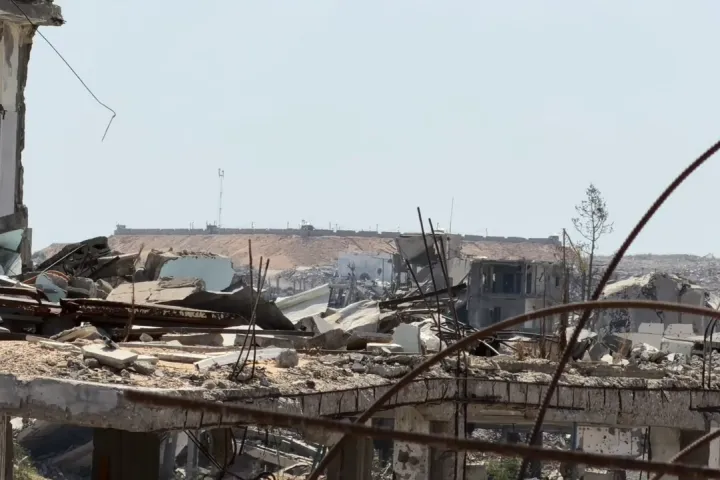
Much of Gaza's housing has been destroyed, reconstruction materials remain restricted, and movement in and out of the enclave is heavily constrained.
A person who has lost a home and cannot rebuild it, cannot safely return to it and has limited ability to leave or move freely is making a decision under circumstances fundamentally different from ordinary migration.
Nuseibah describes conditions in Gaza that leave people with little real choice but to leave.
"The Palestinian population in Gaza, which before the genocidal campaign was living in one of the densest areas in the world, is now living on only a third of the territory, in tents, seeking the very essentials of life on a daily basis.”
“They wake up every morning seeking water, food and mere survival. There is no development, no jobs, no education. Everything has been destroyed,” Nuseibah explains.
“Their lives have been set back to the Stone Age, and Israel is blocking every attempt to allow Gaza to be rebuilt,” he adds.
UN human rights experts have warned that removing Palestinians from Gaza under current conditions would amount to forced transfer, regardless of whether the policy is presented as voluntary.








Eight Arab and Muslim states, including Türkiye, Saudi Arabia, Jordan, and Qatar, have likewise rejected any displacement of Palestinians from Gaza, calling it a flagrant breach of international law and warning against any attempt to impose a new demographic reality on the occupied Palestinian territory.
The objection is therefore also to creating the conditions and incentives under which leaving becomes the practical alternative to remaining.
That distinction is central to the legal argument.
What Israel is doing is building a coercive environment, using difficult living conditions to push people out of a territory, which is a crime against humanity of forcible deportation and transfer, according to Nuseibah.
"Under such circumstances, we cannot talk about a choice for people to leave.”
“Any Palestinian currently leaving Gaza is not leaving by choice, they are leaving because they are looking for survival, because they are looking for a way to educate their children and simply to live,” he adds.

Gaza as an election issue
Ben-Gvir is not leaving ‘Disengagement 710’ as a campaign slogan. His Otzma Yehudit party wants a dedicated Emigration Ministry, with its own minister and budget, and has made its creation a condition for joining Israel's next coalition.
That would give the plan a direct place in coalition negotiations after October's elections, while allowing Ben-Gvir to position himself further to Netanyahu's right as Israel's far-right competes over what Gaza should look like after the genocide.
Controversial former general Ofer Winter has also included a similar idea in his platform.
Netanyahu has so far kept some distance from the proposal, reportedly voicing reservations in Cabinet even as he has previously used the idea of Palestinian emigration to keep Ben-Gvir inside the government.
Defence Minister Israel Katz has said Israel is waiting for US approval to move forward.
The idea, however, did not begin with Ben Gvir's election campaign. The US proposed in February 2025 that Palestinians leave Gaza, before the White House backed off and said in its subsequent 20-point Gaza plan that the population would remain in the besieged enclave.
For Nuseibah, that history is important because reducing the proposal to an election tactic risks missing the broader policy behind it.
"Ben-Gvir is likely trying to use this ethnic cleansing plan as an element of his upcoming election campaign. But we cannot look at it only as election propaganda.”
“Israel has been trying to displace millions of Palestinians out of Gaza for quite some time. It has tried to pressure Egypt and Jordan, through the US and Germany, to take in Gaza's Palestinian population."
"It has been looking for places to send Palestinians to, and it has facilitated flights to different countries around the world to absorb more of them."
But Nuseibah also sees a clear electoral calculation in the proposal, particularly among the constituency Ben-Gvir is trying to mobilise.
"But of course Ben-Gvir wants to use it in the elections too, because his political base is a group who wants to ethnically cleanse the land and colonise it, driven by a messianic religious framework of thought and ideology," he adds.