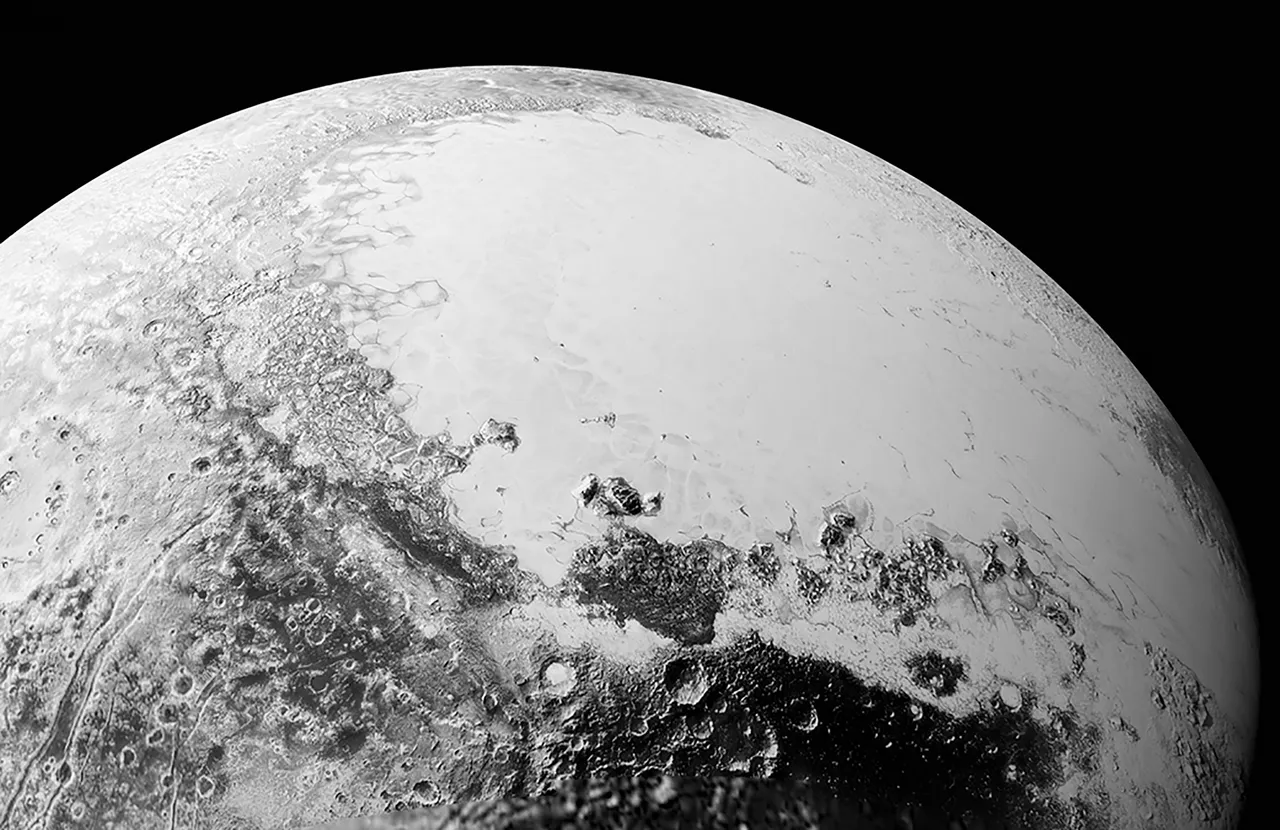
NASA Administrator Jared Isaacman wants to restore the status of Pluto as a planet of our solar system.
Speaking at a US Senate hearing on April 28, the chief of the world’s largest space agency said that Pluto “rightfully deserves” its planetary status to be restored.
“Senator, I am very much in the camp of ‘Make Pluto a planet again’,” he was quoted as saying.
A wordplay on US President Donald Trump’s political slogan, Isaacman’s statement has revived the long-standing debate over Pluto, with many astronomers saying it belongs to our solar system as a full planet.
Pluto used to be the ninth planet in our solar system until 2006, when the International Astronomical Union (IAU) reclassified it as a “dwarf planet”.
Scientists at the time agreed that the celestial body from the outer edges of our planetary system failed to meet the strict criteria for a full-sized planet.
Responding to a question from Senator Jerry Moran during testimony on NASA’s 2027 budget, Isaacman said the agency was preparing scientific papers to “escalate through the scientific community to revisit this discussion”.
Isaacman appears to have based his remarks on data from NASA’s New Horizons mission, the first spacecraft to explore Pluto up close, which flew past the celestial body in 2015.
What happened in 2006?
Pluto enjoyed full membership of the solar system from its discovery in 1930 until 20 years ago, when astronomers at the IAU’s General Assembly in Prague voted to adopt a new three-part definition of a planet.
The definition holds that a planet is a celestial body that orbits the Sun, has sufficient mass for its self-gravity to pull it into a nearly round shape, and has “cleared the neighbourhood” around its orbit.
Pluto meets the first two benchmarks, but fails the third criterion about clearing the neighbourhood.
In space terminology, clearing the neighbourhood means a planet should be able to achieve “gravitational dominance” over its immediate space surroundings.
In simpler words, it means a planet must be big enough to either consume or gravitationally control smaller celestial objects present in its orbital path to become the most dominant body in its space neighbourhood.

As a result, the IAU created a new category in 2006 called “dwarf planet”. The term covers celestial bodies that orbit the Sun, are nearly round, but have not been able to gravitationally ‘clear’ their respective orbital paths of debris and other objects.
The IAU has recognised five dwarf planets in our solar system so far. However, there may possibly be “more than a hundred” such bodies waiting to be discovered.
The reclassification process was not without controversy though.
Critics, including New Horizons principal investigator Alan Stern, say the reclassification process was flawed: Of about 10,000 IAU members at the time, only 237 voted for the resolution to change the definition, while 157 voted against the move.
The rest of the registered members of the body responsible for determining the definition of a planet never voted.
Pluto’s demotion in 2006 sparked widespread public outcry, with schoolchildren writing protest letters demanding the decision be reversed.
Writers noted that Pluto’s demotion gave a boost to the underdog narrative: a small, distant world discovered by an American, yet stripped of its lofty status by snotty experts.
To make a case for restoring Pluto’s former status, Stern calls for adopting a “geophysical” definition of a planet. It defines a planet as a body massive enough to achieve a rounded shape (due to self-gravity) but not massive enough for nuclear fusion (which would turn it into a star) – regardless of its orbital environment.







According to this definition, Pluto qualifies as a planet. But so do many others in the Kuiper Belt, a doughnut-shaped region of icy debris and small celestial bodies beyond Neptune's orbit.
What’s Pluto like?
Launched in 2006, NASA’s New Horizons spacecraft flew past Pluto in July 2015, showing a dynamic, geologically active body.
Images showed water-ice mountains, nitrogen ice glaciers, dunes, and evidence of cryovolcanism, a type of volcano that releases gases and volatile material.
The surface of Pluto is extremely cold, with temperatures as low as minus-226 to minus-240 degrees Celsius.
The low temperatures mean that water, which is necessary for the existence of life, is in a rock-like form.
Pluto's interior is warmer. Many scientists say there could be an ocean deep inside it.
People pushing for the restoration of Pluto’s status as a planet say these attributes make the celestial body behave like a “real” planet: geology, potential habitability ingredients, and moons, which are natural satellites orbiting a planet or a dwarf planet.
Pluto has five moons circling around it.
Members of Team Pluto say its status as planet/dwarf planet should reflect these characteristics in totality, not just the “clearing the neighbourhood” benchmark in a crowded orbit.
The counterargument from Team No Pluto is that the IAU’s definition of a planet brings clarity and puts a stop to an ever-expanding list of the solar system’s full members.
In other words, they think that restoring Pluto to its original status would open the door to dozens more planets, complicating a rather neat solar system.
Politics around Pluto
The public stance of Isaacman, a billionaire entrepreneur and private astronaut, aligns with public nostalgia for a solar system of nine planets.
He has vowed to honour the discovery of Pluto in 1930 by Clyde Tombaugh, an American astronomer and telescope maker, by restoring the celestial body to its former glory.
But the problem is that NASA itself does not define planets. It is the job of the IAU.
Therefore, any formal change will require international scientific consensus, not a single US agency, however big and influential, nor executive action by President Trump.
Yet this limitation does not diminish the importance of NASA’s data and advocacy in matters relating to space exploration.
The timing of Isaacman’s advocacy for Pluto, coinciding with annual budget hearings, has drawn some criticism.
Observers have noted that his statements are little more than a populist distraction amid proposed US government cuts to space programmes.