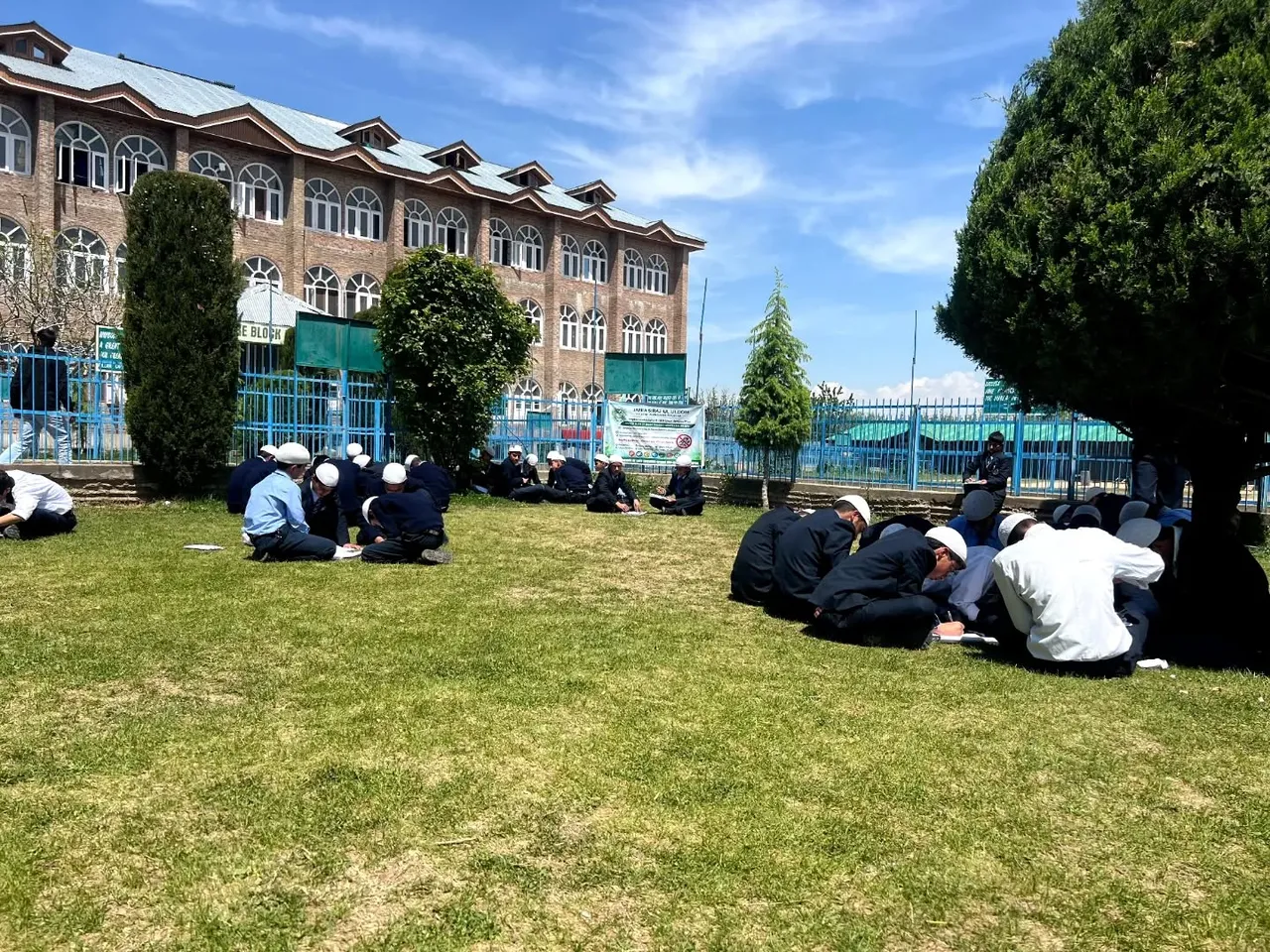
A major educational seminary for Muslims in Indian-administered Kashmir has been declared unlawful under anti-terror legislation, triggering strong criticism from religious and political figures in the region, Indian media reported.
Kashmir divisional commissioner, Anshul Garg, issued the order, citing a police dossier that allegedly found “sustained and covert links” between the seminary and the banned group Jamaat-e-Islami (JeI), according to local media.
The institution, Jamia Siraj-ul-Uloom, is among the largest seminaries in southern India-administered Kashmir and is affiliated with the Jammu and Kashmir Board of School Education.
The action was taken under the Unlawful Activities Prevention Act (UAPA), a controversial law that allows authorities to label individuals or organisations as “terrorist” without evidence.
Authorities claimed that members of the seminary’s management and teaching staff had connections to JeI.
Mohammad Shafi Lone, the seminary’s chairman, denied the allegations.
Leaders in Muslim-majority India-administered Kashmir condemned the decision, describing it as part of a broader pattern of overreach by New Delhi.
“Declaring Jamia Siraj-ul-Uloom ‘unlawful’ under UAPA is the latest act in a calculated dismantling of Kashmir’s civic life,” wrote Aga Syed Ruhullah Mehdi, a member of the Jammu and Kashmir parliament, on X.
“The pattern is unmistakable. Trusts, mosques, libraries and now seminaries serving underprivileged children, every social and nongovernmental institution that holds Kashmiri society together is being strangled.”
He added that the school has more than 800 students and has “produced doctors, scholars and professionals from homes that could never afford private education.”
Mehbooba Mufti, a former chief minister of Jammu and Kashmir, described the move as a “flagrant injustice to the poor underprivileged sections of society.”



Kashmir’s chief Muslim cleric, Mirwaiz Umar Farooq, pointed to recent actions taken against residents, including property seizures and detentions under the Public Safety Act.
“Can the … administration tell people of Kashmir clearly how long they will continue this policy of harassment and disempowerment?” he asked. “And can the elected [government] tell us how long they will let this happen?”
Indian-administered Kashmir is designated as a “union territory,” meaning it is governed directly by the federal administration in New Delhi.
India has imposed several restrictions in the Muslim-majority region after revoking its constitutional autonomy in 2019, laying out rules for how the region is covered and reported.
Until 2019, Article 370 of the Indian Constitution granted the region a degree of autonomy over areas such as education, employment, and land ownership. However, Prime Minister Narendra Modi’s Hindu nationalist government revoked the provision and split the region into two federally governed territories: Jammu and Kashmir, and Ladakh.
Since then, local leaders have increasingly voiced concerns over what they see as restrictions on religious and civil liberties.
Earlier this year, authorities began profiling mosques in Kashmir, sparking fears of expanded surveillance.
Kashmir remains a long-standing flashpoint, contested by two nuclear powers, India and Pakistan, since the British vacated the subcontinent in 1947.
Since 1989, rebel groups have fought some half a million Indian troops for the territory to become independent or unite with Pakistan, a goal most of the region's Muslim majority population supports.
Rights groups have accused India of using repression to suppress the movement for self-determination.