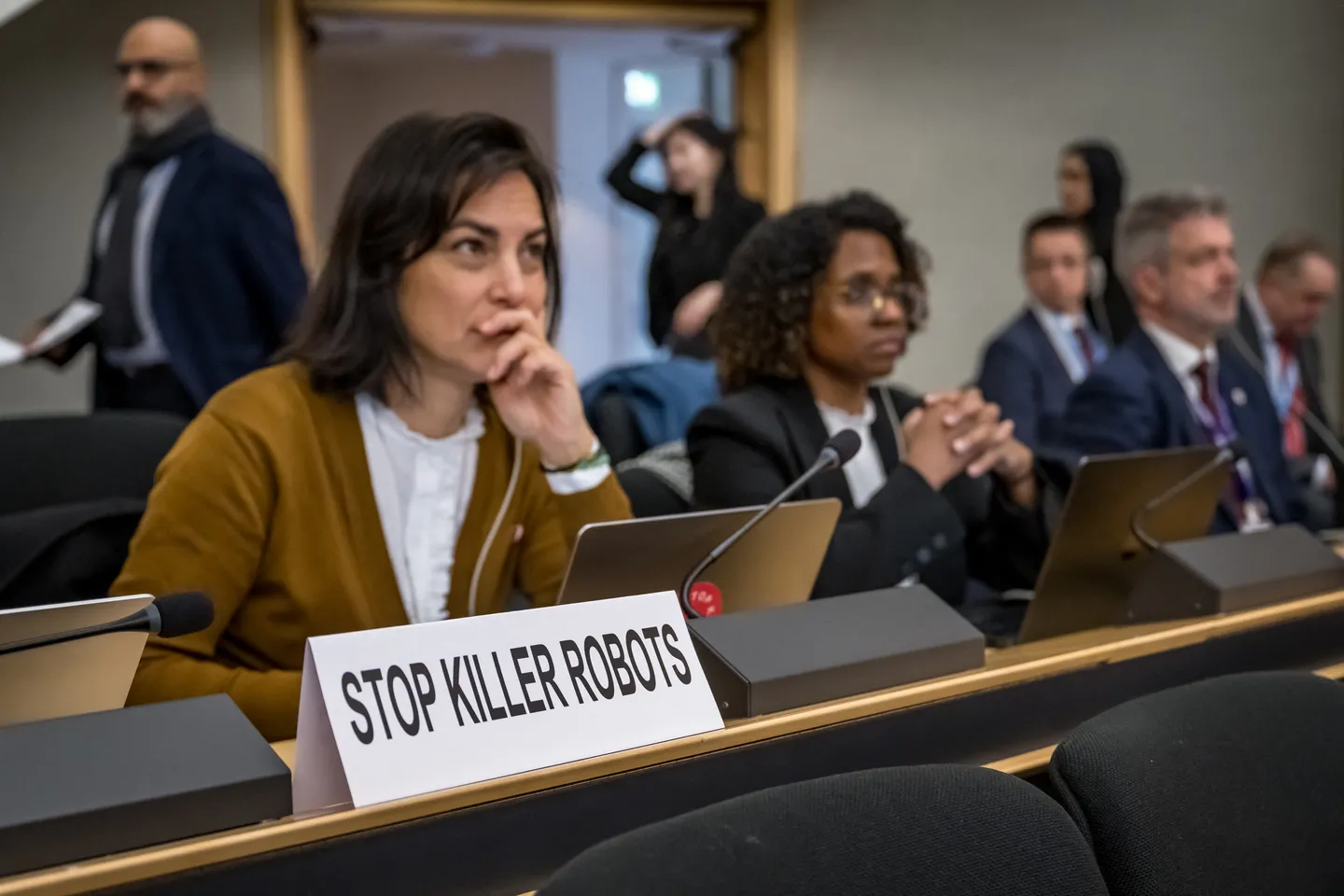
Russia and the United States are blocking a path towards a binding agreement regulating lethal autonomous weapons systems (LAWS), despite most countries being in favour, rights groups have said.
"According to our numbers and the count we did in the room, 95 states have so far expressed their support for a legally binding instrument," Nicole Van Rooijen, the executive director of Stop Killer Robots, told a press briefing given by NGOs and rights groups on Wednesday, who are following the talks.
"And of course, you have the positions of the United States and Russia that are at the other extreme."
The United Nations' Review Conference of the Convention on Conventional Weapons (CCW), running from Monday to Friday in Geneva, is struggling to find a way through the impasse on lethal autonomous weapons systems, often dubbed "killer robots".
Warfare is undergoing a radical transformation as armies seek to capitalise on artificial intelligence to boost their capabilities by identifying and striking targets more quickly and with greater accuracy.
Amid a chorus of warnings against handing the power of life and death to autonomous machines, representatives from the 128 countries that are parties to the CCW are this week set to decide whether or not to launch negotiations towards regulating the use of such weapons, following more than a decade of discussions around the topic.
Rather than voting, decisions are reached by consensus at the CCW.

'Encouraging signs'
On day one, Russia triggered a procedural stand-off by objecting to allowing observers, including the European Union and civil society organisations, to participate in the debate.
That forced states to continue their discussions in an informal format.





Nonetheless, Richard Lennane, a disarmament adviser at the International Committee of the Red Cross, said some "encouraging signs" had emerged from the discussions so far.
"There's a large number of states that are pressing really quite firmly for negotiations to start," he said.
And the opposing camps have been "discussing various compromises and ways of reconciling those differing views".
"Several states that previously haven't really spoken one way or the other or have been reserved have been expressing a degree of flexibility and openness to a legally binding instrument," he said, citing China and Australia.

Non-binding measures
According to NGOs, some countries, including France, are trying to build support for a hybrid approach combining legally binding rules with non-binding measures.
Lennane welcomed the prospect of a binding agreement that also included voluntary or optional measures.
NGOs said several countries, among them Austria, Brazil, Cuba and Mexico, have reaffirmed their support for a fully legally binding protocol and have not endorsed a hybrid approach.
Magnus Lovold, of the Lex International philanthropic fund, said that if the conference failed to launch negotiations, the states in favour of a binding agreement might choose to pursue the process through a different framework, much like the Convention on Cluster Munitions agreed in 2008.