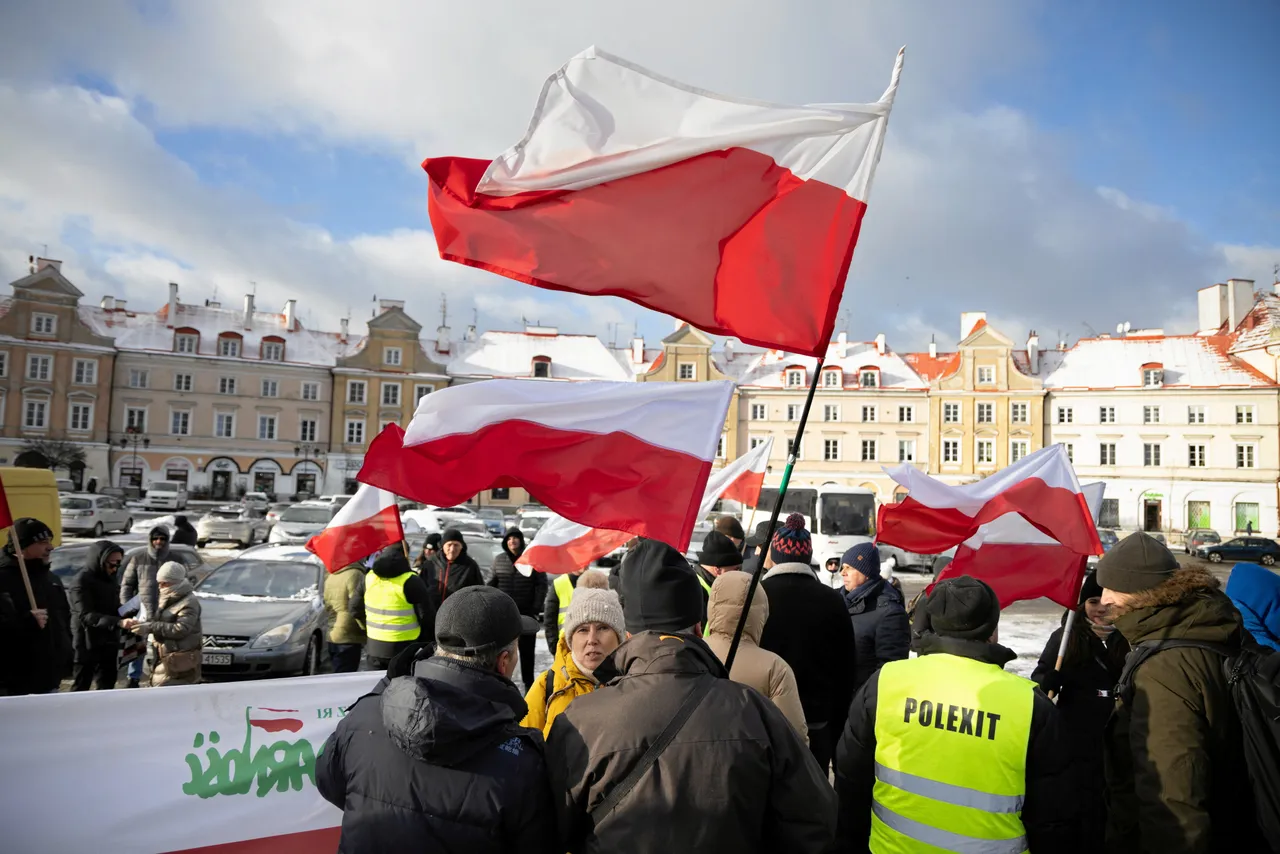
Farmers across Poland staged nationwide protests on Tuesday at more than 160 locations, demonstrating against the planned EU-Mercosur trade agreement, which they say threatens Poland’s agricultural sector, rural communities, and national food security.
Organisers argue the deal would open the EU market to agricultural products from South America produced under lower environmental and regulatory standards, undercutting Polish farmers and accelerating the decline of family-run farms.
Actions organised by the National Grassroots Farmers’ Protest were held on highways, expressways, national roads and key transport points. Traffic disruptions were reported in central Poland, Pomerania, the Lodz and Opole regions, and in Warsaw, with additional demonstrations in Lublin and Silesia.
Organisers said not all protests involved full blockades. “In many cases, farmers will simply be lining up along the main roads in their region,” said protest representative Krzysztof Olejnik in an interview with RMF FM.
Protest leaders also published a map marking demonstration sites, which some reports said approached 200 nationwide.

One of the most significant disruptions occurred on National Road 50 in the town of Wiskitki, where around 30 tractors blocked one of two lanes from 10.30 am, causing delays near the A2 motorway exit.
“The protest began as announced and will last until 3.00 pm. There are currently around 30 tractors on National Road No. 50. One lane is blocked, and traffic is moving through the other,” said Staff Sergeant Monika Michalczyk, a police press officer from Zyrardow.




The EU-Mercosur trade agreement would grant preferential tariffs for imports of beef, poultry, dairy products, sugar, and ethanol from Brazil, Argentina, Paraguay, Uruguay, and Bolivia, while European industrial goods would gain wider access to South American markets.

Polish farmers fear the agreement would expose them to unfair competition and weaken domestic production. “These agricultural protests are a direct result of inaction, decision-making chaos, and a lack of real support from Polish politicians,” the National Grassroots Farmers’ Protest said on social media, calling for dialogue and guarantees for the sector.
The deal, initially expected to be signed in December 2025, has been postponed to January 2026. Prime Minister Donald Tusk has maintained a negative stance towards the agreement, saying the delay should give the European Commission time to consider safeguards. President Karol Nawrocki has urged the government to seek partners within the EU to form a blocking minority.
Opposition to the deal has also surfaced elsewhere. In mid-December, farmers from several European countries, including France and Italy, protested in Brussels, warning that Mercosur tariff preferences could harm European agriculture.
Organisers of Tuesday’s demonstrations said further protests are possible if demands are not addressed.