 Mohamed Solaimane
Palestinian poet Alaa al-Qatrawi sits surrounded by her literary works and certificates of recognition in Nuseirat refugee camp in central Gaza.
The papers scattered around her represent a year's worth of creative output born from unbearable loss.
In December 2023, Israeli air strikes killed her four children—Yamen, 8, twins Kinan and Orkida, 6, and Karmel, two and a half—when their home in Khan Younis was bombed.
Yet al-Qatrawi, 35, who holds a doctorate in literature and criticism, has made 2025 her most productive year ever.
"My painful story and my continuous grief over my children's martyrdom became fuel burning within me, transforming into texts and writings filled with sorrows and pains on one hand, and hopes and imaginings of what they could have been on the other," she tells TRT World.
As 2025 nears its end, Gaza and its inhabitants keep suffering relentless Israeli attacks and a humanitarian disaster despite a ceasefire.
Severe winter conditions brought heavy rainfalls that drowned thousands of displaced families, while low temperatures killed frail children.
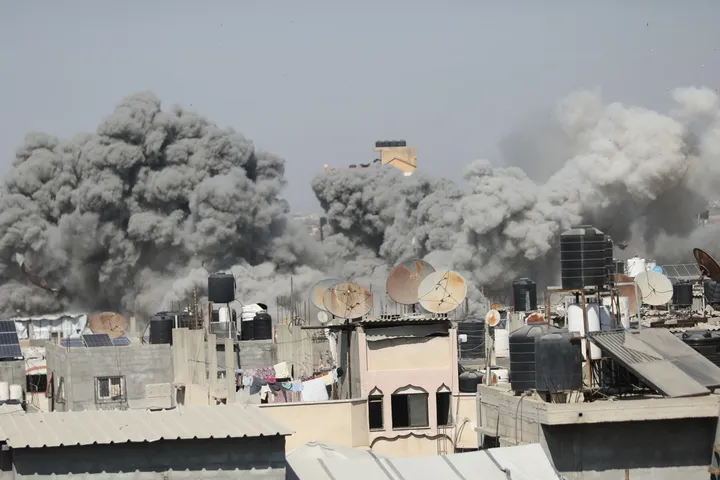
Post-ceasefire strikes from October led to more than 300 fatalities and 672 injuries by late November, including 67 children.
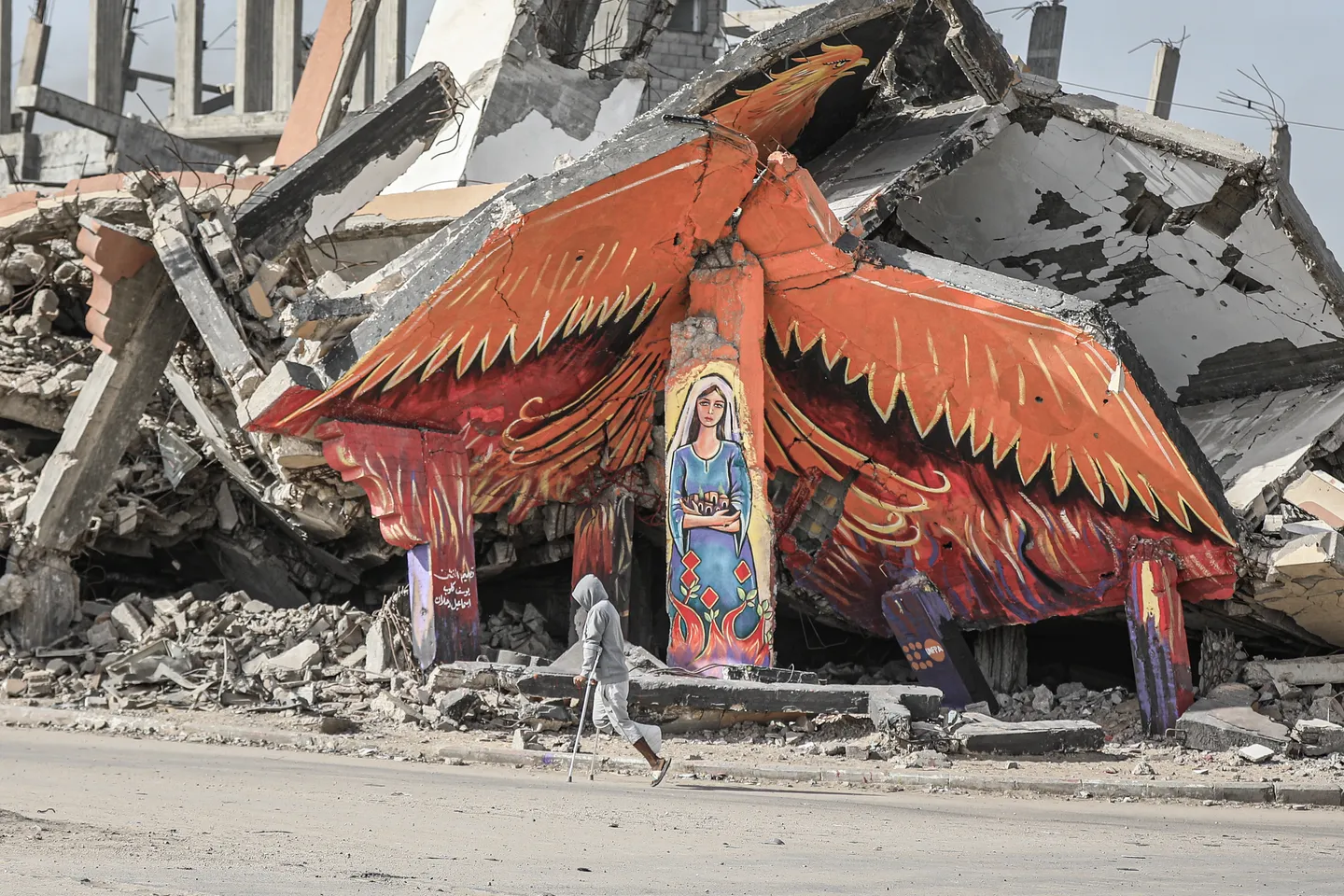
Yet amid this devastation, a remarkable creative movement has emerged, with poets, filmmakers, and writers transforming their trauma into art that bears witness to the genocide.
The genocide has proven, paradoxically, to be "fertile ground for endless creativity because reality exceeded description in every detail of daily life," al-Qatrawi says.
"Gaza absorbed the initial shock in 2024, and that's what happened to its writers and poets."
Her 2025 achievements include winning the Suad Al-Sabah Award for Palestinian Creativity in Kuwait for her poetry collection A Tent in the Sky, in which she mourned her children, her friend and fellow poet Heba Abu Nada—killed in an air strike in 2023—and journalists Ismail al-Ghoul and Hussam Abu Safiya, among others.
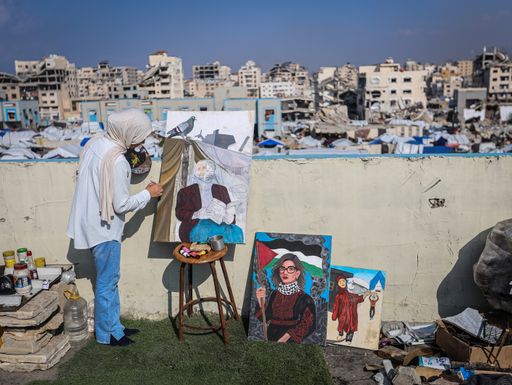
Her poetic play Orkida won the Antoun Saadeh Prize in Beirut for theatre, in which her daughter dreams of becoming a poet. Another collection, My Butterfly That Never Dies, made the longlist for the Sheikh Zayed Book Award in the Young Author category.
"How can a poet not write when she never said goodbye to her children like me? When she doesn't know the exact date of their martyrdom like me?" al-Qatrawi tells TRT World.
Her last phone call with her eldest son on December 13, 2023, was while he was trapped with his siblings in their grandfather's house in Khan Younis.
Communications cut off. In February 2024, she learned the house had been bombed with everyone inside.
"My children and others are not just numbers. Their memory must be immortalised," she says.
"Writing doesn't need gardens or the sea or quiet and a cup of coffee as some imagine. It needs a human being carrying a message they want to deliver to the world—and that's what many of Gaza's creators carry."
When joy becomes revolutionary
For 27-year-old poet and writer Jawad al-Aqqad, 2025 brought a different kind of defiance: he married his university classmate and fellow poet Ramia al-Sous on December 12, whom he had proposed to in January 2020.
The young man now lives in a small rented apartment in Bureij refugee camp after Israeli forces destroyed his family's three-story building in Khan Younis. Yet he's writing—this time about joy itself as an act of resistance.
"I'm temporarily shifting from writing about death to writing about life, after the latter disappeared from Gaza since the war began," he tells TRT World, as he describes the "enormous psychological difficulties" Palestinians face when trying to embrace happiness amid genocide.
Al-Aqqad, who published his first poetry collection in 2017, describes the war's early months as shocking for all Palestinians, including writers and poets.
He couldn't write at first. But he recovered and produced what he considers two important books in 2025.
I Write My Death Standing: Margins of Writing and War, published by Dar Al-Shuruq in Amman and Ramallah, is a collection of essays and narrative texts about existence, identity, and Palestinian concerns, focusing on war diaries: bitter displacement, the first night in a tent, the struggle of identity and destiny, and how poetry feeds bread.
The book grapples with the battle of narratives between Palestinians and Arabs on one side and the Israeli occupation on the other.
"What's happening in Gaza isn't just war—it's a policy of uprooting the land's indigenous people by the opposite, the occupier," he says.
His certainty about the importance crystallised when he returned to his home before its destruction in May 2024.
His library of 3,000 books had been stolen, burned, or destroyed—but he found novels in Hebrew left behind.
"I figured the soldier was interested in poetry and literature, so he took what I had and left some Hebrew novels," al-Aqqad says.
"This increased my certainty about the importance of the Palestinian narrative in the conflict and defending it."
Displacement itself evoked the Palestinian catastrophe.
"The moment the first displacement from north to south happened in the war's first month, the shock was enormous because we didn't expect the Nakba to repeat itself," he says.
"Therefore, this idea emerged prominently in my texts during the war, as displacement and refuge are among the most devastating scenes for me."
His upcoming bilingual poetry collection, I Lead the Birds From the Slaughterhouses, will be published by Safarjal Press in London. His selected poems have been translated into English, French, Estonian, and Persian.
Cinema under fire
Filmmaker and novelist Mustafa al-Nabih agrees that the genocide's dense details contributed to an increase in artistic production across all fields.
He points to a film movement and production that exceeds pre-war levels, driven by artists' roles in documenting history, addressing aspects of life, and embodying national character.
The 53-year-old director and father of four has been displaced eight times from northern to central and southern Gaza.
In 2025, he produced four films: Offerings, Gaza's Artists, October 7 Donkey and Dreams of Farah and Zahra, currently screening at the Carthage Film Festival. Six of his films screened at the Toronto Film Festival in southern Italy.
He also wrote the play Lentil Republic, currently in rehearsals, and a novel titled Lessa Helwa that will be published soon. Additionally, he implemented the Sit al-Husn initiative—10 meetings in displacement camps connected to heritage and belonging to the homeland.
This year saw four film festivals organised: the Women's Film Festival, the Gaza Children's Film Festival, the Return Film Festival, and the Jerusalem Film Festival.
Through the Qattan Foundation, 74 artistic initiatives in singing, music, theatre, drawing, and other fields were implemented.
"The challenges are enormous," al-Nabih tells TRT World.
"The elements of cultural and artistic work are completely nonexistent, so mere production is an achievement—let alone major achievements winning local and international awards."
Creativity as survival
Atef Abu Hamada, member of the General Secretariat of the Palestinian Writers Union and professor of literary criticism at Al-Quds Open University, says 2025 exceeded expectations in terms of activities, production, and awards, despite the genocide's conditions.
"Writing is more abundant, but paper printing inside Gaza ceased due to destroyed presses and war conditions. They resorted to printing outside Gaza and electronic publishing," Abu Hamada tells TRT World.
"There's fertility in production at the cultural level—festivals, conferences, and events internally and externally."
Despite continuous displacement and harsh daily life demands, Gaza's intellectuals succeeded in navigating the phase, absorbing successive crises, and transforming war into a fertile ground for creativity rather than surrender.
"Gaza's writers and artists were shocked at the war's beginning by the genocide's horror, but they quickly transformed reality into an abundant cultural product, because every corner of the war is suitable to become a cultural product," he says.
"Every minute passing in war is a story requiring documentation."
This article was produced in collaboration with Egab.