 Mawada Bahah
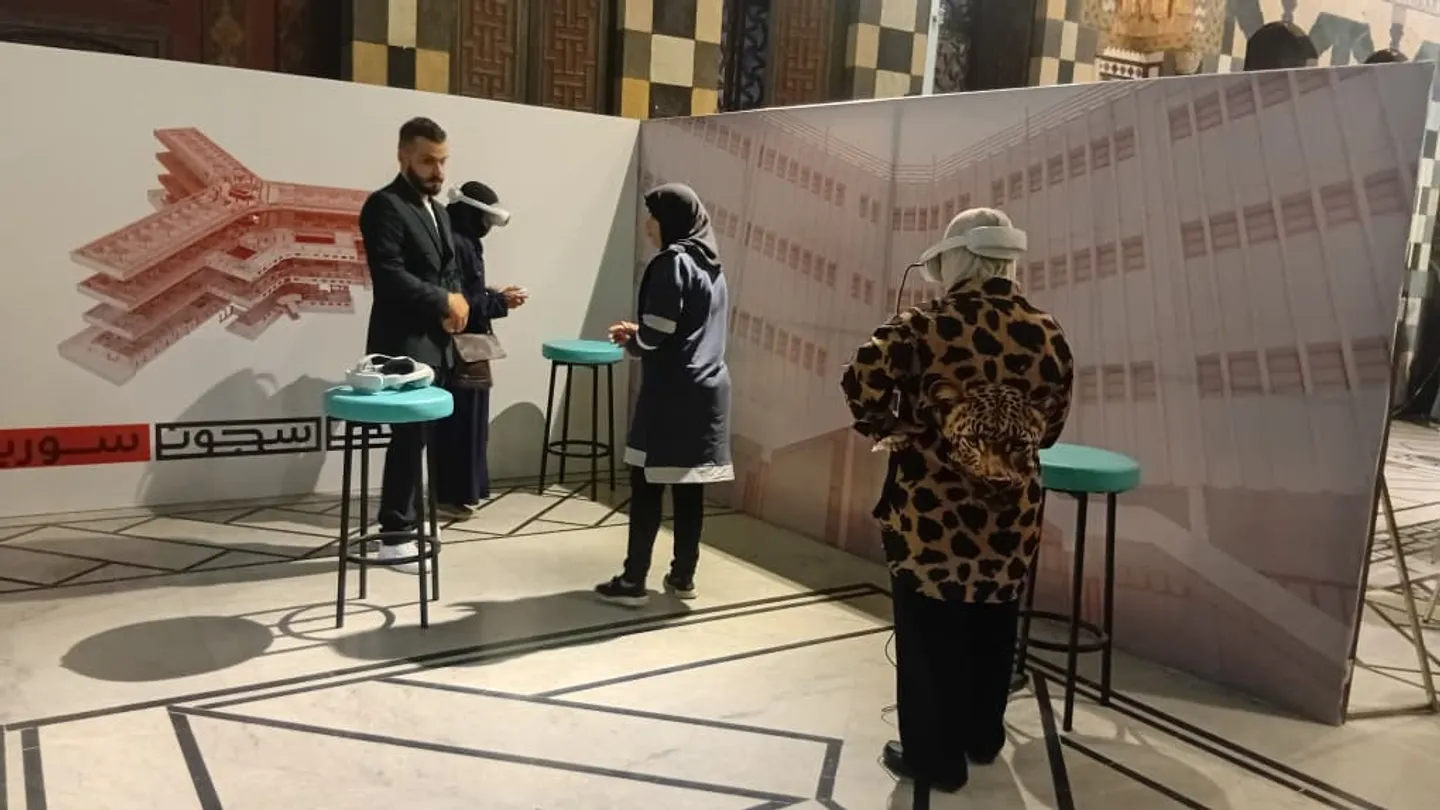
Through a VR headset at Damascus's National Museum, visitors enter the chilly corridors of Saydnaya prison.
They walk past empty cells where tens of thousands were once detained, listen to survivors' testimonies echoing off bare walls, and observe the architectural details of a detention facility that became synonymous with systematic torture and death in Bashar al Assad’s regime Syria.
The prison itself remains largely inaccessible, heavily guarded even after the fall of the Assad.
But what visitors are experiencing is a painstakingly reconstructed digital archive, one that journalist Amer Matar and his team at Al-Share Media Foundation spent years building.
The aim is to bear witness, to serve as a reminder, and to make sure the prison’s history can never be erased or forgotten.
Amer’s virtual museum project, which began to take shape in 2017, documented Daesh prisons across Syria and Iraq. Now, the organisation has shifted its focus towards the extensive network of detention centres operated by the Assad regime.
According to estimates from the Syrian Observatory for Human Rights, over two million Syrians have been imprisoned under the Assad regime, half of them following peaceful protests that started in 2011.
The Syrian Network for Human Rights reports that 112,414 people remain forcibly disappeared even after the prisons were emptied, while only 24,200 individuals have been released or accounted for out of 136,000 total detained or disappeared.
Most of the missing are believed dead.
How it began
Amer's journey to create a digital archive began with a personal search.
In August 2013, photojournalist Muhammad Nour Matar, Amer's brother, disappeared without a trace after Daesh terrorists in Raqqa detained him.
Even after the territory was freed from Daesh control, no information about Muhammad's fate emerged.
Rather than let their search end in silence, the Matar family chose to help other families find answers, gathering documents and testimonies that revealed the fates of many who passed through these prisons.
In 2017, as the terror group began losing territory and retreating from Raqqa and other Syrian areas, Amer started investigating the numerous prisons Daesh had used for detention and torture.
"We entered about 100 prisons in Syria and Iraq," Amer tells TRT World."The mission was extremely difficult and dangerous because the organisation had converted everything into prisons: schools, hospitals, homes, and commercial shops.
“Anything could potentially be a prison, and we had to enter every building, every area Daesh had passed through, not to mention the enormous danger from the huge quantity of mines the organisation left behind."
Amer and his team have conducted hundreds of interviews with witnesses and the families of detainees.
Recently, they uncovered several previously unknown prisons.
He describes the network of detention facilities as an ocean—vast, with discoveries constantly surfacing.
After gathering an enormous collection of information and documents, the challenge became how to make it both accessible and meaningful.
Their solution was to create a virtual museum, launched by the Al-Share’ Media Foundation, which comprises a group of journalists and filmmakers.
Amer and other group members spent approximately seven years developing their methodology, designing the technology, and figuring out how to organise the virtual tours, investigations, and witness protection protocols
To make the experience both accessible and realistic, they chose 3D photography and a VR headset presentation.
Their first presentation took place at the National Theatre in London, followed by an inaugural exhibition at UNESCO headquarters in Paris and later showcases in cities such as Berlin.
Finally, they brought the project home to Damascus, shifting the focus to documenting the notorious prisons run by Assad.
"Documenting Assad's prisons was one of our dreams as an organisation and as individuals," Amer says.
Amer was imprisoned as well. A Raqqa native, Amer regularly participated in the 2011 Damascus uprisings against Assad.
"In 2011, I was imprisoned in Branch 215, and I used to talk with other detainees about how this place should be turned into a museum, so people would know the torments we experienced, that others experienced.
“We dreamed that Syria would be liberated quickly, that we'd get out of prison and achieve this dream. We didn't know it would take all these years, that such a heavy price would be paid."
When the Assad regime fell in December of last year, the museum team began a new journey.


"Unfortunately, every Syrian household has a detainee. Some survived and some disappeared, and this is what makes our relationship with prisons so strong and precise," Amer says.
"They represent a large part of collective consciousness. I, like most people of my generation, share this bitter experience of imprisonment."
Establishing a Syrian prison museum is important and serves Syrians, he believes, "preventing the erasure of memory and the disappearance of detainees' stories”.
"It was a great responsibility to see details about any detained or killed person in a document thrown on the ground without photographing it. We must preserve for families the fate of their children."
He stresses they took no documents, only photographed them like thousands of journalists did, and they do not publish any names of detainees or information about torturers due to the sensitivity of the subject.
"We're not a journalistic entity concerned with scoops," he says.
All their data is for use only with local and international legal bodies.
The Damascus chapter began with Saydnaya prison, where the team photographed and documented architectural details and cells, conducting several interviews with released detainees who spoke about the harsh conditions they endured.
They launched this experience publicly through an initiative at the National Museum in Damascus in September 2024, allowing the Syrian public for the first time to engage with an experience that directly concerned them but had been condemned to exist only abroad.
Rima al-Khouli, Secretary General of the National Museum in Damascus, emphasises the importance of choosing the national museum to launch exhibitions on the prison theme.
She tells TRT World that the experience, as a cultural centre and platform, connects the public with a matter of utmost importance: the issue of detainees and the disappeared.
This initiative, she adds, affirms the necessity of "securing justice rights and underscores the importance of disseminating culture produced during the revolution that expresses the cruelty of prisons and the absence of human rights”.
‘Exceptionally realistic’
Among the prominent participants at the exhibition opening was Raghid al-Tatari, the dean of Syrian detainees, who spent 43 years of his life in Assad's prisons and was released following Assad’s ouster from Tartous prison.
"Any activity concerning detainees is important for preserving memory and reminding people that Syrians lived through a harsh experience that must inform how society thinks about imprisonment going forward, as a means of developing society rather than causing harm and oppression."
Al-Tatari used VR headsets for the first time to view the museum. He described the technology as "beautiful," giving users the feeling of being at the heart of events.
However, he noted that the prison appeared empty as it exists today and therefore didn't reflect the reality to the full extent.
The experience needs more work to incorporate other illustrative details, such as what prisoners' lives were like, to complete the picture, he adds.
"The idea needs further development and greater effort, and government agencies should provide more facilitation for activists and interested parties, because entering these prisons today is no longer easy," al-Tatari advises.
Judy Hussein Hallaq attended the museum opening and described it as "a moving experience to meet several people who lived through suffering similar to hers”.
She is the daughter of a martyr whose photo appeared in the Caesar photos.
"The museum is extremely important for commemorating those who disappeared or were detained and released, and for preserving the Syrian narrative, since even now there are people who don't know what violations and injustices occurred in the prisons," Hallaq says.
The testimonies that appeared during the virtual tour helped her understand the context these detainees lived through and what they experienced.
"It is exceptionally realistic, as if the person wearing the headset is actually walking through the place and seeing its details."
Amer and his team hope to document all Assad-era prisons and speak about the injustices committed there, but he feels this dream may be difficult at present.
"Current authorities have become strict regarding prison access, requiring advance permits that may not be easy to obtain," he says.

For now, the Sednayah experience continues to raise awareness among Syrians about the country’s hidden prisons and the memories they hold.
Through its careful reconstruction, the project bridges technology and testimony, allowing visitors to engage with spaces once sealed off from public view.
"The documentation is incredibly close to the true form of the place," Hanin Khalil, an architecture graduate, says.
"It gives you the sense of actually walking through it, seeing the rooms, corridors, and walls as they were. But beyond the realism, its greatest importance is in providing justice for people whose traces were lost, whose families learned nothing about them, and justice for the disappeared themselves."
This article is published in collaboration with Egab.