Ufuk Necat Tasci
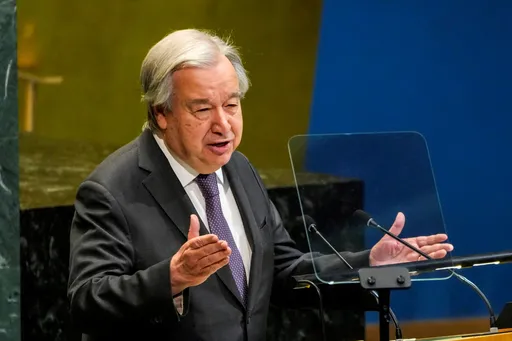
On Wednesday, while marking the Commemoration of the International Day to Combat Islamophobia at a United Nations event, Guterres said that hatred and discrimination against Muslims has risen to “epidemic proportions”.
Drawing attention to skyrocketing anti-Muslim bigotry that is taking shape around nationalism, Guterres said, "A resurgence in anti-Muslim bigotry is certainly in-line with other distressing trends we are seeing globally: a resurgence in ethno-nationalism, neo-Nazism, stigma and hate speech targeting vulnerable populations including Muslims, Jews, some minority Christian communities, as well as others."
It is not the first time he has raised this issue. The secretary general last month also called for a global reset for the sake of human rights.
In his last speech on Wednesday, Guterres also said, "Minority communities are part of the richness of our cultural and social fabric, yet we see not only forms of discrimination, but also policies of assimilation that seek to wipe out the cultural and religious identity of minority communities".
He quoted the Holy Quran. “Nations and tribes were created to know each other,” suggesting that diversity richness should not be seen as a threat.
Guterres also mentioned that stoking the fires of racism, anti-Semitism, anti-Muslim bigotry, violence against some minority Christian communities, homophobia, xenophobia and misogyny, is nothing new.
“It has just become more overt, easier to achieve, and globalised.”
“When we allow the denigration of any one of us, we set the precedent for the demonization of all of us,” Guterres added on 22 February.
The International Day to Combat Islamophobia was marked for the first time this year following the deadly attacks on two mosques in Christchurch, New Zealand on March 15, 2019 in which 51 Muslims were killed and 49 others injured.




A grudge transcending centuries
Even Joram van Klaveren, a former far-right European politician, and a once close ally of Geert Wilders, speaking to TRT World said that the far-right across the world attempts to use and impose historical events on the present day, and today’s violence against Muslims is a form of revenge.
Now, after two years since Brenton Tarrant live-streamed a massacre of Muslims at two mosques in New Zealand, Klaveren says nothing has changed.
“What Tarrant and the others from the far-right do is that they bring these stories out of history, twist them around and use them to scare everybody,” he explains.
“They don't say that we in Europe should be thankful to Muslims for algebra, maths and hospitals - the things we borrowed from the Islamic civilisation,” Klaveren added.
The main lines of Tarrant’s infamous manifesto, which suggests Muslim migrants are a threat to white Europeans, have been widely used against Muslims in racist attacks accross the continent, and Klaveren says that this perception has not really changed.
“More often they see the news of terrorist attacks and young Muslim migrants shown as hooligans. A combination of this worries people. There are Muslim organisations, which are doing a lot of charity work but it never gets the media coverage,” he told TRT World.
He adds that many Europeans have an inherited fear of Islam because of a history of wars that Muslims and Europeans fought centuries ago.
“At the same time, the rise of the nationalist right-wing politics has coincided with the rapid increase in Europe’s secularisation,” said Klaveren.